
The market has caught many value investors off guard in 2026—and not in a good way. Stock pickers who missed the semiconductor rally last year, or even earlier this year, have likely underperformed the broader market by a wide margin. In fact, many find themselves firmly in the red or, at best, hovering slightly above breakeven.
However, temporary underperformance shouldn’t discourage you; a compelling future remains for those disciplined enough to buy the right businesses at attractive valuations. Today, I want to focus on Meta, and outline why I believe this company is uniquely primed to replicate Google’s standout 2025 performance.
The Market’s Growing Anxiety Over Meta
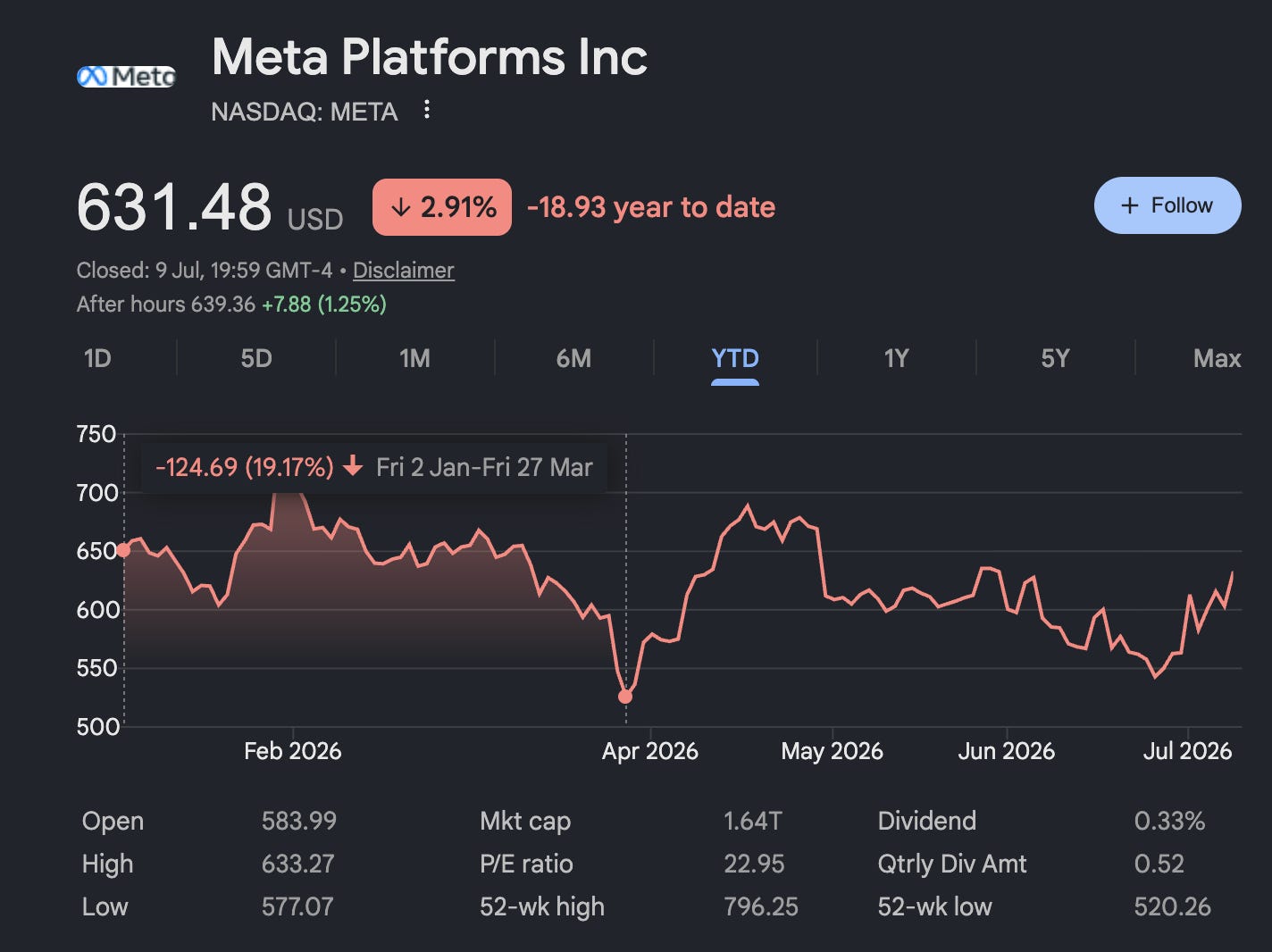
Despite rallying off its mid-$500 lows, Meta remains down year-to-date, massively underperforming the broader benchmark.
What drove this intense volatility over the first half of the year? As noted earlier, if you didn’t own semiconductors this year, you likely underperformed. Semis are leading the market because hyperscalers continue to aggressively scale their capital expenditures (CAPEX)—even turning to the bond market to fund massive data center buildouts.
The demand for artificial intelligence infrastructure is so massive that it has triggered a severe supply bottleneck. To keep pace, Hyperscalers like Microsoft, Amazon, Google, and Meta are relentlessly increasing their CAPEX budgets. The ultimate beneficiaries of this capital flight are semiconductor and memory giants like Nvidia, AMD, SanDisk, Micron, ASML, and TSMC and many more.
Right now, this demand shows no signs of decelerating; it continues to outpace supply, allowing semiconductor companies to command immense pricing power over the hyperscalers.
Naturally, this has led investors to the ultimate question: Will this unprecedented AI spend actually generate an attractive return on invested capital (ROIC)? This exact anxiety is what is holding Meta back.
Beyond the ROIC debate, a few specific fears are spooking the market:
The Metaverse PTSD: Investors worry that Mark Zuckerberg’s AI investments will turn out to be a massive capital sink, mirroring the 2022 Metaverse pivot that burned through billions in free cash flow.
Balance Sheet Dilution: There is growing concern that Meta might follow the path of peers like Google and Amazon by issuing massive debt or conducting dilutive capital raises to fund this infrastructure arms race.
The Narrative Noise: Headlines continue to hammer the company with stories on regulatory lawsuits, low employee morale, executive unpredictability, and massive, ongoing losses in Reality Labs.
But to find true value, we must look past the noise and focus on the fundamental engine of the business. Is revenue growing at a durable pace? Are net income and EPS compounding faster than the top line? Is trailing-twelve-month (TTM) operating cash flow accelerating? That is the core of our discussion: Is Meta’s underlying business structurally sound, and how is Zuckerberg leveraging AI to drive that growth?
Meta’s Core Ad Engine: Fundamental Reality vs. Accounting Noise
To understand Meta’s true potential, we must look past the headline volatility and examine the core business fundamentals. Is the underlying business growing rapidly?
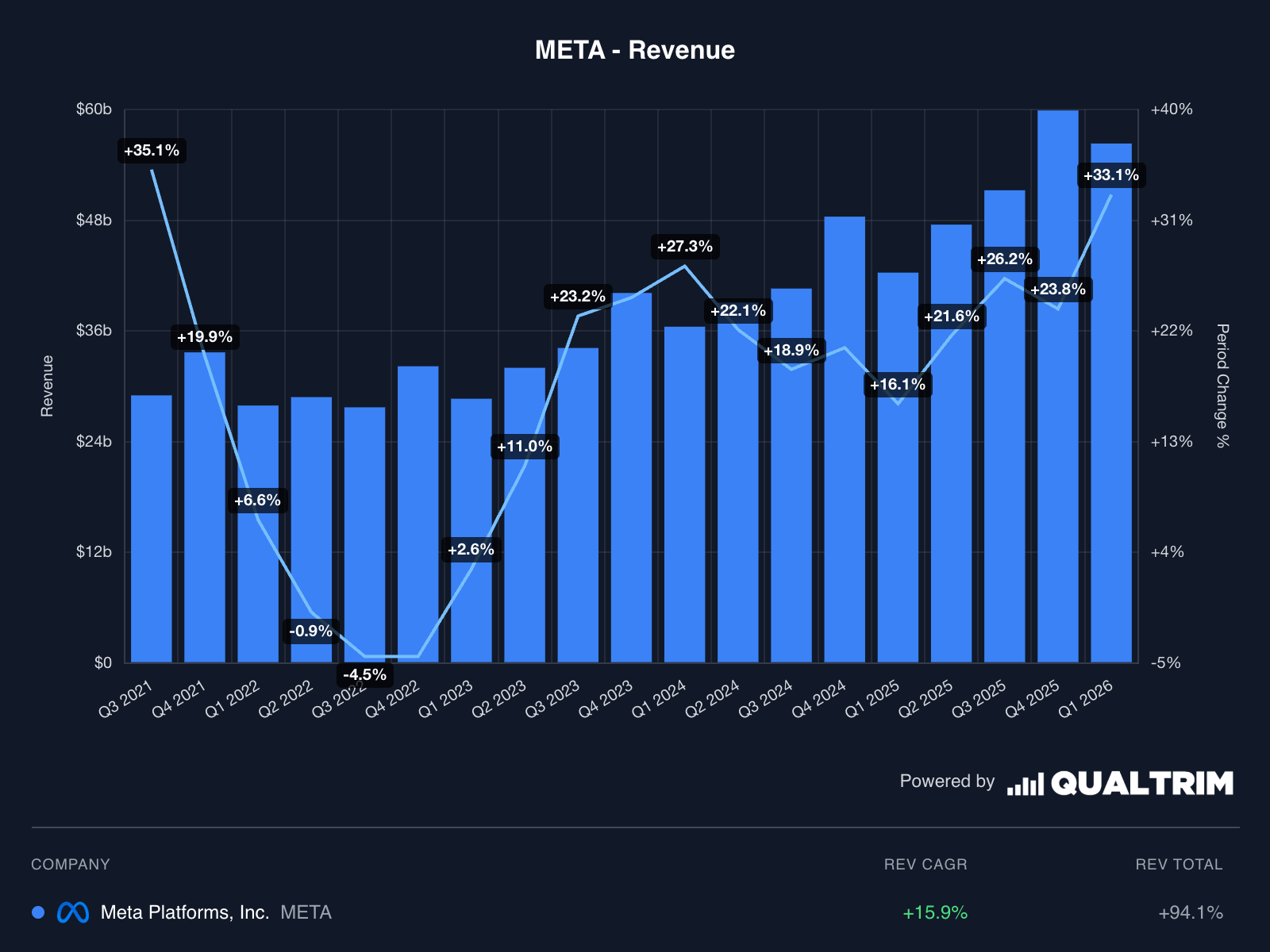
Meta’s top-line revenue is accelerating at 33% year-over-year—a stellar figure for a company of this scale.
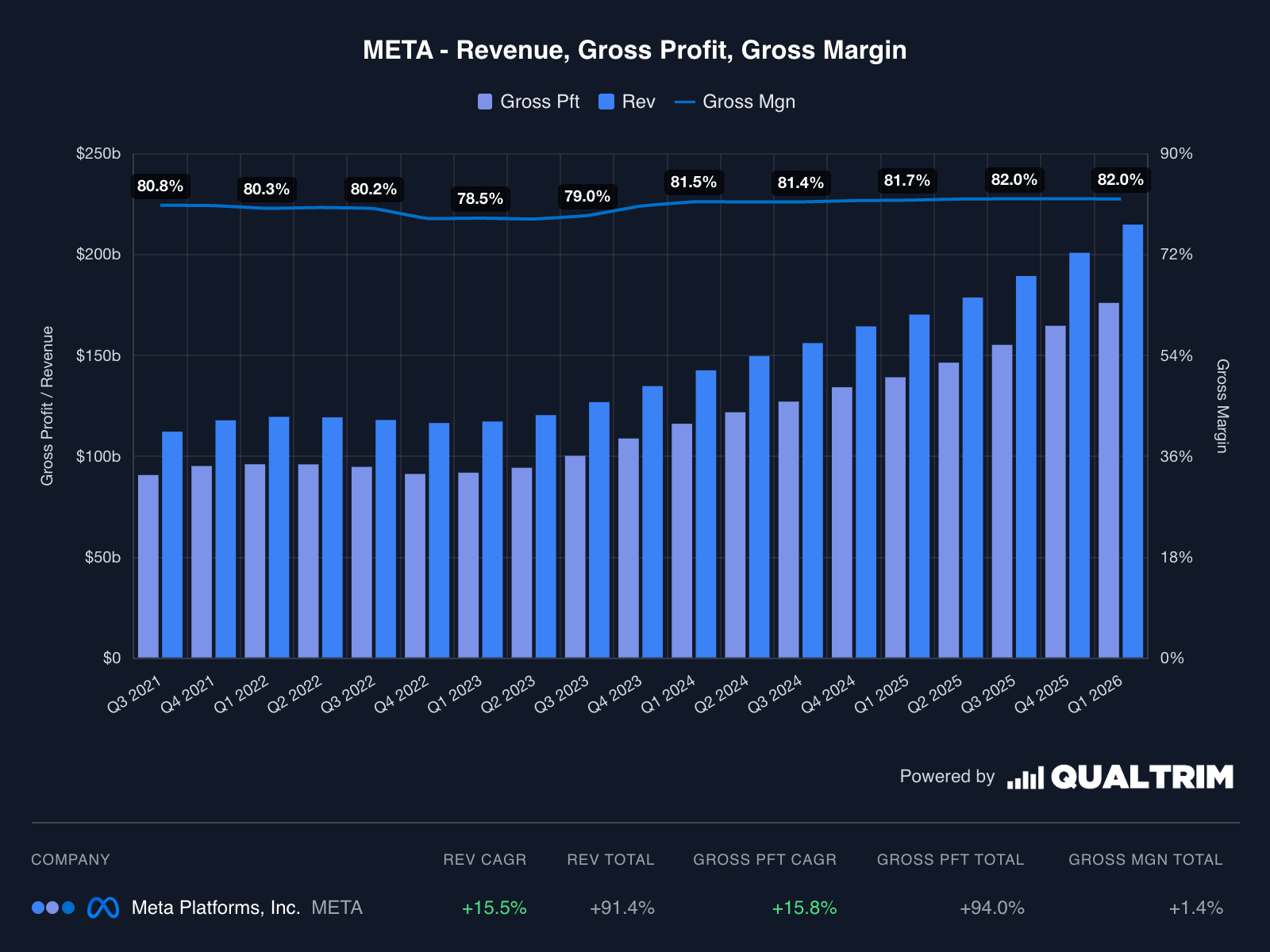
Furthermore, gross margins remain north of 80%, an "elite" level of profitability that confirms the ad business is firing on all cylinders.
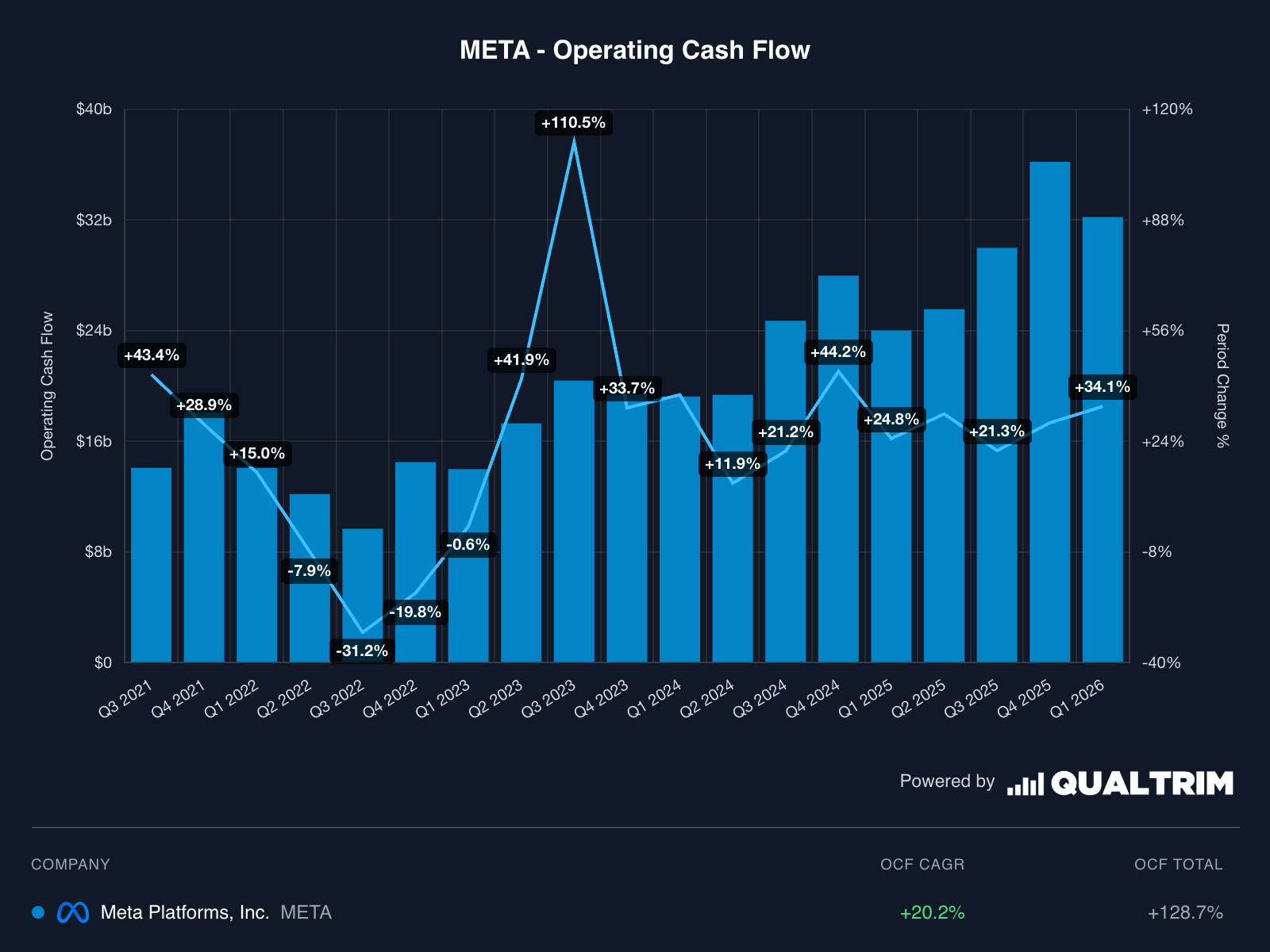
Meta’s operating cash flow is compounding in the high double digits, reinforcing that the operational engine is heading in the right direction.
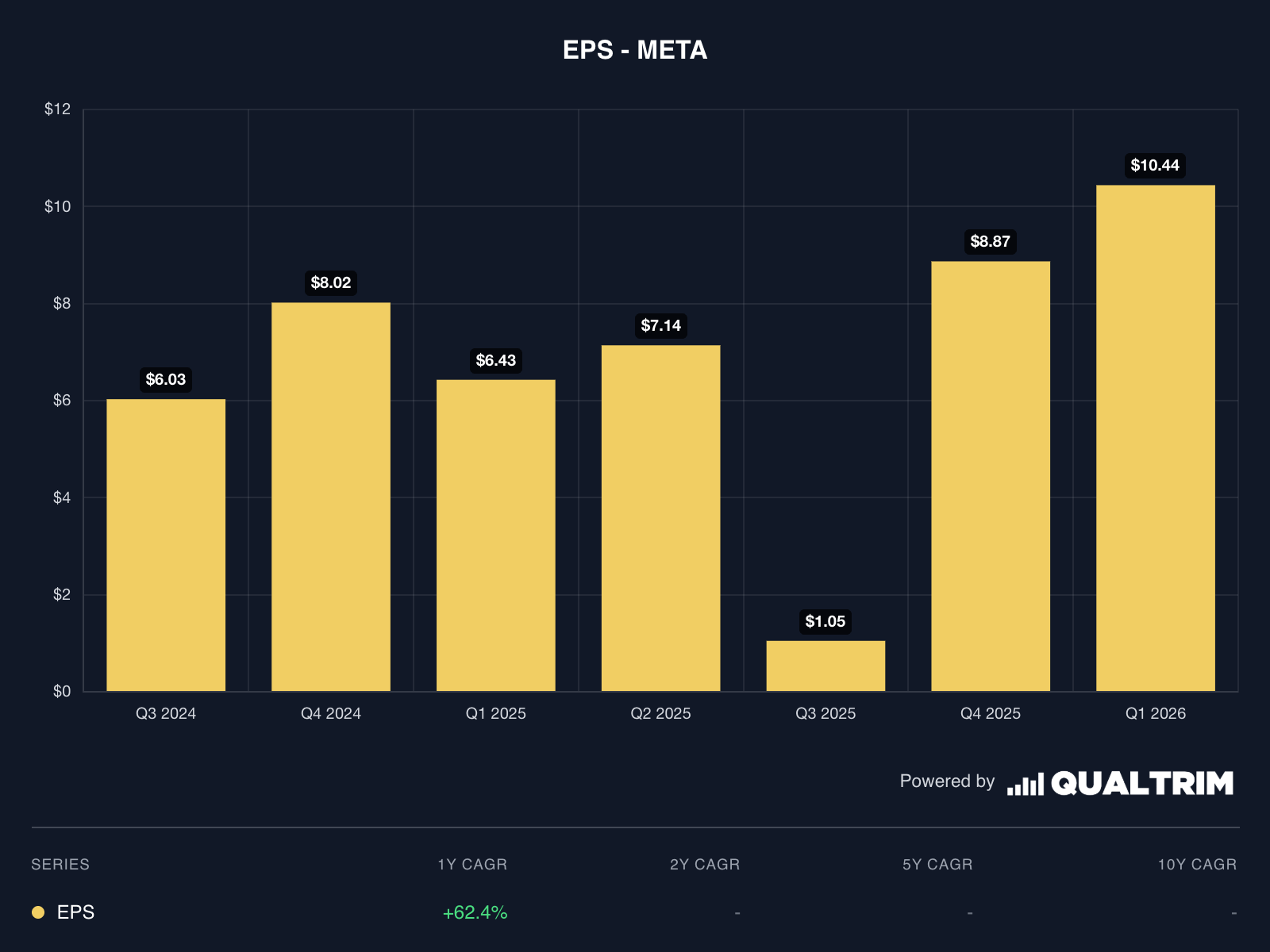
Meta on their Q3 2025 reported GAAP EPS of $1.05 which the consensus was $6.71. What happened there?
Meta's massive GAAP EPS miss in Q3 2025 was entirely driven by a single, unexpected accounting event: a $15.93 billion one-time, non-cash income tax charge.
Aside from this tax anomaly, Meta’s core business fundamentals actually had an incredibly strong quarter.
The $15.93 billion charge was tied to new federal tax legislation (specifically associated with the implementation of the One Big Beautiful Bill Act / updates to corporate tax regulations). This single event spiked Meta’s effective tax rate for the quarter to a staggering 87% (compared to what would have been a normal 14% rate).
Because it was non-cash, it heavily distorted the GAAP net income and EPS figures on paper, while the company's real-world cash generation remained completely healthy.
So in reality Meta core operational business delivered $7.25 in adjusted EPS against the estimate of $6.71.
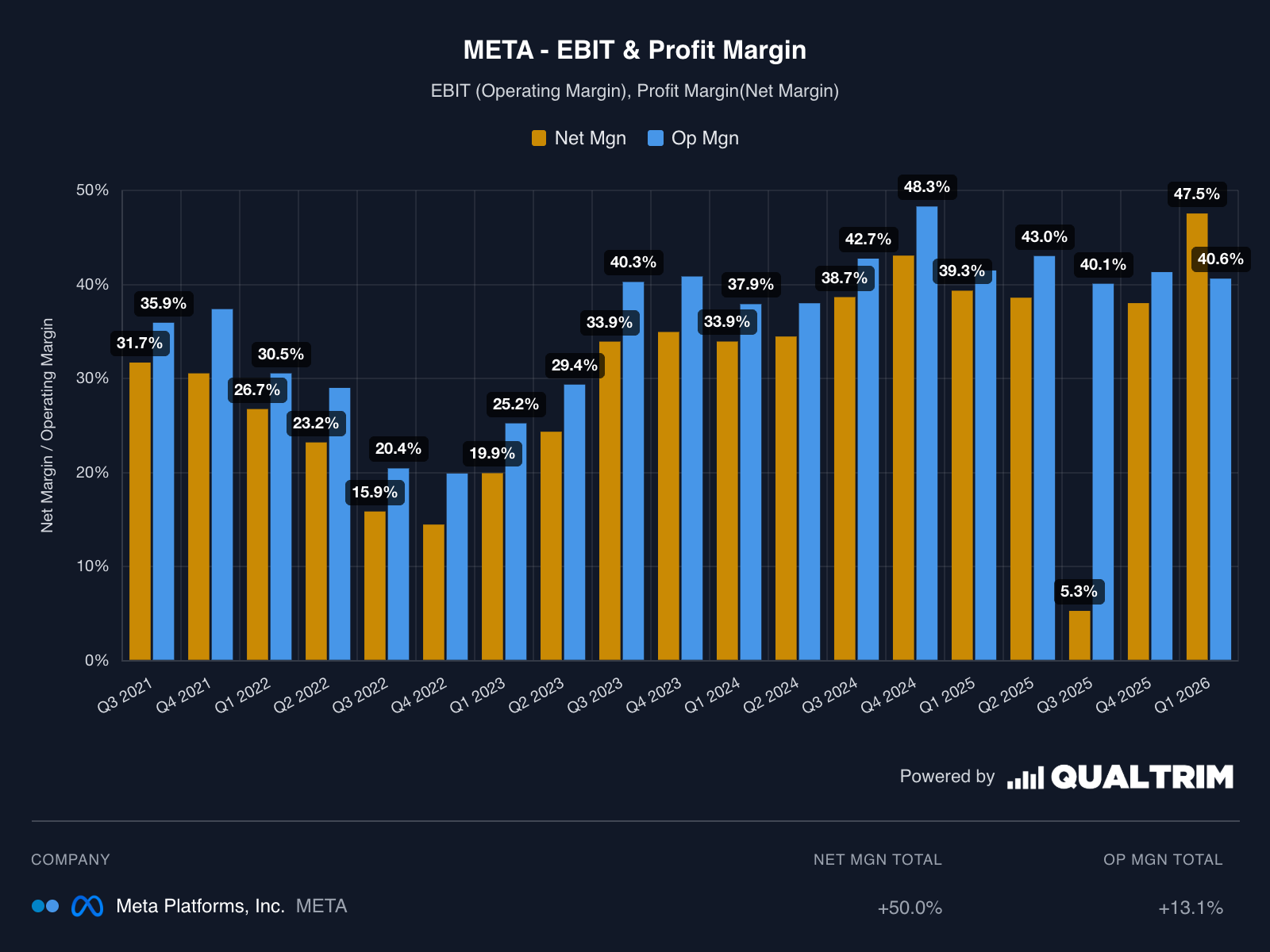
Another thing to point out is that in Q1 2026 Meta received a non-recurring $8.03 billion income tax benefit.
The $8.03 billion windfall was a result of U.S. Treasury Notice 2026-7, which provided transitional relief for the Corporate Alternative Minimum Tax (CAMT). Specifically, it clarified the tax treatment of previously capitalized U.S. research and development (R&D) costs, allowing Meta to book a massive credit.
This resulted in a negative 23% effective tax rate for the quarter. Without this accounting benefit, Meta’s underlying net income would have been roughly $18.74 billion, dropping its net margin back below its operating margin to a more typical ~33.3%.
So if we exclude this one-time tax hit from Q3 2025, and exclude the one-time tax benefit from Q1 2026, the real TTM EPS today is $30.58. Even after the stock run-up to $650 the real TTM PE is still 21 and adjusted GAAP forward PE is still at 20 which for such high quality business that’s more than a fair price to pay.
The forward PE is analyst consensus and so far Meta has exceeded many analyst expectations and continued to surprise to the upside with accelerated top-line revenue growth and fast profitability.
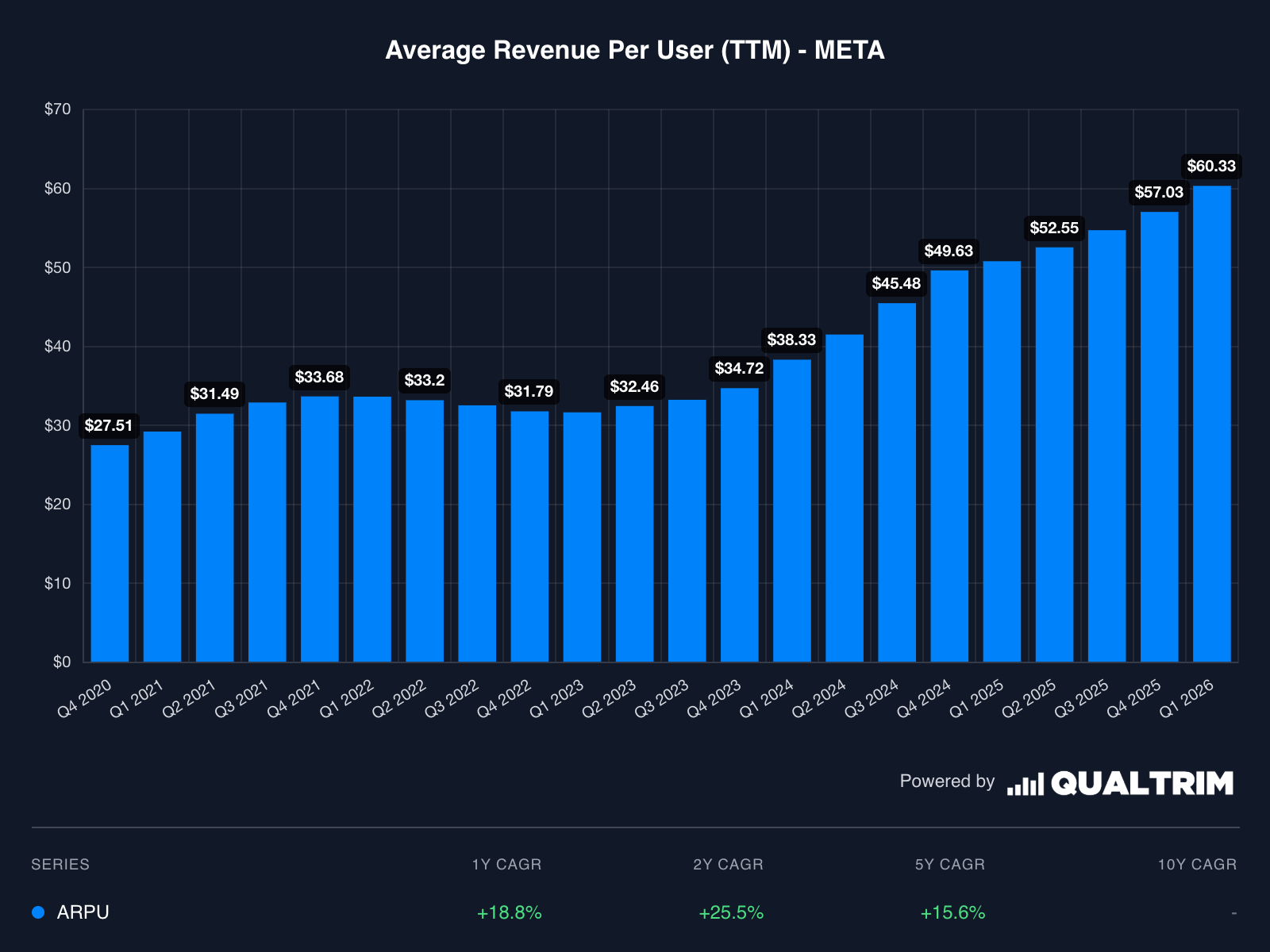
Meta’s ARPU (Average Revenue Per User) also continues to climb, currently hitting $60 on a TTM basis. Meta is effectively leveraging AI to optimize ad targeting, and there is no sign of this efficiency plateauing.
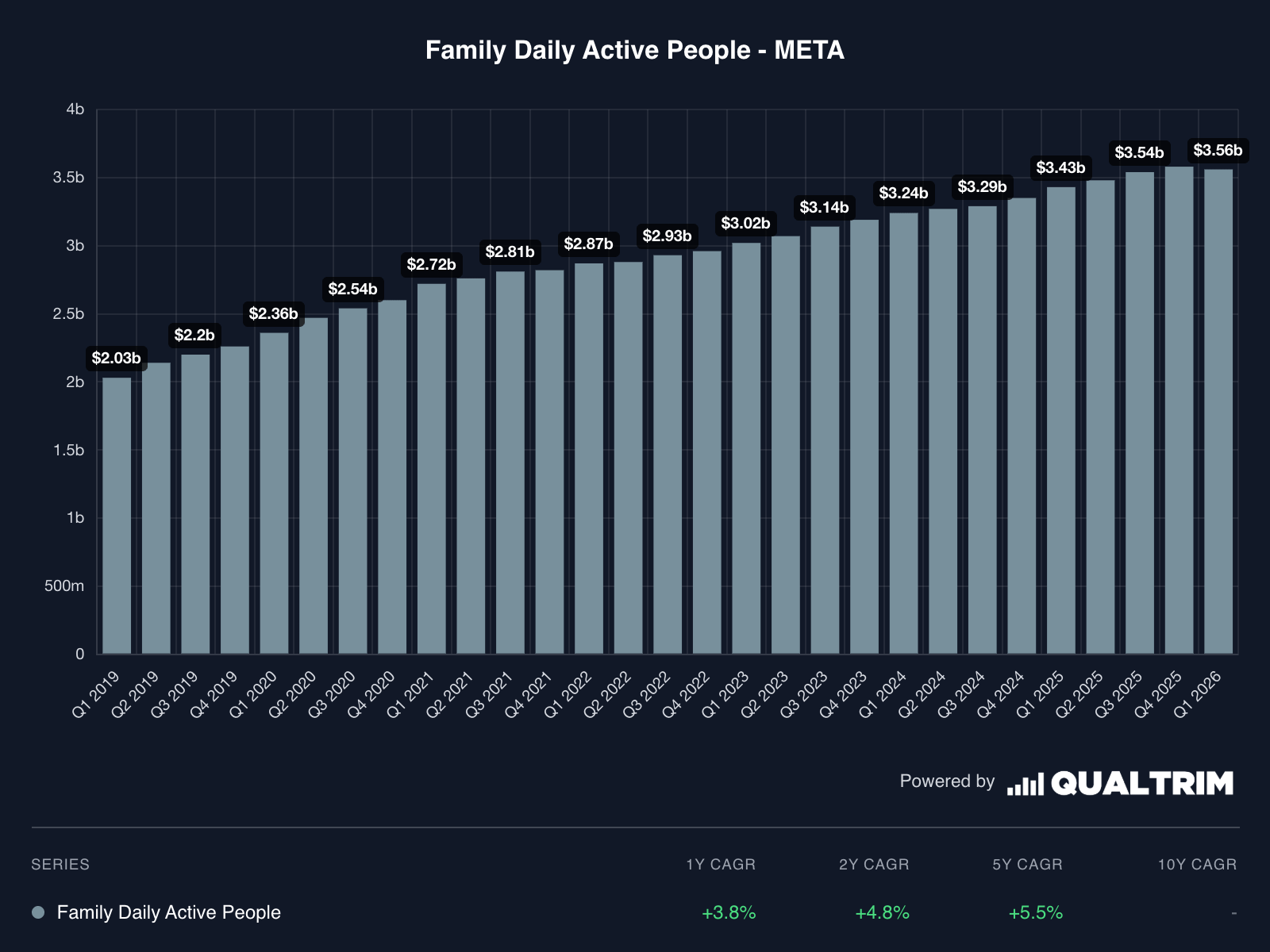
You may have noticed the slight dip in Family Daily Active Users (DAP) from 3.58 billion to 3.56 billion in the most recent quarter. While any decline warrants attention, it is important to contextualize this: Mark Zuckerberg confirmed this was primarily due to external geopolitical factors—specifically, internet outages in Iran and regulatory restrictions in Russia. It was not a sign of waning platform interest, but rather a temporary friction point in specific geographic markets.
So on paper everything regarding the core business is solid and continues to grow at a rapid pace. But is there anything that we’re missing? Well, let’s go through the balance sheet and see if Meta can continue to fund all of their AI CAPEX.
Balance Sheet
One of the loudest bearish narratives circulating right now is the fear that Meta will be forced to dilute shareholders or cripple its balance sheet to fund its massive 2026 AI CAPEX guidance of $125 billion to $145 billion.
But when you actually open the financial statements, the data tells a completely different story. Meta isn’t facing a liquidity crisis—it’s operating from a position of generational financial strength.
The Cash Fortress vs. Modest Debt
As of the latest Q1 2026 report, Meta’s balance sheet remains an absolute fortress:
Cash and Liquid Liquidity: $81.18 billion in cash, cash equivalents, and short-term marketable securities.
Long-Term Debt: $58.74 billion (rising to roughly $83.7 billion following a strategic $25 billion corporate bond issuance in May 2026).
Even with the recent bond issuance of $25 billion on May 2026, Meta remains in a highly enviable net-cash or near-neutral net debt position depending on how you account for operating leases. More importantly, issuing corporate debt is entirely non-dilutive to equity holders. By using the bond market to fund data centers, Meta is taking advantage of its pristine credit rating to lock in relatively low-cost capital without touching its equity structure.
Another critical factor to highlight is the shift in capital allocation priorities. While Meta has maintained its base quarterly dividend program, management has deliberately de-prioritized massive share buyback expansions to fund this infrastructure cycle. Directing their massive operating cash flow into data center buildouts signals exactly how far Mark Zuckerberg is willing to go. He is taking calculated risks to build a fully self-reliant infrastructure stack—ensuring Meta owns its own hardware and compute capacity rather than relying on third-party ecosystems.
In short, Meta’s balance sheet remains rock-solid. Despite the unprecedented capital expenditure program, the company shows absolutely no signs of financial distress, operating instead from a position of generational strength.
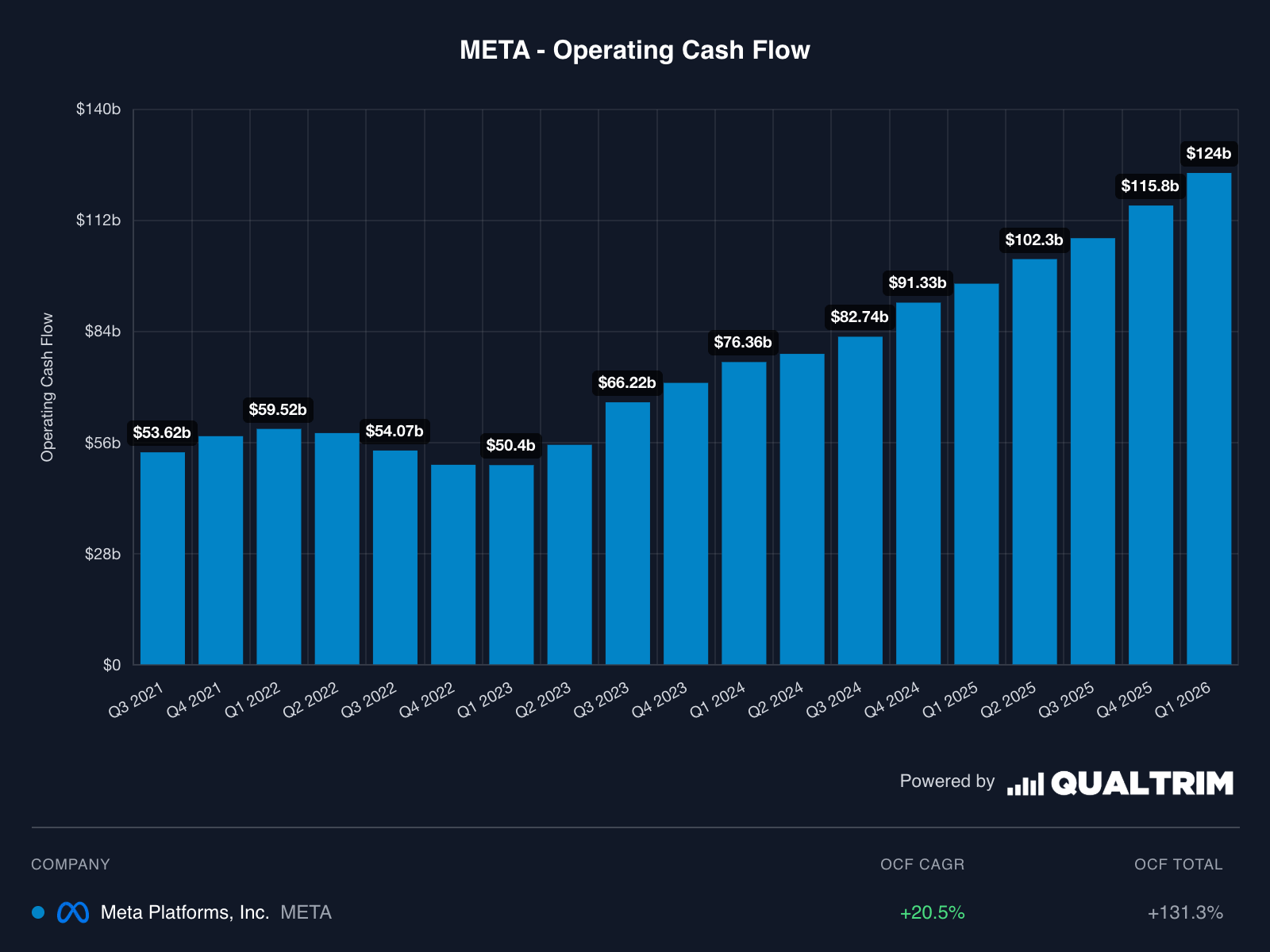
Meta Generating roughly $124 billion in annual operating cash flow can easily self-fund its aggressive capital expenditures entirely from internal operations alone.
The Economic Moat and Risks
Many analysts look at Meta’s $125 billion to $145 billion AI CAPEX budget and assume they are starting from scratch to compete with OpenAI or Google. This assumption completely misses Meta’s unfair distribution advantage.
The Core Network Effect: Meta’s Family of Apps (Facebook, Instagram, WhatsApp, Messenger, and Threads) boasts over 3.56 billion daily active users. No other platform on Earth commands this level of aggregated human attention.
The AI-Ad Flywheel: Meta isn’t just building AI models for standalone subscriptions; they are injecting AI straight into their core ad-ranking engine (via architectures like their unified Lattice model). By doubling down on custom infrastructure, Meta has supercharged ad-targeting efficiency, driving a massive increase in advertiser conversions. Better AI leads to higher returns for advertisers, which pulls more ad spend away from competitors and goes straight into Meta’s high-margin bottom line.
The Massive Optionality Meta has: Renting compute, Meta AI Glasses, Subscriptions, WhatsApp Monetization and now the Muse Spark 1.1 Cost per token. Meta is leveraging their massive core business to find new growth vectors to add to top and bottom line given their massive scale.
Meta possesses an unrivaled scale advantage, commanding a user base that encompasses nearly half the planet's population. With this massive footprint, the company can seamlessly layer advanced capabilities onto its existing platforms to unlock entirely new high-margin revenue streams. This distribution flywheel is exactly why Meta’s economic moat remains one of the widest and most defensible in the entire technology sector.
GEM (Generative Ads Recommendation Model)
I’ve recently been reading about GEM (Generative Ads Recommendation Model) and how this breakthrough technology delivers higher ROAS (Return on Ad Spend) for advertisers by more effectively targeting the right audiences with relevant ads.
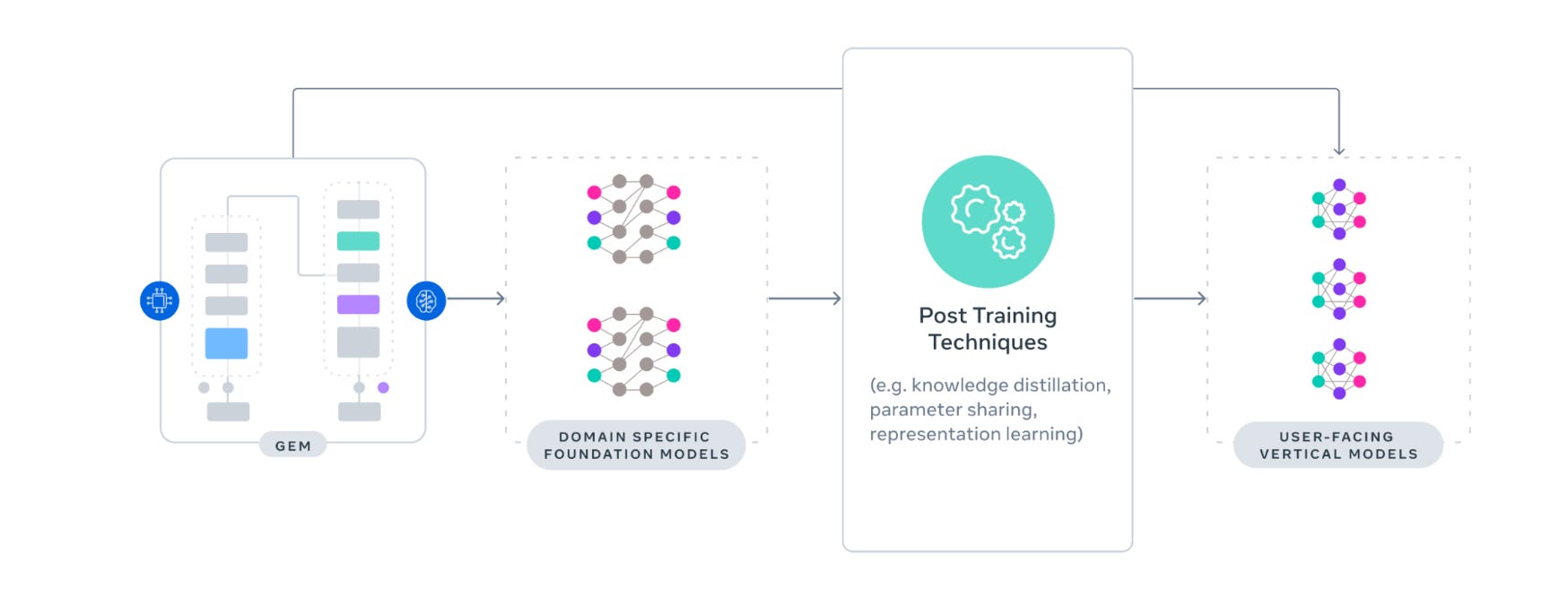
GEM serves as Meta’s central foundation model (FM) for ads recommendation. It learns from massive amounts of user interaction data — clicks, skips, time spent, conversions, and more — across Facebook and Instagram.
This allows GEM to build rich, generalized understanding of user preferences and ad performance. It then transfers this knowledge to smaller, specialized Vertical Models (VMs) that make the final, real-time decisions on which specific ad to show each user.
Think of GEM as the central brain that learns broadly and shares its intelligence with the rest of the system.
GEM uses knowledge transfer techniques (distillation, representation learning, parameter sharing) to improve the many lighter Vertical Models (VMs) that actually serve ads in real time.
GEM helps Meta deliver higher ad conversions and improved performance, leading to better ROI for advertisers and increased ad spend on its platforms.
I find it very impressive how Meta is leveraging AI — especially with GEM — and the results are clearly showing: Meta delivered 33% YOY revenue growth in Q1 2026.
Another company I’m watching that’s creating strong value for its customers through advanced AI marketing is Zeta.
It shows that Meta is one if not the best company on the planet that fully utilizes AI into their core products and actually sees massive ROI from their CAPEX investments given the fast acceleration they have from their overall business.
Also, I highly recommend you to check out Manu Invests page where he has many good articles that cover high quality companies and one of those companies is Meta.
He has many great articles covering high-quality businesses, and his breakdown of the engineering behind GEM is excellent. He covers fascinating data points on Meta’s untapped growth potential that are well worth your time. On a personal note, his work was one of the reasons I decided to invest in Meta myself, and it inspired me to write this article and share my own thesis here.. Here’s his article:

Risks
I won’t spend pages detailing every minor risk, but every investment carries them. For Meta, the primary threat is not a structural decline in its long-term terminal value, but rather a combination of near-term macro cyclicality and massive capital commitments.
The most immediate risk is macroeconomic. Because Meta still derives the vast majority of its revenue from advertising, its top-line growth is highly sensitive to the broader economic cycle. In the event of a global recession, marketing budgets are historically the first operational line items that corporations slash. A sudden pullback in ad spend would hit Meta’s short-term free cash flow heavily—a reality made riskier by the fact that they are simultaneously locked into fixed, massive multi-year data center outlays.
Another prominent risk weighing on the stock is the ongoing skepticism surrounding Meta’s AI capital expenditures. Ironically, Meta’s showing 33% top-line growth already provides hard evidence that these infrastructure investments are yielding immediate operational ROI. Despite this tangible outperformance, Wall Street remains highly skeptical about the long-term sustainability of this growth runway, fearing that the massive CAPEX cycle could outlast the current demand acceleration.
Meta’s Additional Growth Vectors
As highlighted earlier, Meta possesses an extraordinary amount of structural optionality. By continuously identifying and capturing new growth verticals across its massive ecosystem, the company is building powerful secular growth engines. Over time, these emerging business lines will provide highly meaningful contributions to both the top and bottom lines—diversifying Meta's financial profile well beyond traditional advertising revenue.
Renting Compute
Wall Street panics over the $125B–$145B CAPEX guidance because they view it as an unrecoverable expense. What they miss is that Meta is actively building out a cloud infrastructure business. Because data center buildouts happen in chunky phases, Meta frequently possesses massive, temporary clusters of idle GPU compute. By renting out this surplus compute directly to enterprises and AI startups, Meta can instantly convert unutilized capital expenses back into high-margin revenue, creating an entirely new infrastructure-as-a-service (IaaS) business line out of thin air.
Although I don’t know how much revenue can Meta generate from renting compute. What I do know is that Meta will earn an estimated 80% to 85% operating margin from this. This will be pure operating cash flow going straight to the bottom line which is a nice additional income for the company.
Meta AI Glasses
While Apple struggles with the mass adoption of heavy, expensive headsets, Meta has quietly won the face via its smart glasses ecosystem. By embedding Muse Spark's multimodal reasoning natively into everyday eyewear, Meta has bypassed the App Store restrictions imposed by Apple and Google. They are successfully building the definitive hardware portal for the AI era—owning both the device and the operating system.

The Ray-Ban Meta Smart Glasses ecosystem has crossed an estimated annualized shipment rate of 2.5 million to 3 million units. At an average retail price point of $300, this hardware vector is pulling in roughly $750 million to $900 million in gross annualized revenue.
Right now, hardware manufacturing margins are relatively modest (estimated 30% to 35% gross margins due to the Luxottica partnership split). However, the real monetization strategy isn't the plastic and glass—it's the face estate.
By bypassing Apple and Google's 30% app store fees, Meta is positioning this device to serve as a zero-friction gateway for premium AI features. The current revenue pays for the R&D, but the long-term margin profile will mimic pure software as they scale on-device AI features.
WhatsApp Monetization
For years, WhatsApp was viewed by value investors as an under-monetized asset. That is changing rapidly in 2026. Through WhatsApp Business APIs, click-to-message ads, and integrated AI customer service agents powered by Muse Spark, Meta is turning the world’s most popular messaging app into a comprehensive transactional marketplace. For small and medium businesses globally, a specialized WhatsApp AI agent can handle sales, customer support, and payment processing 24/7—allowing Meta to take a toll booth fee on global commerce without relying on traditional display ads.
According to Meta's recent Q1 2026 financial disclosures and their official March 2026 corporate milestones, WhatsApp's core paid messaging business has officially crossed a $2 billion standalone run rate, anchoring a broader non-advertising 'Other Revenue' segment that is clearing a $4.5B+ annualized threshold
WhatsApp is still vastly under-monetized compared to Facebook and Instagram, making it a significant potential contributor to Meta’s overall growth.
The Muse Spark 1.1 API Pricing
Recently Mark Zuckerberg and Alexandr Wang released their flagship model the Muse Spark 1.1 early July 2026 and the results of the model in the benchmark alongside it’s pricing was quite impressive.
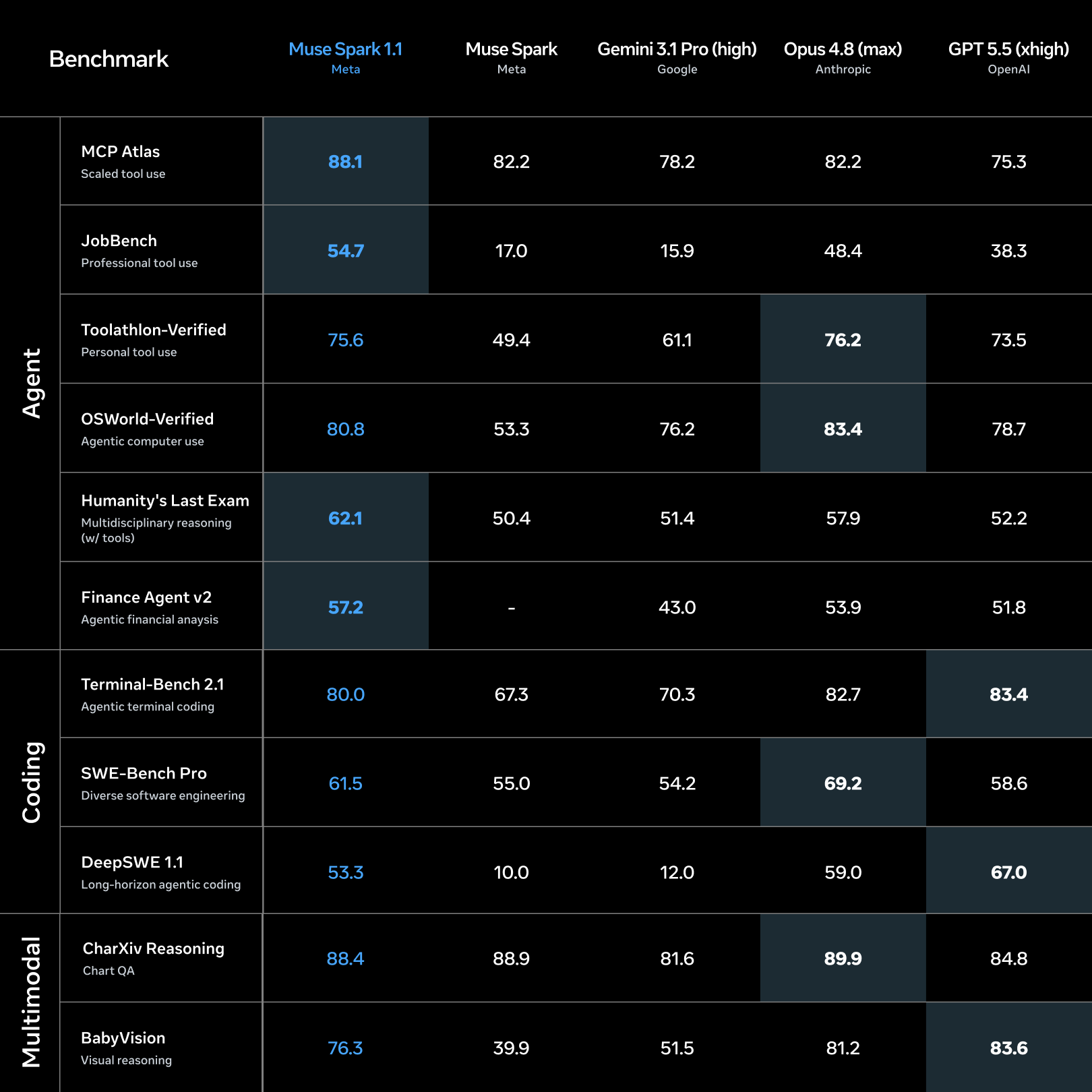
Muse Spark 1.1 delivers exceptional performance across advanced agentic workloads, outclassing peers on specialized tool-use and reasoning benchmarks. It achieved class-leading marks on MCP Atlas (scaled tool use), JobBench (professional workflow execution), and Finance Agent v2 (financial analysis), proving its capabilities are fully competitive with the market's premium flagship models.
Meta opened the Model API at $1.25 per million input tokens and $4.25 per million output tokens, Meta is pricing its flagship reasoning model roughly 85% below GPT-5.6 Sol and Claude Opus 4.8.
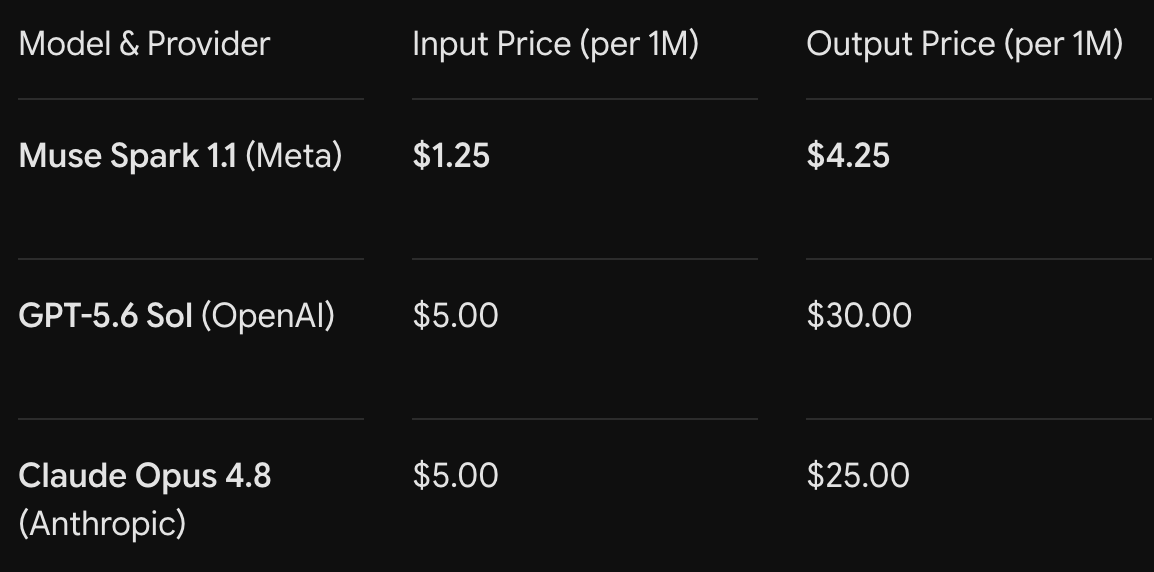
Because output tokens are the single largest expense for enterprise AI coding and process automation, Meta is leveraging its massive CAPEX scale to commoditize the developer layer. They are sacrificing near-term API margins to force the entire developer ecosystem onto Meta’s architecture, establishing a massive downstream B2B software moat.
Subscriptions
Beyond enterprise APIs and hardware, the consumer layer represents another massive, untapped growth vector for Meta. As consumer reliance on advanced AI assistants grows, Meta has a clear runway to introduce a premium subscription tier within Meta AI. By offering power-users specialized access to hyper-fast multi-agent workflows, higher file-processing limits, and deep analytical capabilities, Meta can establish a sticky, recurring consumer SaaS revenue line overnight. With nearly half the planet already active on their platforms daily, even a tiny conversion rate to a premium subscription tier translates into billions of dollars flowing directly to the bottom line.
Meta launched two subscription tiers:
The Core Social Tier Launch: Meta launched baseline, app-specific subscription features to standard users, including Instagram Plus ($3.39/month), Facebook Plus ($3.99/month), and WhatsApp Plus ($2.99/month). These add-ons include custom profiles and advanced insights.
The Premium AI Tier Test: Meta is testing consumer AI subscription tiers under the Meta One Plus ($7.79/month) and Meta One Premium ($19.99/month) tiers. These are currently being tested in specific international markets (like Singapore, Guatemala, and Bolivia) to gauge consumer demand before a full global rollout.
If Meta successfully mirrors the YouTube Premium model and captures 100 million paid subscribers across its new "Meta One" tiers, it would unlock a massive, high-margin recurring software revenue stream independent of the ad cycle.
If 100 million subscribers choose the lower-tier $7.99 option (which bundles basic Meta AI limits, Instagram Plus, and Facebook Plus), this could generate $9.588 billion Annual Revenue Run-Rate. This is very massive IMO.
Custom Silicon Chips (Iris)
According to recent corporate leaks, Meta is officially moving its highly anticipated, next-generation AI chip—code-named "Iris"—into mass production. Iris represents the flagship vanguard of Meta's MTIA (Meta Training and Inference Accelerator) road map, a highly ambitious project designed to shift the company from being a computing tenant to an infrastructure landlord.
The deployment of the Iris chip architecture proves that Meta's capital expenditure isn't a temporary, reactionary spending spike—it is a highly calculated, structural land grab. By substituting high-margin commercial GPUs with its own specialized, low-cost silicon, Meta will drastically lower the ongoing operational cost of serving AI features to its 3.56 billion users by reducing it’s reliance of Nvidia and AMD chips.
Furthermore, Meta’s long-term infrastructure goal is to scale its computing footprint from 7 gigawatts in 2026 to an astounding 14 gigawatts by 2027. At that massive industrial scale, even a minor 10% gain in chip power efficiency translates to billions of dollars saved in electricity bills. Custom silicon is the only way to make a 14GW network financially viable
For long-term value investors, this vertical integration represents the ultimate structural moat: it compresses future operating expenses while cementing a scale advantage that no smaller competitor can hope to replicate.
Competitors
To properly frame the macro-competitive dynamics surrounding Meta, we must first look beyond individual corporate battles and evaluate the fundamental structural divide in modern advertising: the closed ecosystems of the Walled Gardens versus the decentralized networks of the Open Internet.
In the digital ad market, Meta, Google, and Amazon are the absolute definition of the "Walled Gardens"—they own the audience data, the ad tech stack, and the proprietary content. Companies like The Trade Desk and Zeta Global are the champions of the "Open Internet" (or open web), capturing the massive programmatic advertising spend outside of those closed ecosystems.
The "Walled Gardens" consist of a select few mega-caps that control their own media inventory, hardware footprints, and user login data. Meta, Google, and Amazon dominate this category, historically vacuuming up an estimated 70% to 80% of global programmatic ad spend. Because these platforms use their own closed targeting and measurement tools, they have complete control over their pricing dynamics and margins.
Meta's core moat relies on its 3.56 billion daily active users. While Google dominates search intent and Amazon dominates high-intent retail shopping data, Meta captures deeply entrenched social and communication graph data.
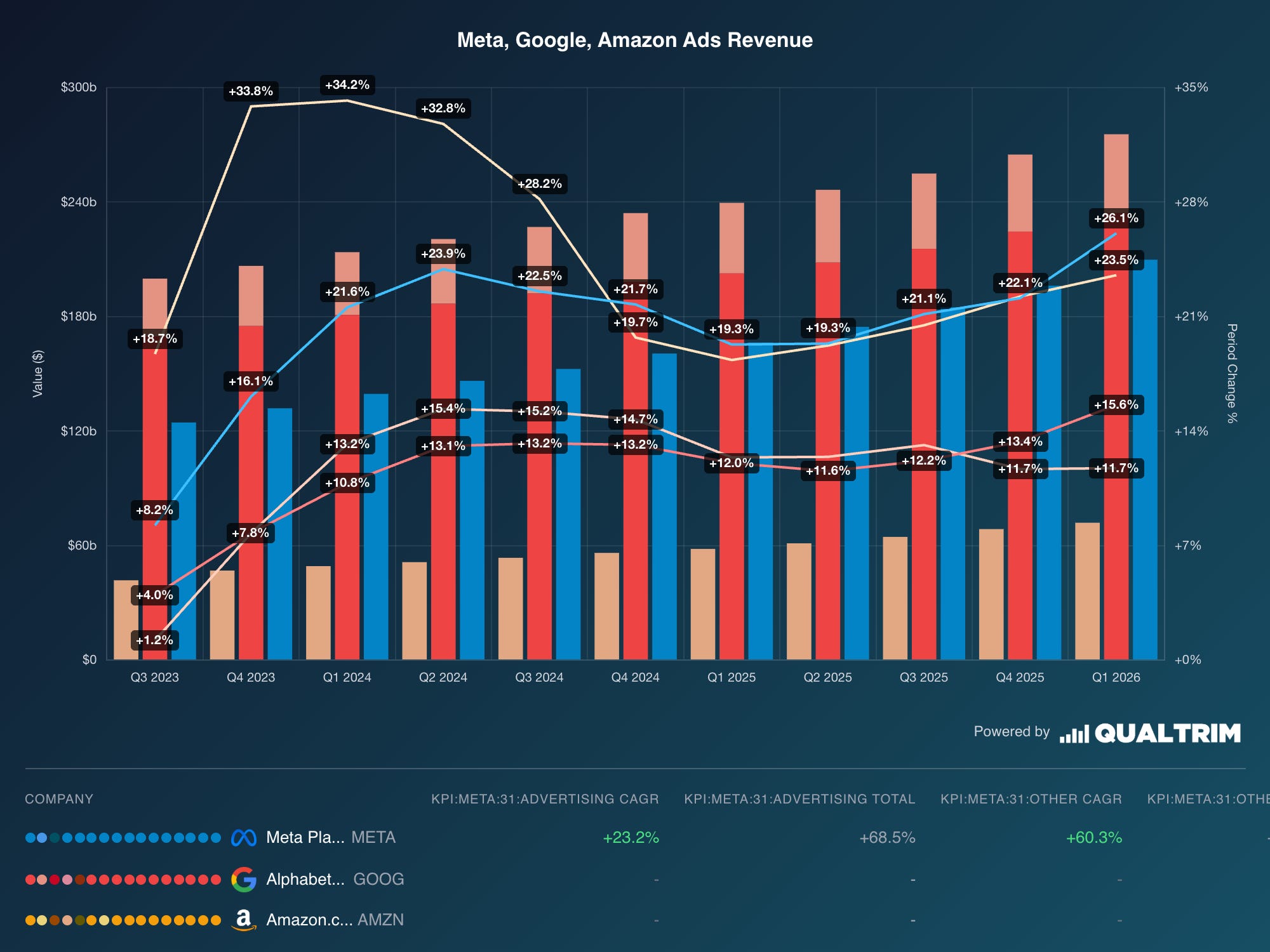
Driven by its accelerating momentum, Meta currently leads the tech sector as the fastest-growing advertising business among the big three, outstripping both Google and Amazon. On its current trajectory, Meta’s total ad revenue is pacing toward a staggering $209.81 billion, rapidly closing in on Google’s flagship Search ad revenue, which sits at $234.23 billion. Because Meta's growth rates are significantly faster than Google’s, it is capturing a disproportionate share of new marketing budgets. Ultimately, all of these companies remain highly defensive because each continues to dominate user intent within their respective business segments.
The Open Internet Framework (The Trade Desk & Zeta Global)
Outside of Meta’s closed ecosystem lies the “Open Internet”—the vast network of independent blogs, news outlets, Connected TV (CTV) apps, and mobile publishers. Brands looking to diversify away from Big Tech pour billions into independent demand-side ad platforms to retain transparency and neutral performance metrics.
The Trade Desk (TTD): As the premier independent programmatic platform, The Trade Desk is pacing to process massive advertising volume, targeting roughly $3 billion to $3.2 billion in 2026 revenue. They win by aggregate-buying premium CTV inventory (like Roku, Disney, and Fox) and offering open attribution that doesn’t force buyers to rely on a closed tech stack.
Zeta Global: Operating as an AI-native customer data platform, Zeta’s rapid acceleration (surpassing a $1.78 billion 2026 revenue guidance at a blistering 37%+ growth clip) proves that enterprise brands want out-of-the-box, predictive AI targeting on the open web.
Meta’s Structural Shield: While TTD and Zeta are successfully scaling the open web, they remain inherently vulnerable to external tracking shifts, data signal deprecation, and changes to internet privacy rules. Meta, by contrast, operates entirely on deterministic, first-party user login data. Because Meta’s users remain natively authenticated across Facebook, Instagram, and WhatsApp, Meta is totally insulated from open-web tracking disruptions, allowing its AI targeting engine to deliver a higher Return on Ad Spend (ROAS) than the open internet can structurally guarantee.
The Battle for Pure Attention (TikTok & Snapchat)
While ad-tech platforms compete for ad dollars on the open web, platforms like TikTok and Snapchat challenge Meta inside the garden by attempting to capture raw user minutes.
1. TikTok: The Algorithmic Juggernaut
TikTok is the most intense attention competitor Meta has ever faced. Driven by its viral discovery feed and the massive explosion of TikTok Shop (which is forecast to clear an astonishing $112 billion in GMV in 2026), TikTok is projected to bring in $43.96 billion in global ad revenue this year.
Meta’s Counter-Punch: Meta successfully neutralized TikTok’s momentum via the aggressive algorithmic optimization of Instagram Reels. By leveraging its massive CAPEX to build superior backend recommendation models, Meta matched TikTok’s formatting and successfully drove user engagement back into its own ecosystem.
2. Snapchat: The Demographically Sticky Network
Snapchat continues to hold a remarkably loyal, younger demographic base, moving past 950 million monthly active users globally.
The Monetization Delta: Despite its sticky user engagement and a successful premium layer (Snapchat+ passing 25 million subscribers), Snap continues to run on a highly constrained monetization framework. Snapchat’s global Average Revenue Per User (ARPU) sits at a modest $3.17.
The Scale Moat: Because Meta possesses a far more robust, enterprise-friendly ad platform, it is able to extract several times more revenue per user than Snap. Furthermore, platforms like Snap simply do not have the free cash flow required to match Meta’s multi-billion dollar infrastructure spend, ensuring Meta keeps its massive technical advantage.
Meta remains defensive: it has first-party data that protects it from open internet risks, and it has the capital scale to clone and out-optimize the features of attention-share rivals.
Guidance 2026
Capital Expenditures (CAPEX)
The biggest piece of news for value investors is Meta’s upward revision of its infrastructure spend.
The New Guidance: Meta raised its full-year 2026 CAPEX forecast to a range of $125 billion to $145 billion (up from its previous projection of $115B to $135B).
The Corporate Reason: Management noted that this aggressive increase directly reflects higher AI hardware component pricing and the acceleration of data center buildouts needed to secure future capacity for its advanced reasoning infrastructure.
Near-Term Top-Line Momentum (Q2 2026 Revenue)
The Guidance Range: Meta expects its second-quarter 2026 total revenue to land squarely between $58 billion and $61 billion which represents 22%-28% which 25% is the midpoint.
Currency Factors: This top-line guidance safely assumes an approximate 2% foreign currency tailwind to year-over-year revenue growth based on prevailing exchange rates.
Full-Year 2026 Operating Costs & Profit Goals
Total Expenses: Meta left its full-year 2026 total expense guidance unchanged at $162 billion to $169 billion, showing continued operational discipline even as they scale infrastructure outlays.
Profitability Commitment: Despite the heavier infrastructure investments, management explicitly reiterated that the company is on track to deliver full-year 2026 operating income that comfortably exceeds 2025 levels.
The underlying numbers prove that Meta's core ad engine is successfully subsidizing its massive AI buildout and can switch off from being CAPEX heavy to a high FCF generation machine once the buildout is done.
About Mark Zuckerberg

To accurately value Meta, an investor must realize that they are not buying shares in a standard, board-managed enterprise. They are backing Mark Zuckerberg. Because of Meta's dual-class share structure, Zuckerberg retains roughly 61% of the voting power. This means he operates with complete structural autonomy, insulating the company from the short-term pressures of activist investors and quarterly consensus modeling.
History proves that Zuckerberg is highly willing to burn short-term market value to secure long-term infrastructure dominance.
The Mobile Pivot (2012): Zuckerberg aggressively forced Meta to pivot to mobile, decimating desktop ad revenue for multiple quarters while engineers rebuilt the app from scratch. Wall Street hated it; the pivot saved the company.
The “Year of Efficiency” Pivot (2023): After the market severely punished Meta’s unconstrained Reality Labs spending in late 2022, Zuckerberg immediately executed a sharp operational pivot, cutting headcount and optimizing the ad engine to unlock the massive free cash flow fortresses we see today.
The $145B AI Infrastructure Weapon (2026): By driving full-year capital expenditures up to an unprecedented $125 billion to $145 billion, Zuckerberg is intentionally forcing a heavy investment phase. He knows that pure-play AI labs and smaller ad networks cannot structurally scale to match this level of capital intensity.
When adding Meta to a portfolio, you have to accept a specific set of operational behaviors that the street will inevitably misprice over time:
Extreme Capital Volatility: Zuckerberg will always favor a massive, front-loaded infrastructure spend over smooth, predictable quarterly margin expansion if he catches a glimpse of a generational paradigm shift.
Ruthless Execution Over Consensus: If the data shows that open-sourcing premium reasoning models or subsidizing hardware eyewear destroys a competitor’s business model, Meta will sacrifice near-term software monetization to own the ecosystem.
The Ultimate Counter-Cyclical Asset: Because Meta can fund a $145 billion infrastructure build entirely through internal advertising operations while still expanding total annual operating profit, it acts as a corporate fortress. When the market panics over rising capital bills, it is almost always giving long-term investors a massive structural entry point.
Investing in Meta requires an investor to look past the short-term noise of the expense line. Zuckerberg’s ultimate competitive moat isn't just the algorithms or the 3.56 billion daily users—it is his structural ability to take massive, asymmetric risks that his competitors are legally and financially unable to match. If you are tracking Meta, you are tracking a generational land grab for the infrastructure of the next century.
Highlighting just how high the stakes are for Meta's new business model, Mark Zuckerberg returned to X for the first time since July 2023. He and Chief AI Officer Alexandr Wang used the platform to drop Muse Spark 1.1, Meta's latest agentic AI reasoning model, kicking off a massive industry price war.

Mark Zuckerberg is in founder mode again:)
Valuation
Now for the fun part: what price are we willing to pay to secure a healthy margin of safety?
Keep in mind that valuation models are merely structured estimates and are only as reliable as their inputs. Even a minor tweak to terminal multiples or growth curves can radically alter your projected returns, so you should adjust these figures to match your own conservative benchmarks.
Earlier, we established that Meta’s current adjusted trailing EPS sits at roughly $30.58, which serves as our baseline. If we model a 20% annualized EPS growth rate over the next five years and assign a conservative terminal P/E multiple of 20—a baseline that feels overly pessimistic given Meta’s massive data moat and current acceleration—we arrive at a year-five price target of roughly $1,522.
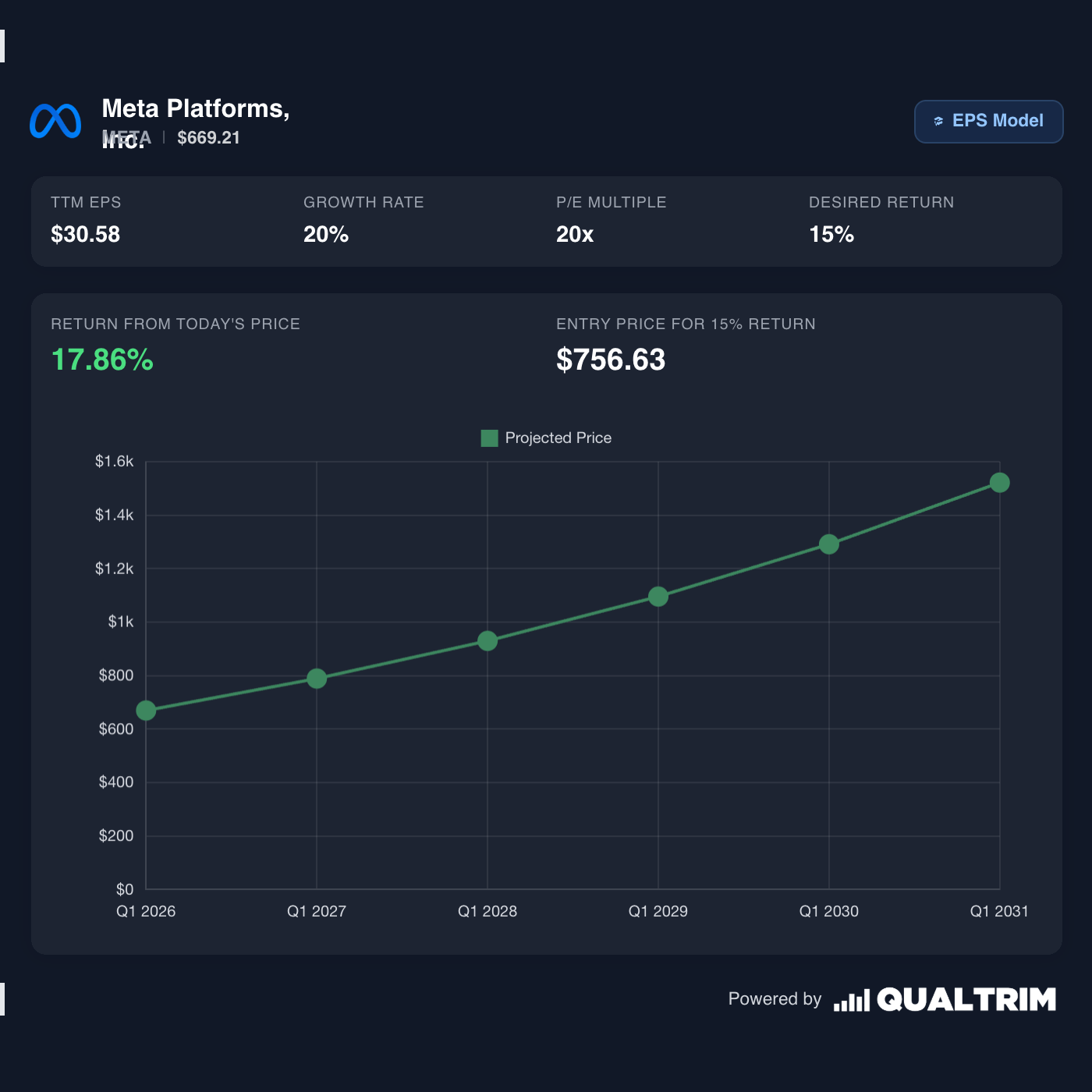
Starting from the current market price of $669, this conservative path still yields a highly attractive 17.86% Compounded Annual Growth Rate (CAGR). While grabbing shares below the $600 mark during the recent pullback offered a significantly wider margin of safety, Meta’s underlying engine remains capable of delivering stellar returns even at current levels.
To build a more comprehensive picture, the other valuation frameworks I am going to show here are EV/EBIT (Enterprise Value to Operating Income), EV/EBITDA, and Price-to-Operating Cash Flow (P/OCF).
To properly run an EV/EBIT or EV/EBITDA model, we must account for D&A (Depreciation & Amortization). This is particularly vital for Meta given the company’s unprecedented capital deployment toward custom infrastructure, high-density data centers, and advanced GPU clusters.
Essentially, D&A is the accounting practice of spreading the historical cost of a long-lived asset across its estimated useful life, rather than expensing the entire cash outlay the moment it is purchased.
Depreciation applies strictly to tangible, physical assets—such as Meta’s massive fleets of AI servers, custom silicon, cooling systems, and data center facilities.
Amortization applies to intangible, non-physical assets—such as acquired patents, intellectual property, and proprietary software architectures.
Let’s review the bear, base and bull cases.
My Bear Case: The Depreciation Wave Outruns the Payoff
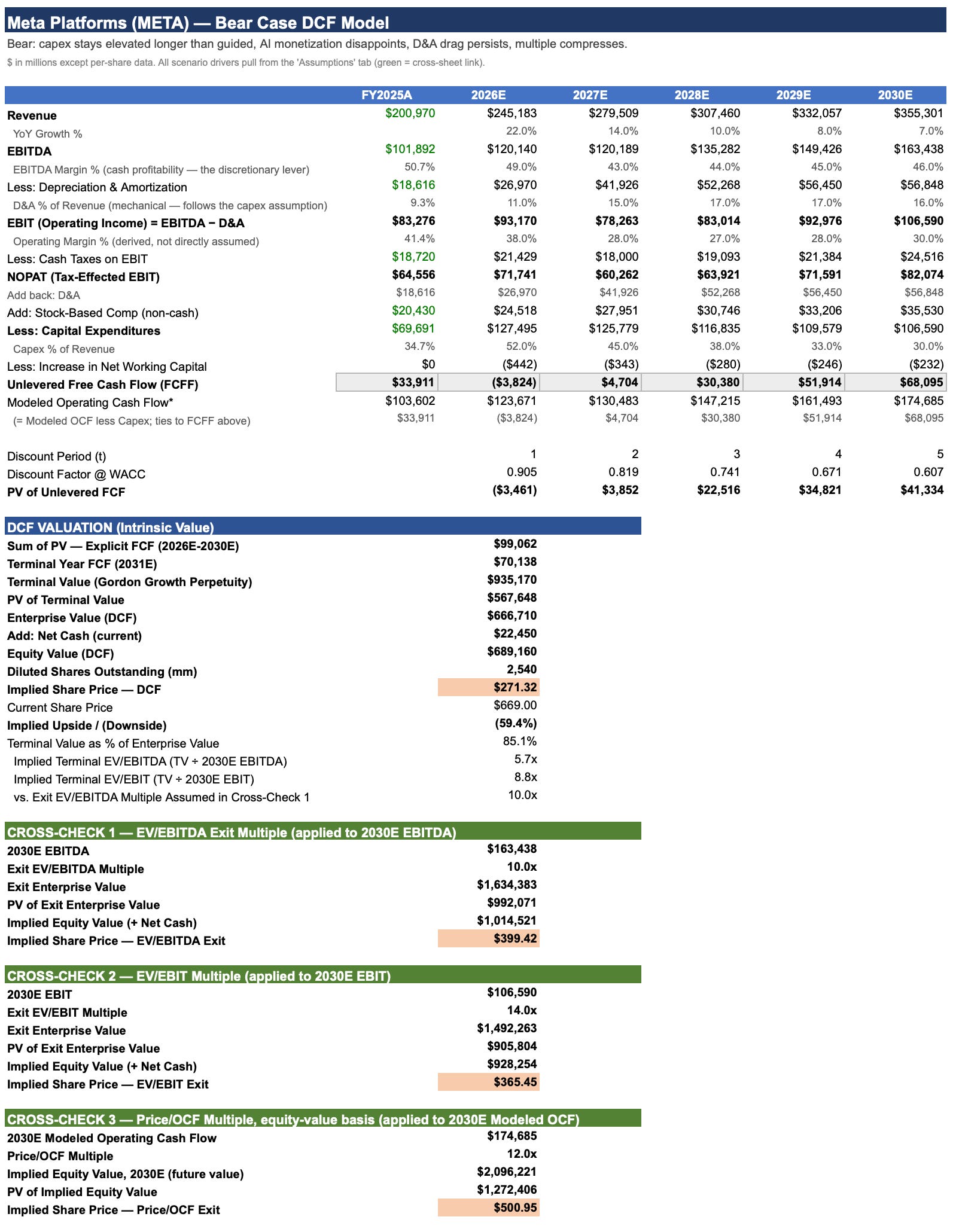
Growth decelerates faster than guidance implies, CAPEX stays elevated for longer than management currently signals, and the market loses patience — not because Meta becomes badly run, but because a several-year gap opens between "money spent" and "money earned back.”
Personally, I don't see this worst-case scenario playing out. However, healthy investing requires us to look at all possible outcomes to make a truly informed decision on whether the stock is a buy at current prices.
My Base Case: Meta Delivers Roughly What It's Promising
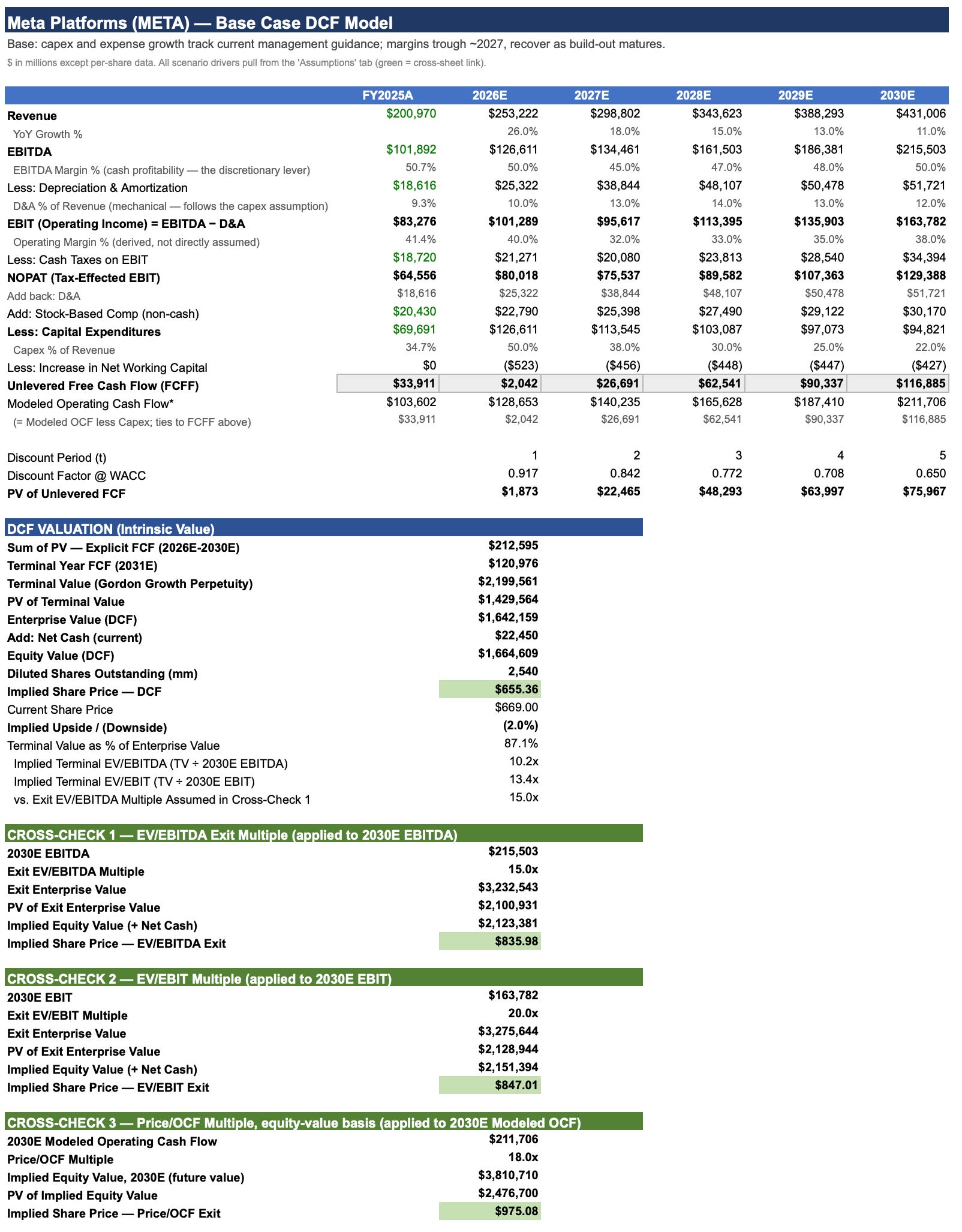
Revenue and expenses track management's own current guidance — 2026 revenue near the $253B consensus figure, capex in the guided $125–145B range, margins troughing around 2027 as depreciation catches up, then recovering as the infrastructure build-out matures and monetization (core ads, WhatsApp business messaging, agentic AI tools) scales against it.
That’s about $830-$840 share price which lands almost exactly on Wall Street’s actual consensus price target.
My Bull Case: The Investment Pays Off Faster Than Promised
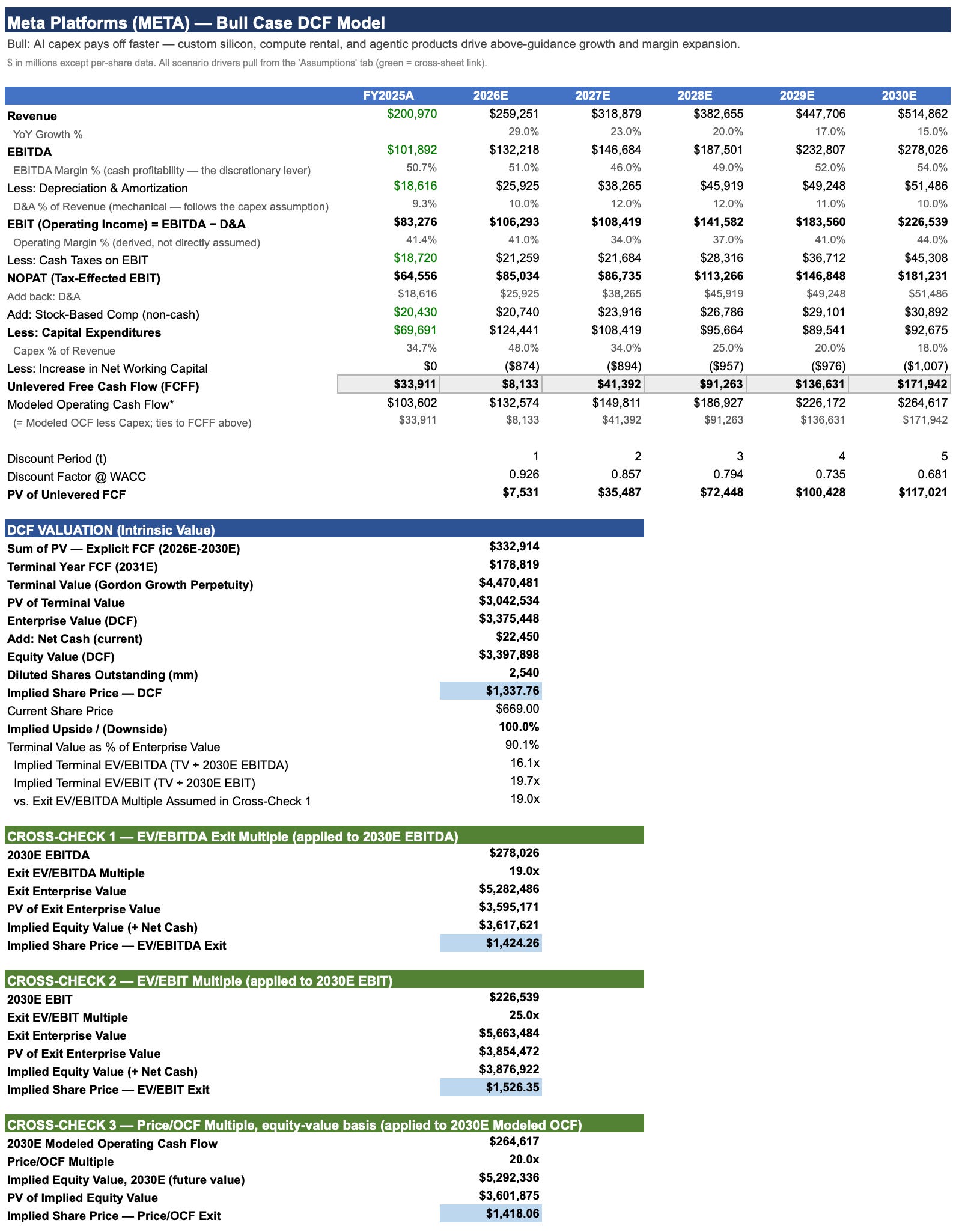
Custom silicon (Meta's in-house "Iris" chips, reducing reliance on Nvidia) lowers the unit cost of compute faster than expected, enterprise compute rental and agentic AI products scale into real revenue lines, and operating leverage takes hold — margins don't just recover, they expand past 2025 levels.
By 2030, revenue reaches $515B and EBIT nearly triples from today. At a lower 8% WACC (reflecting a de-risked thesis) and 4% terminal growth.
This scenario assumes that the investments will be paid back much faster than expected.
Verdict
Weighting those 25% Bear / 50% Base / 25% Bull produces a probability-weighted fair value of roughly $803 — implying today's $669 undervalues Meta if you think Base Case is the most likely single outcome.
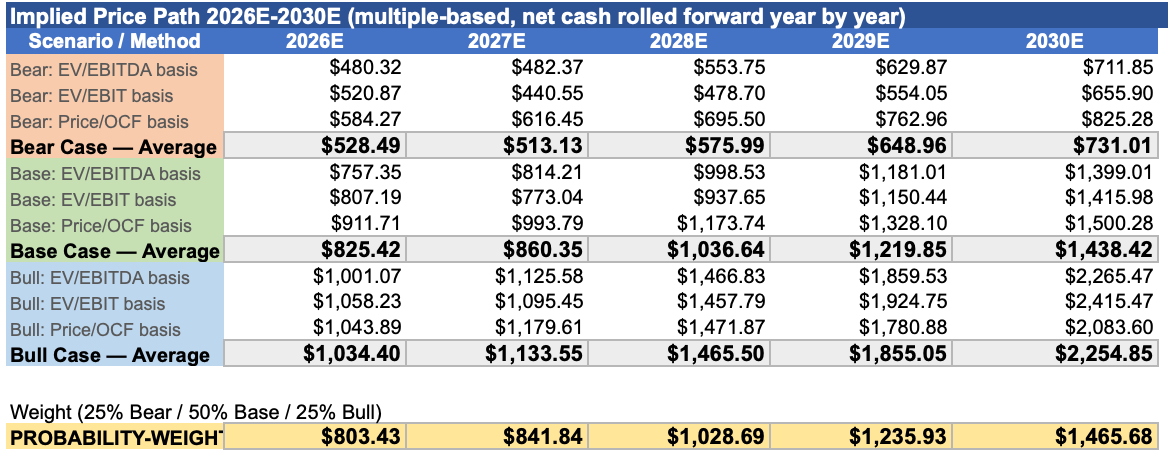
Rolling the same math forward to year-end 2030 (nominal dollars, undiscounted) implies $731 in Bear, $1,438 in Base, and $2,254 in Bull — a Base Case annualized return of roughly 17% a year from today's price, if management's current roadmap plays out.
Final Thoughts
Meta remains one of the most fascinating companies in the market—permanently fixed at the center of retail investor debates and a constant lightning rod for negative headlines. Yet, as the data shows, the financial reality inside the fortress tells a completely different story.
If you enjoyed this deep dive, please consider hitting the Like button and leaving a comment with your personal thesis on Meta. I value accurate, rigorous analysis above all else—if you spot any data points that need tweaking or have a different take on the numbers, let me know in the comments below so I can keep this piece as accurate as possible for the community!
Disclaimer: I own shares of Meta. This is not financial advice, nor am I telling you to buy the stock. You must do your own due diligence and determine for yourself if you are comfortable investing in this company given the risks Mark Zuckerberg is willing to take in order to secure the next decade for Meta.
The key question is whether AI capex is creating durable earnings power or simply extending the investment cycle. That distinction matters more than the headline capex number.
Congrats on your thesis about Meta, Arthur! I strongly believe that WhatsApp monetization will continue to provide strong revenue for the business. It is used by hundreds of millions of users, and small to medium businesses are finding the service vital for their own growth.
I also like that you pointed out a crucial fact every Meta investor must keep in mind: investing in Meta basically means supporting Mark's vision, given his 60%+ voting power. Some of his ideas may seem wild, but he has consistently delivered great results overall.
Finally, I really appreciate the nice DCF projection. The "Verdict" section made those projections incredibly easy to follow. I might just have to feature your article on my channel again, lol. Well done, Amigo!