
In 2026 a lot has happened in the first half of the year. The market has exceeded my wildest expectations about all the things that could go wrong despite having a good investment thesis of buying high quality compounding companies at attractive valuations.
Many SaaS and Fintech companies have been absolutely wrecked YTD thanks to Anthropic releasing new features every time that each feature is a potential AI disruption fear that has incited fear in the market about these companies.
Even as I’m writing this article now, Shift4 stock bottomed at $34.56 being down more than %43 YTD despite the fundamentals of the company improving. Now, we got a nice rebound and the stock is down only %18 YTD.
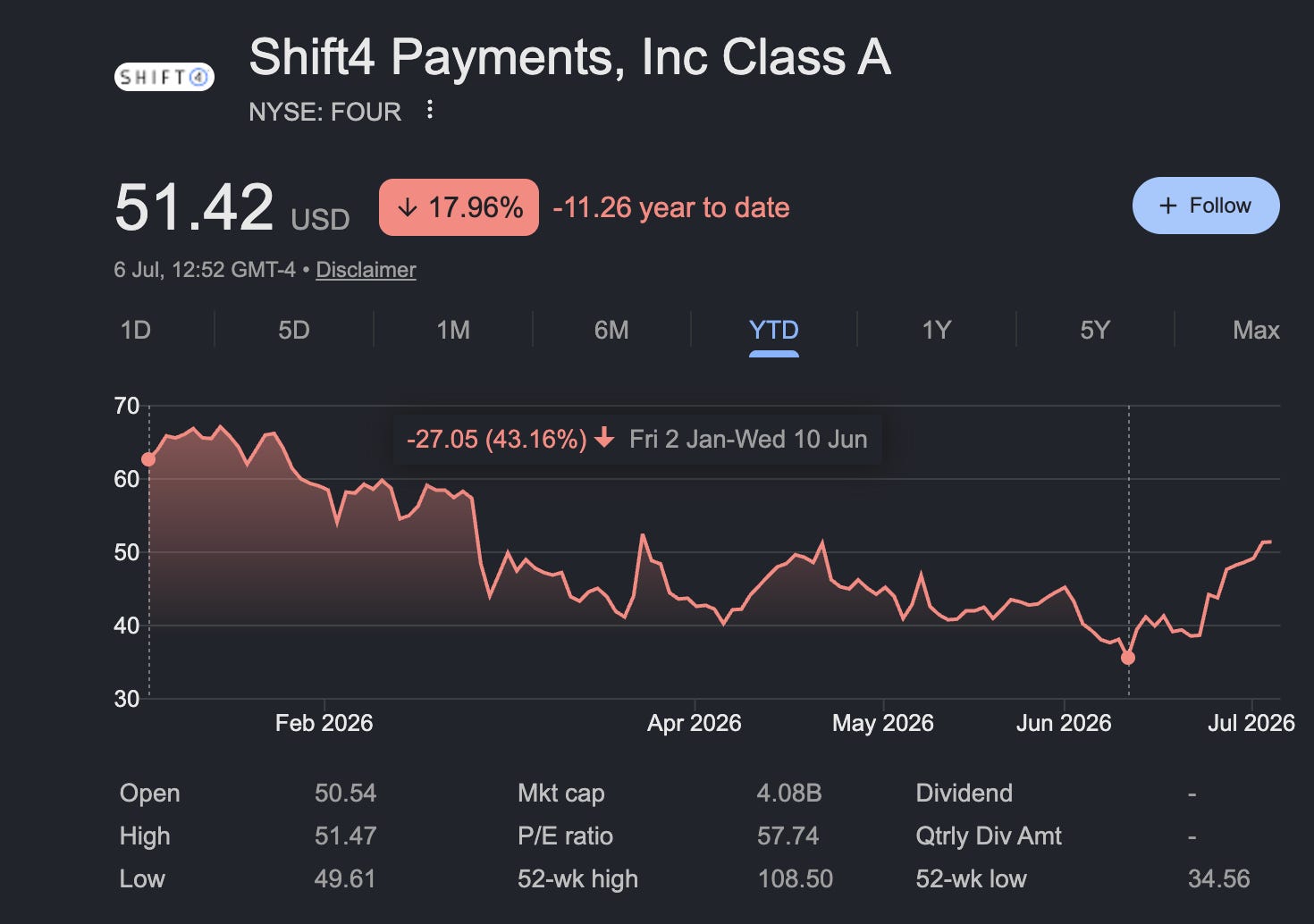
But why is that happening? When stocks go down there’s usually a reason for it where investors assess if the company is deteriorating or is this an overreaction by the market. I personally think it’s the latter, and I’m going to walk you through as to why I believe this is a real gem that the market is currently sleeping on.
What is Shift4?
At its core, Shift4 is a payment processing company. They are the invisible technology that securely moves money from a customer’s credit card or digital wallet into a business’s bank account.
If you’ve ever bought a hot dog at a baseball stadium, ordered a drink at a hotel bar, or purchased something online, there is a very high chance Shift4 handled the transaction behind the scenes.
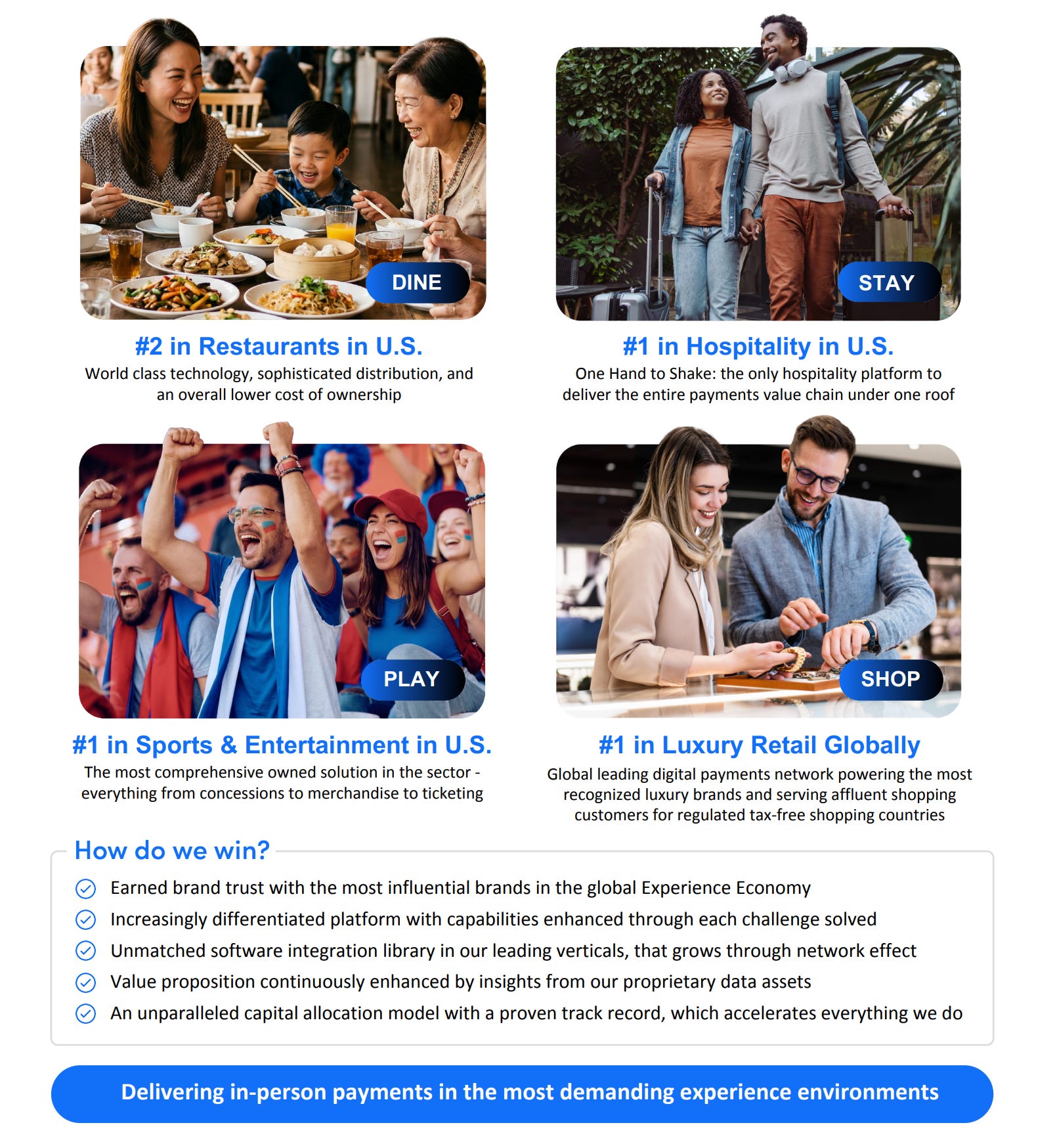
Shift4 powers the Experience Economy. Enabling businesses to deliver the Moments that Matter across verticals like stadiums and entertainments, hospitality, restaurants, and luxury retail.
What Do They Actually Do?
Instead of just processing card payments, Shift4 specializes in combining everything a business needs into one single platform. They take a lot of messy, moving parts and simplify them.
Here is what they handle for a business:
The Hardware: They provide the actual physical card readers, touchscreens, and checkout terminals you see at registers.
The Software: They build the “Point of Sale” (POS) systems that waitstaff, cashiers, and hotel receptionists use to take orders and check people in.
The Security: They use a specialized security method called tokenization to mask credit card numbers, ensuring hackers can’t steal a customer’s data during a transaction.
The Gateway: They connect the merchant directly to major card networks like Visa, Mastercard, and American Express.
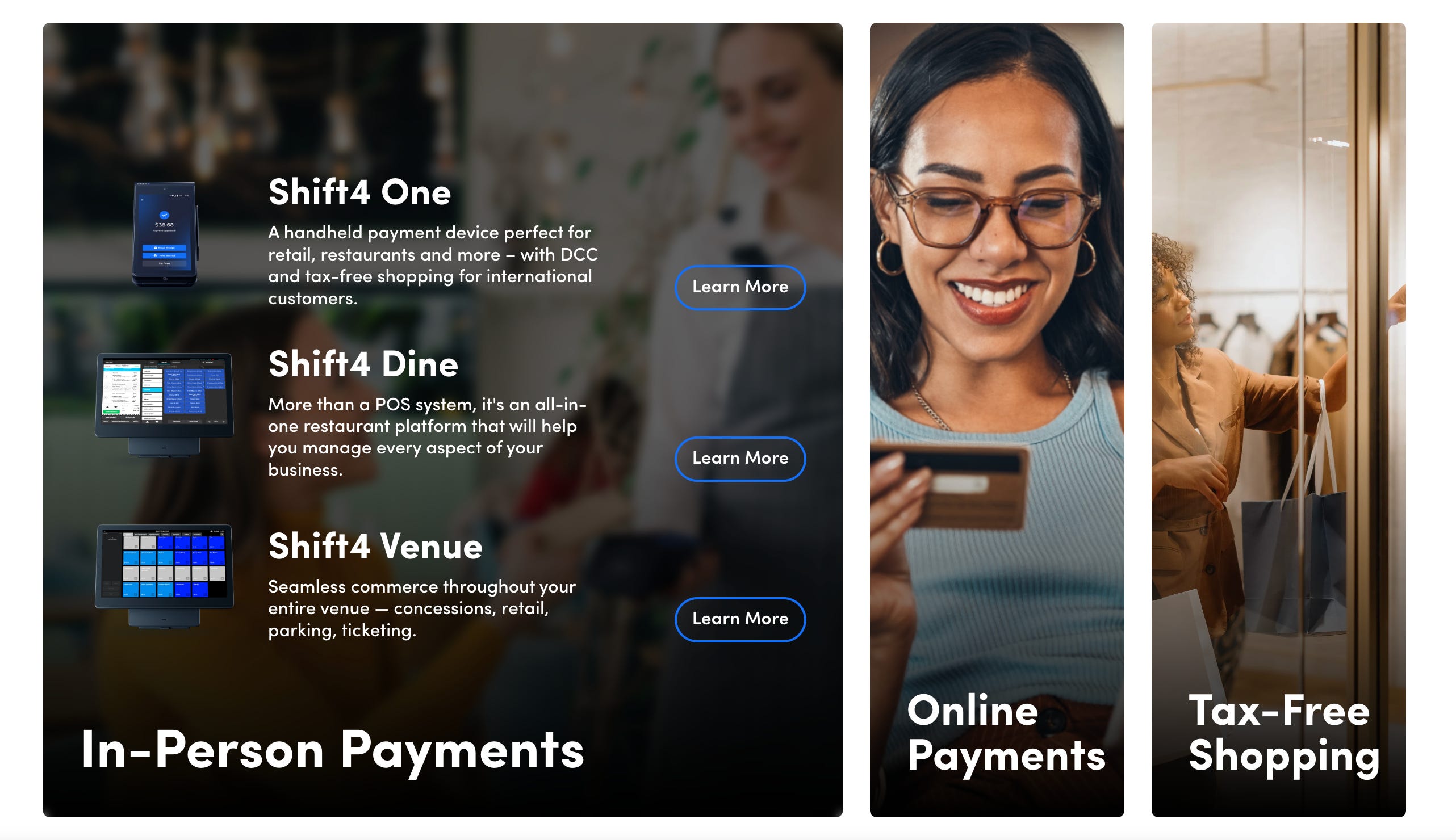
So essentially, merchants get a single, bundled solution covering everything a business needs to operate their sales. Instead of managing and paying five or more different vendors specializing in separate aspects of the business, they can work entirely with Shift4. This creates a powerful economic moat: ripping out an integrated hardware and software ecosystem to move to a competitor introduces massive friction. Because every great investment requires a durable moat to fend off competition, this stickiness underpins a strong investment thesis for Shift4.
The Founder and Management

Meet the legendary founder of Shift4 Jared Isaacman. Isaacman started the company in 1999 from his parents’ basement at just 16 years old. Over the next two and a half decades, he methodically scaled the business from a local credit card processing startup into a global fintech giant handling hundreds of billions of dollars in volume. Isaacman is famously known not just as an aggressive operator, but as an elite jet pilot and civilian astronaut who commanded SpaceX’s historic Inspiration4 and Polaris Dawn missions. It was this exact relationship with Elon Musk that secured Shift4’s exclusive, high-profile global partnership with Starlink.
However, the management story took a historic turn when Isaacman was confirmed by the U.S. Senate to serve as the 15th Administrator of NASA. To step into this prestigious public service role, Isaacman resigned from his active executive duties at Shift4 and collapsed the company’s complex, multi-share voting structure into a transparent, single Class A share class. Yet, his alignment with shareholders remains absolute: he remains Shift4’s largest equity holder, retaining a massive ~30% ownership stake in the company he built from scratch.
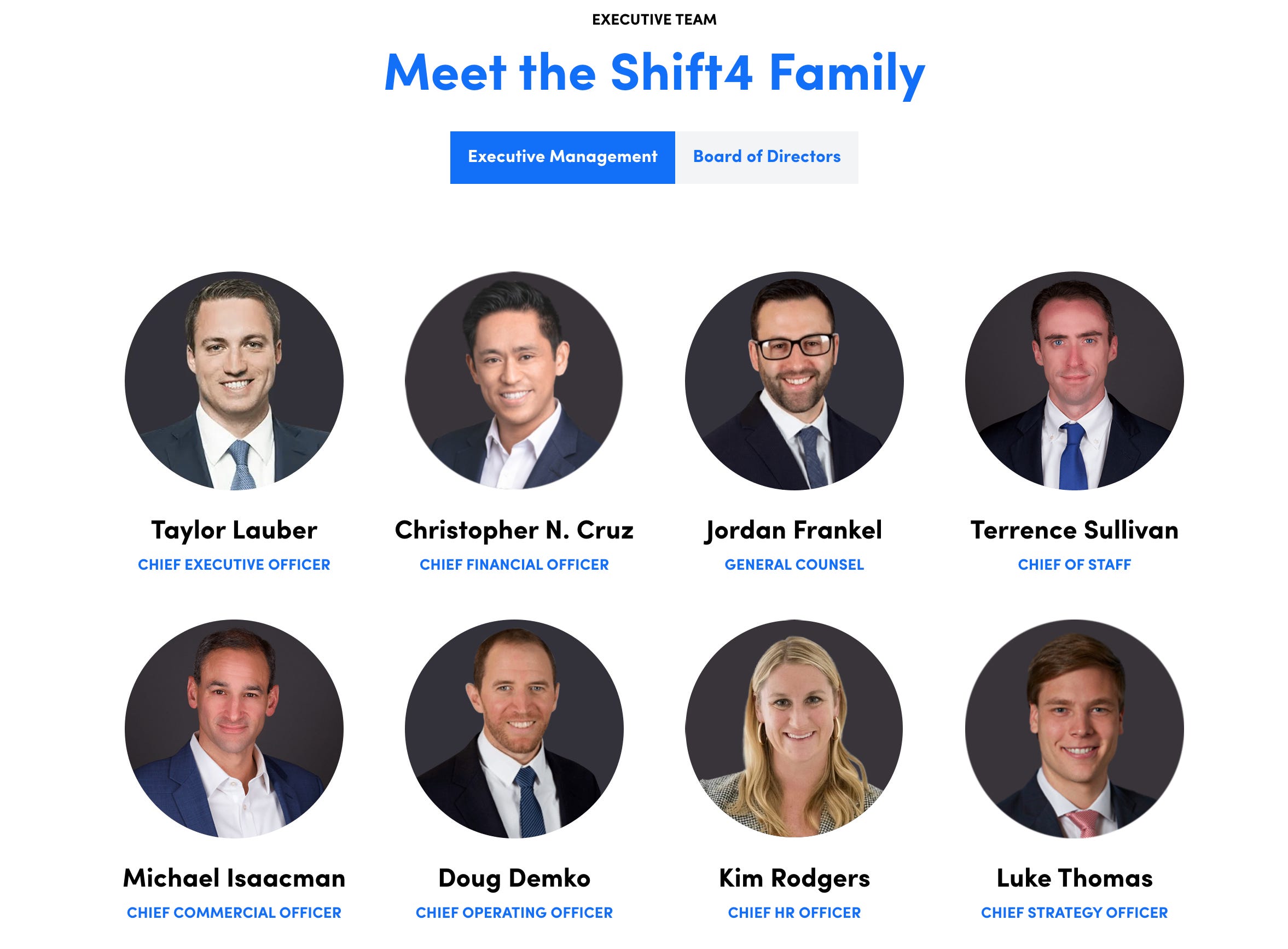
With the founder stepping into the history books at NASA, leadership transitioned seamlessly to Taylor Lauber, who stepped up as Chairman of the Board alongside his role as CEO. Far from an unproven outsider, Lauber has been the core operational engine at Shift4 for years, serving as President and working side-by-side with Isaacman to orchestrate the company’s massive enterprise expansions, including the highly strategic acquisition of Global Blue. This transition marks Shift4’s evolution from a founder-led growth story into a highly disciplined, institutionally mature financial powerhouse. For investors, the thesis is clear: the company retains the immense strategic advantages of its founder’s legacy and massive equity ownership, while being steered day-to-day by a deeply experienced executive team focused purely on execution, margin expansion, and scaling global market share.
Shift4 Core M&A Strategy
To standard Wall Street analysts, Shift4 can look like a frantic serial acquirer that takes on debt to buy seemingly unrelated companies. But when you look beneath the surface, management is executing a highly disciplined, repeatable playbook. They don't just buy companies for more revenue; they target very specific software gatekeepers to control high-value payment volume.
Their M&A framework breaks down into a clear three-step cycle:
Buy the “Messy” Software Software Gatekeepers
Shift4 looks for industries where the payments infrastructure is incredibly fragmented and messy—think hotels, stadiums, or international luxury retail. Instead of trying to build competing software from scratch, Shift4 buys the dominant software platforms already deeply embedded in those industries.
The Strategy: They look for great software companies that are historically bad at—or simply not focused on—monetizing their own payment volume.
The Conversion Engine (The “Cross-Sell” Magic)
When Shift4 acquires a software company, they inherit thousands of legacy merchants who are using that software but routing their actual credit card processing through third-party banks or legacy competitors. This is where Shift4 strikes.
The Strategy: They approach these newly acquired merchants and offer a highly lucrative deal: they will slash or entirely waive the merchant’s software fees if the business agrees to switch its backend credit card processing over to Shift4. For the merchant, it’s an easy way to cut overhead. For Shift4, it instantly unlocks a massive wave of high-margin transaction volume.
International Arbitrage (The Finaro and Global Blue Strategy)
Historically, Shift4 was a purely North American business. Building international payment networks from scratch is a regulatory nightmare that takes decades. Shift4 used M&A to completely bypass this hurdle. By acquiring Finaro (giving them a European banking license and cross-border tech) and Global Blue (giving them an absolute lock on tax-free shopping infrastructure across 50 countries), Shift4 accomplished in a few years what would have taken a generation to build organically. They can now immediately route their major domestic enterprise clients—and global giants like Starlink—internationally without relying on foreign banking partners.
The takeaway here is that Shift4 is not just a mechanical serial acquirer trying to inflate its top line. They deliberately buy out the software gatekeepers that serve as the bread and butter of their target industries. Management excels at taking those acquired merchant bases and cross-selling them into Shift4’s unified commerce platform. Crucially, this strategy secures an immediate footprint in new international markets—a feat that would normally take years, an army of sales teams, and a massive Customer Acquisition Cost (CAC) to achieve organically. By letting M&A do the heavy lifting, Shift4 effectively bypasses traditional barriers to entry, allowing them to expand globally at an undeniable speed.
The Economic Moat
Before investing in any company, we must assess its long-term durability. This requires looking at three critical factors: whether the company’s value proposition provides massive utility to its customers, whether rivals can threaten its core market share, and whether its unit economics yield the kind of solid margins that ultimately reward shareholders.
High Switching Costs (The "Sticky" Software Moat)
This is Shift4’s strongest advantage. They don’t just process payments; they provide the core operational software for complex businesses.
The Reality: If a major resort or a massive stadium wants to fire Shift4 to save a fraction of a percent on transaction fees, they can’t just swap out a card reader. They have to rip out their entire booking system, their restaurant point-of-sale software, their ticketing platform, and their back-end accounting tools.
The Moat: Ripping and replacing core enterprise infrastructure introduces massive operational risk, employee retraining costs, and potential downtime. Because of this friction, once a massive venue integrates Shift4, they almost never leave (resulting in incredibly high merchant retention).
Deep Technological Integrations
Shift4 has spent years building deep integrations into hundreds of property management systems (PMS) and specialized third-party software.
The Reality: Think of a hotel chain that uses a specific, legacy software to track room cleanings and check-ins. Shift4 has spent over a decade writing the custom software code to link directly into those systems.
The Moat: A new tech competitor can’t just show up with a pretty card reader and win that hotel’s business. Unless the newcomer spends years building those identical software integrations, they literally cannot serve that customer. Shift4 has a massive head start here.
The "All-in-One" Price Advantage (Cost Leadership)
In the payment world, a business usually has to pay multiple vendors: one for the payment gateway, one for the software, one for the hardware, and one to process the actual money. Shift4 eliminates the middleman.
The Reality: Shift4 waives a lot of the traditional upfront software and hardware fees by bundling them together. They make their money entirely on the backend transaction volume.
The Moat: They can pitch a massive stadium or restaurant group an offer that’s hard to refuse: “We will give you the software and the hardware for free/cheap, and just charge you standard processing rates.” Pure software companies or pure payment processors can’t compete with this cross-subsidized pricing model without obliterating their own margins.
Geographic Expansion & Cross-Border Friction
While Shift4 has aggressively expanded its international footprint—most notably through its massive acquisition of Global Blue—the move has drawn skepticism. Many investors view it as a misstep, arguing that Shift4 over-leveraged its balance sheet to acquire a legacy business that will yield poor returns. I strongly disagree. In my view, this acquisition does not weaken the company; rather, it significantly deepens Shift4’s economic moat.
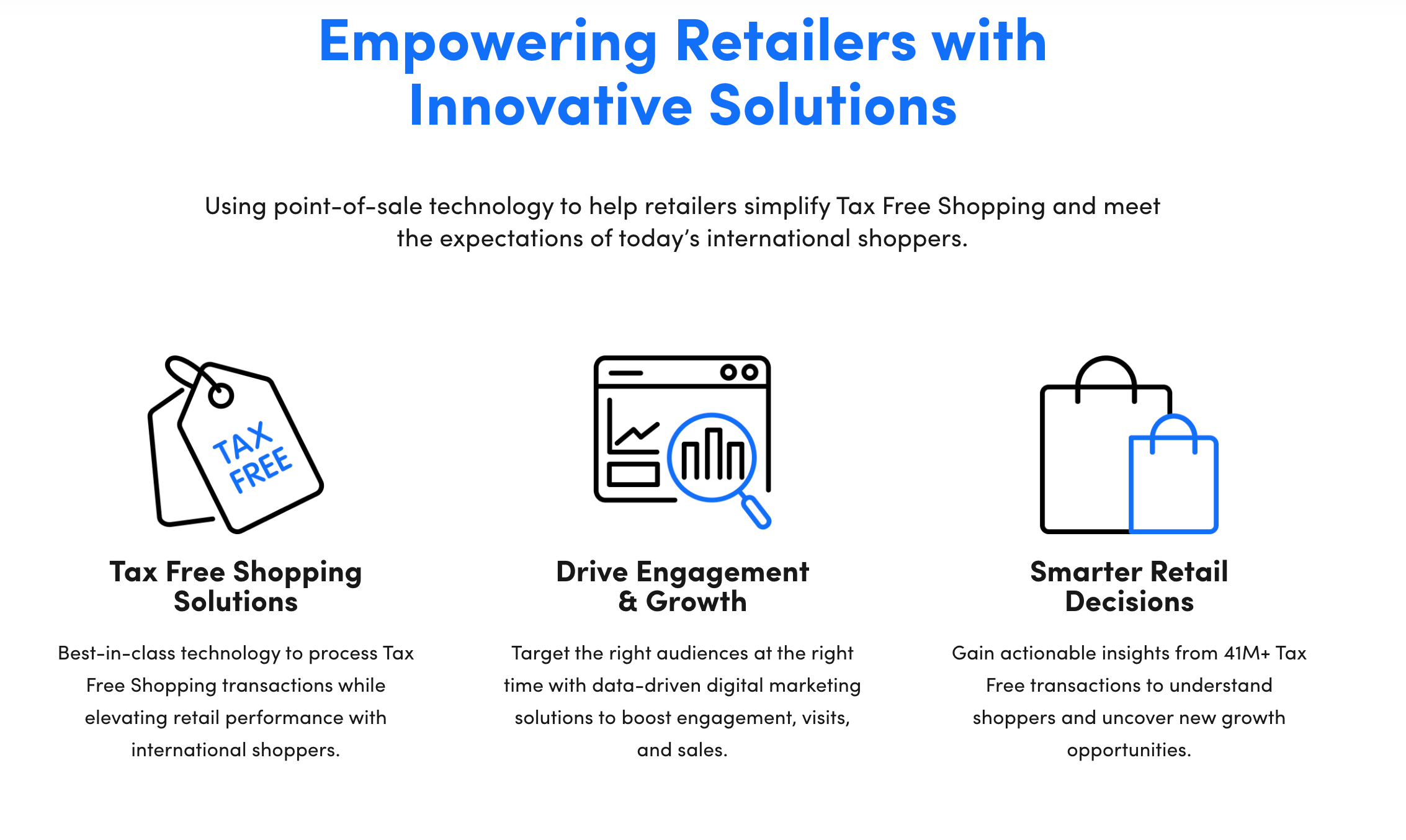
The Reality: Global Blue specializes in Tax-Free Shopping (TFS) and cross-border payment flows for luxury retail and international travel.
The Moat: Managing international tax compliance, currency conversions (like dynamic currency conversion), and alternative global payment rails (like Alipay or WeChat Pay) involves dealing with a brutal web of local regulations and banking laws. This creates a massive regulatory and operational barrier to entry that localized processors simply cannot touch.
Global Blue commands a dominant ~70% market share and a remarkable ~40% Adjusted EBITDA margin. Far from a failed acquisition, this financial profile is highly accretive and poised to significantly expand Shift4's bottom line.
Starlink Recurring Subscription Revenue
Although, this is not part of my core thesis about Shift4, but it does show that Shift4 is not a legacy POS gateway. The company is innovating and expanding it’s TAM across may verticals.
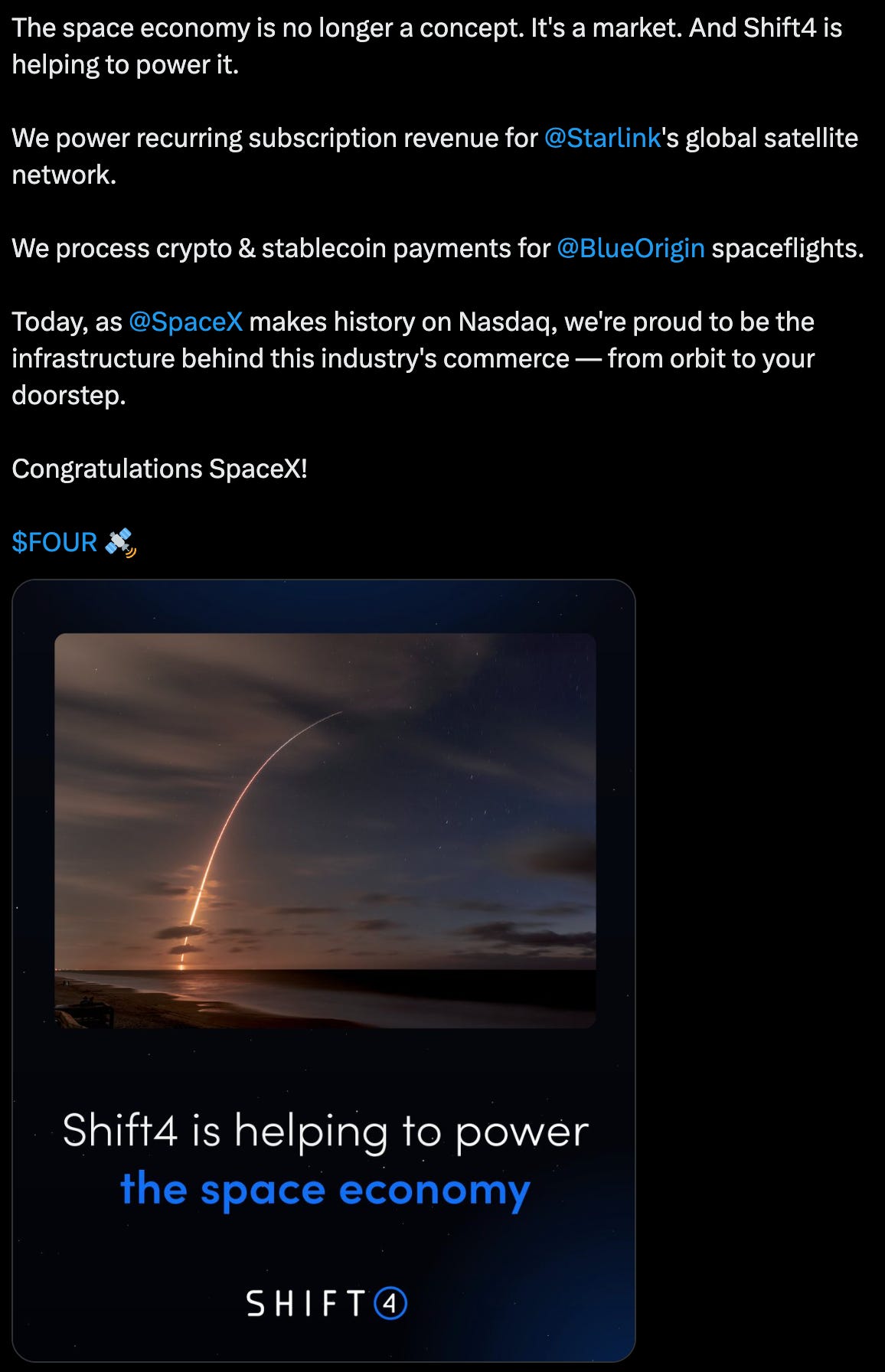
The partnership between Shift4 and SpaceX’s Starlink is one of the most fascinating parts of this story, and it represents a massive, hidden moat. Because Shift4’s CEO Jared Isaacman has a close personal and professional tie to Elon Musk, Shift4 became the exclusive global payment processor for Starlink subscriptions. This isn’t just about collecting fees on millions of satellite internet bills—it’s a genius international growth catalyst.
Normally, breaking into a new country takes a payments company years of fighting through local red tape, banking laws, and currency regulations. But as Starlink aggressively activates new regions across Europe, Africa, and Latin America, Shift4 expands right alongside them, building out their local payment infrastructure on SpaceX’s dime. Once Shift4 is up and running in a new country to handle Starlink, they instantly have a fully compliant, localized footprint they can sell to other major businesses in that region. Plus, processing billions of dollars globally for an Elon Musk enterprise is the ultimate badge of honor. It proves to the world’s biggest stadium and hotel chains that Shift4’s tech is completely bulletproof.
The Competitive Landscape
To evaluate Shift4 as an investment, it is essential to understand their competitive moat. A common misconception is comparing them directly to retail or digital giants like Block (Square), Stripe, or PayPal. While these are exceptional fintech platforms, they serve fundamentally different markets. Square handles micro-merchants and small independent businesses, while Stripe dominates pure online checkout APIs for digital-first enterprises, and PayPal deals with branded checkout and BNPL (Buy Now Pay Later) which Shift4 also supports payments through PayPal.
Shift4 operates in a completely different arena, specializing in highly complex, physical brick-and-mortar ecosystems. Their true market competition is localized to specific industries:
In Large Venues and Stadiums: They primarily go head-to-head with legacy payment titans like Fiserv (specifically their Clover Sport division). While legacy competitors often offer modular, fragmented third-party software setups, Shift4 wins by bundling hardware, software, and processing into a single, unified enterprise package.
In the Restaurant Industry: Their main product rival is Toast. Toast has built an incredibly popular, dedicated operating system for restaurants, but it relies on charging significant ongoing software subscription fees. Shift4 counters this by aggressively undercutting software costs, offering high-end features practically free to secure the more lucrative, long-term payment processing volume.
In Global Commerce: As Shift4 scales internationally, they intersect with tech-forward enterprise gateways like Europe’s Adyen. However, by acquiring Global Blue, Shift4 holds a distinct advantage in physical international retail, commanding a dominant ~70% market share in the deeply specialized airport tax-free shopping ecosystem—a cross-border infrastructure that pure digital gateways cannot easily duplicate.
Ultimately, Shift4’s competitive edge doesn’t stem from beating Silicon Valley at standard e-commerce. It comes from their willingness to take on the complex, integrated operational systems that competitors find too difficult to manage. Once Shift4 is deeply wired into a stadium’s ticketing gate, a resort’s booking engine, or an airport’s customs desk, the switching costs become incredibly high. This structural lock-in is precisely what keeps the business resilient, driving steady market share gains against both legacy players and modern pure-play software competitors alike.
In regards to pricing, Shift4 has a very lucrative offering compared to competitors. In specific niches like food and beverage, competitors like Toast charge standard monthly Software-as-a-Service (SaaS) fees (starting around $69 to $165+ a month per terminal) plus upfront costs for proprietary hardware and their own high transaction fees.
The Shift4 Counter: Shift4 turns this upside down with platforms like SkyTab (rebranding to Shift4 Dine). They charge a radically low flat software fee—about $29.99 a month per terminal—and often throw in the actual hardware (touchscreens, handheld scanners, printers) completely for free up front.
So, despite having a fierce competition in the payments sector, Shift4 value proposition is very strong that it would even be silly for merchants to not work with them.
Financial Data and TAM
Now that we’ve discussed what the company does, its leadership transition, its M&A strategy, and the economic moat that protects it from competitors, a vital question remains: What is the overall addressable market Shift4 can capture in the long run, and how do their unit economics support that growth?
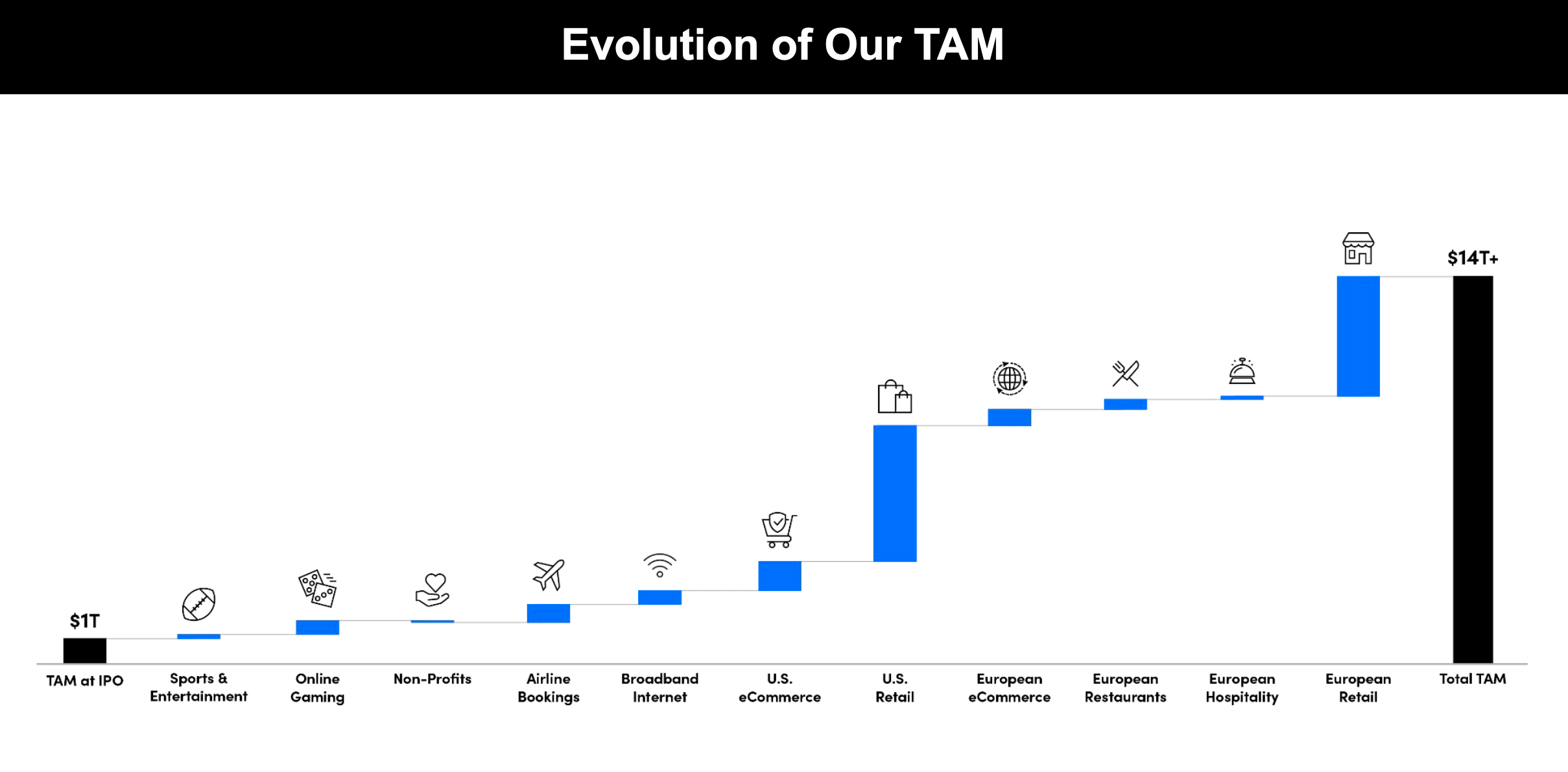
Based on management's disclosures since IPO, Shift4 started out with a roughly $1 trillion TAM while operating almost entirely in the U.S. Since then, they've repeatedly redefined and expanded that figure as they've diversified into new verticals (gaming, sports & entertainment, e-commerce, hotels) and pushed internationally. Most recently, with the Global Blue acquisition, management says their cross-sell funnel — the payment volume opportunity within their existing and newly acquired customer base — has grown from about $800 billion to $1.4 trillion.
As management highlighted in their strategic long-term slides, $1.4 trillion is just the starting block. When you take Shift4’s unified commerce engine and apply it globally, the real ultimate sandbox is a staggering $14 Trillion global enterprise commerce market. When will the TAM reach $14 trillion? I don’t know, but it makes sense to me that the experience economy will continue to expand regardless of AI where transaction volumes will flow indefinitely.
My thesis for Shift4 is very simple. Travel is an innate part of human psychology, and people will keep spending money on experiences. In the end, money was meant to be spent on experiences — so why would that ever stop?
This is why I find Shift4 so compelling: their product offering brings such immense value to the overall experience people can get.
2026 Guidance
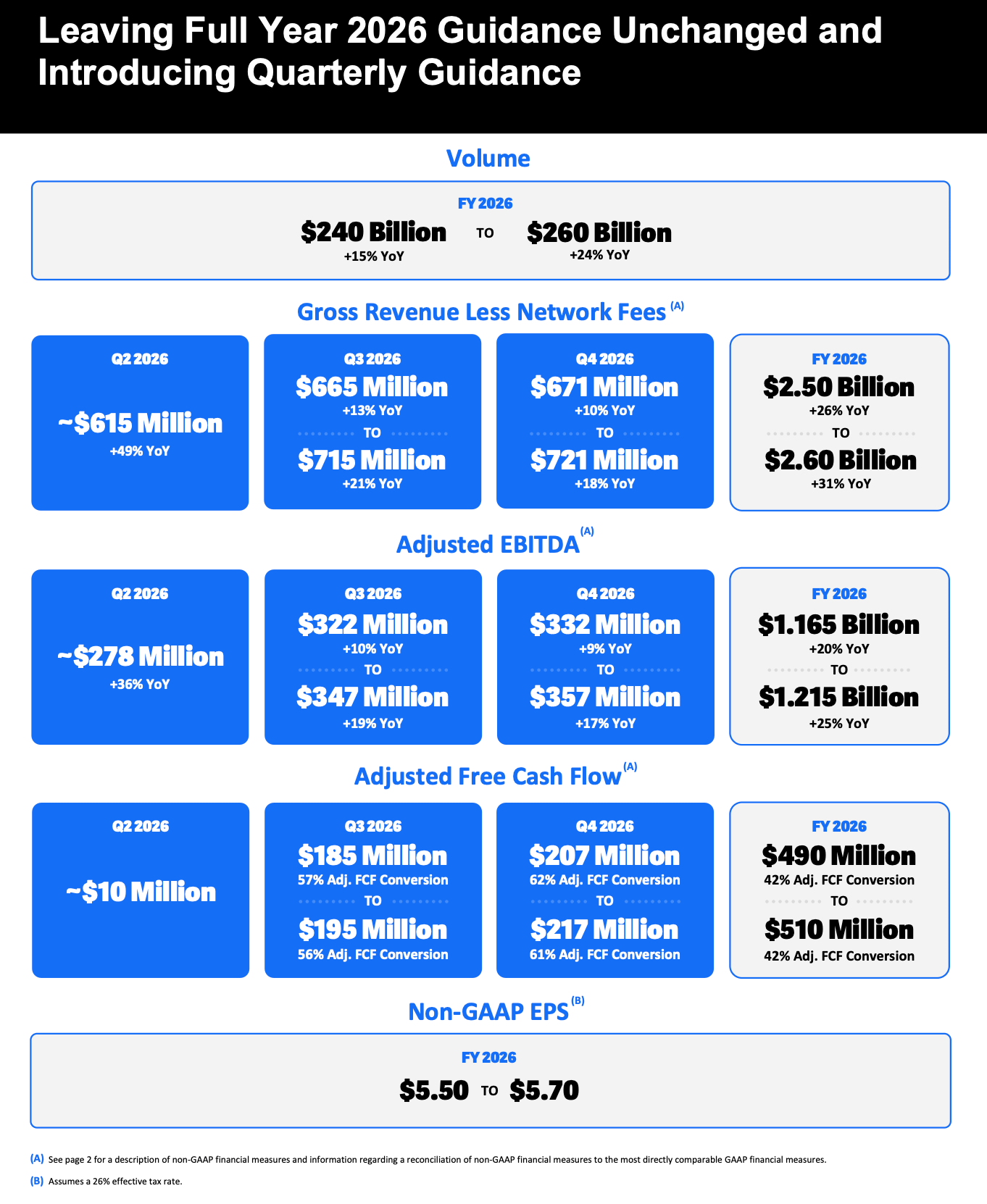
Guidance for 2026 has remained unchanged despite the Middle East conflict involving Iran and its proxies.
IMO, I believe management is sandbagging guidance and will probably beat and raise throughout 2026. The reason for this is that even in their latest Q1 2026 earnings, they maintained full-year guidance despite travel being impacted by the war in the Middle East — management quantified only a modest headwind from it, well within their existing buffer.
In addition, there's the World Cup catalyst, where Shift4 stands to earn from elevated transaction volumes around the venues and stadiums it operates in. Shift4 operates in several of the biggest stadiums hosting World Cup matches and should benefit from higher transaction volumes and DCC (dynamic currency conversion) revenue tied to international attendees.
Beyond that, travel will eventually resume with or without wars. People will not stop traveling in the longterm and will likely continue to spend more on experiences. Add to that the tax-free shopping business, where Shift4 earns high-margin revenue on every transaction.
Balance Sheet
I think this is the most important thing investors need to understand if they are willing to invest in Shift4.
The balance sheet is highly leveraged — and it’s gotten more leveraged, not less, as Shift4 has funded an aggressive M&A strategy over the past two years. As of Q1 2026 (March 31), Shift4 was carrying:
Total debt: $4,522 million
Cash and cash equivalents: $473 million — down sharply from $964 million at year-end 2025
Settlement assets: $756 million (separate from cash, tied to payment-processing float, not really “spendable” the way cash is)
Net leverage: 3.7x on a pro forma basis
Interest expense: $65 million for the quarter — more than double what it was a year earlier
That debt-to-equity ratio, depending on how you calculate it, lands somewhere between 2.5x and 3x. This is not a conservatively financed balance sheet. It's a company that has chosen to lever up meaningfully in order to buy its way into new markets — Global Blue, Bambora, and international expansion being the big line items — and that bet only pays off if the acquired revenue keeps converting into EBITDA at the pace management has promised.
Part of the cash decline is debt-funded acquisitions. But a real chunk of it is also buybacks. Shift4’s board authorized a new $1 billion share repurchase program in November 2025, and management has been running hard at it:
Q1 2026 alone: 5.5 million shares repurchased for $295 million, bringing cumulative execution to $600 million of the $1 billion authorization
One tracking estimate puts the pace even higher — roughly 7.7 million shares bought back between Q4 2025 and early Q1 2026, cutting to roughly 79,328,812 total common shares outstanding excluding RSU which fully is 82,395,540. This is also excluding the 2027 convertible notes diluting to 92,395,540 shares outstanding because these notes have been refinanced by management which I’ll explain shortly. So, including RSU fully diluted shares stand at 82,395,540.
Management's framing is that this is disciplined capital return, not financial engineering — cumulative dilution since the 2019 IPO is still only around 18%, against roughly 8x revenue growth over the same period. That's a fair point. But it's also worth being honest with readers: buying back stock aggressively while simultaneously carrying $4.5B+ of debt and funding acquisitions means the cash cushion is thin, and there's less room for error if growth slows or integration costs run hot.
I think the debt is manageable given management's track record of disciplined capital allocation. Shift4 has consistently generated returns on invested capital above its cost of capital, and I believe the company can continue to grow meaningfully and profitably without taking on excessive risk.
Refinancing the 2027 converts
The most recent balance-sheet news, and arguably the most important for anyone tracking Shift4's credit profile: in late June 2026, Shift4 proposed a new $750 million Term Loan B, with proceeds earmarked to prefund repayment of its convertible notes due August 2027 ($632.5 million face value outstanding).
This was the biggest anchor that shorts were leaning into the stock thinking that Shift4 will not be able to pay the 2027 convertible notes maturing in 2027. Well they just did, and that entire bear thesis just died overnight. We got these confirmation from none other than S&P Global and Moody’s and this is what each one said:
S&P Global affirmed Shift4’s ‘BB-’ rating, characterizing the move as proactive management that reduces refinancing risk heading into 2027 rather than a sign of stress. S&P Global also sees a positive outlook for Shift4 going forward - they projects EBITDA growing from $964M to $1.3B by 2028. That's a 16% CAGR.
Free cash flow from $374M to $613M. That's a 28% CAGR. And leverage dropping from 5.7x to 3.9x.Moody’s affirmed the corporate family rating but downgraded the unsecured notes specifically — a structural point, not a company-wide downgrade. The logic: the 2027 converts being repaid didn’t carry subsidiary guarantees, but the existing unsecured notes do, so swapping converts for a secured term loan shifts the capital structure in a way that’s technically less favorable to unsecured noteholders. Moody’s kept Shift4’s liquidity rating at the top tier (SGL-1), citing continued free cash flow generation, and expects debt/EBITDA to stay above 4x through 2026 — partly a function of the Middle East conflict’s drag on the tax-free shopping business — before falling below 4x in 2027. Moody’s also projects roughly $550 million of average annual free cash flow going forward, about 11–12% of total debt, which is a sign of the balance sheet to delever overtime.
So now the question is what happens with the remaining $117.5 million in cash? Well simple, this money will be bucketed for general corporate purposes which they can use for the following:
A liquidity cushion / buffer (Moody’s specifically framed part of this raise as providing “an additional buffer to geopolitical uncertainty” — a nod to the Middle East conflict headwinds hitting the tax-free shopping business)
Funding for continued share buybacks
Working capital or smaller bolt-on M&A
Covering fees/costs of the debt issuance itself (term loans typically get issued at a discount, and there are underwriting/legal fees, so “net proceeds” is somewhat less than the $750M gross figure to begin with)
So what is their balance sheet made of today? What are the terms?
2032 Senior Notes: $1,650 million, 6.75%, maturing 2032
2033 Euro Notes: $1,283 million (€680M), 5.50%, maturing 2033
Term Loan Facility (original): $997 million, floating (~7%), maturing July 2032
New Term Loan B (pending): $750 million, reportedly SOFR + 2.00% which also deduct the remaining cash of $117.5 million.
Total principal (pro forma): ~$4,680 million
So the debt basically remains the same with additional $117.5 million as liquidity cushion. This shows management is proactive to improve it’s financials and the debt on their balance sheet is not that fearsome as the bearish would make you believe.
Goodwill
When skeptics look at Shift4’s balance sheet, their immediate concern is often the company's ballooning Goodwill, which recently crossed $2.7 billion. In traditional accounting, a massive goodwill balance looks like a red flag—it represents the premium a company paid over the physical net assets of the businesses they acquired. Critics worry that if these acquisitions underperform, Shift4 will be forced to take massive, earnings-destroying impairment charges down the road.
However, this fear entirely misunderstands Shift4’s core M&A model. Traditional companies buy assets for their physical footprint; Shift4 buys them to absorb embedded payment volume. When they acquired Global Blue, the "value" wasn't in their physical office buildings—it was in their software code and their exclusive lock on 70% of the world's airport tax-free shopping market. Because these acquired platforms boast incredibly sticky, high-margin, and recurring transaction profiles, the risk of a major asset impairment is remarkably low.
This efficient capital deployment is clearly visible in the company’s Return on Invested Capital (ROIC) versus their Weighted Average Cost of Capital (WACC). A business only creates true economic value for shareholders if its ROIC is higher than its WACC (the cost it takes to raise debt and equity). Shift4’s ROIC currently hovers at a healthy ~7.1%, while their WACC sits right around 6.5% to 6.8%. Because their ROIC consistently outpaces their WACC, the math proves that management is generating positive economic profit. They are not burning shareholder cash on vanity projects; they are successfully creating value through their acquisitions.
When you look at the company's Adjusted and Organic ROIC, a completely different story emerges. Management evaluates their internal capital efficiency based on actual cash-on-cash Internal Rates of Return (IRR), stripping away the non-cash M&A accounting noise. When deploying hardware and software setups for their core enterprise restaurant and stadium vertical (Shift4Dine), Shift4 consistently prints a stellar organic cash-on-cash return well north of 25%. Similarly, when converting newly acquired software merchants over to their payment processing rails, the incremental returns on that deployed capital scale comfortably into the 15% to 20%+ range.
Finally, let's look at how management behaves when the market misprices their stock. Shift4’s business generates immense Adjusted Free Cash Flow, which converts from EBITDA at a stellar rate. Instead of sitting on idle cash or pursuing dilutive investments, management has aggressively turned to share buybacks. They are currently buying back their own stock at a highly lucrative Free Cash Flow (FCF) Yield of over 10%. For perspective, when a stable, growing business buys its own shares at a double-digit cash yield, it is one of the most accretive moves management can possibly make. It heavily reduces total shares outstanding, supercharges future free cash flow per share, and proves that the leadership team knows exactly how to maximize value when the market panics.
The Asymmetry Potential: A Coiled Spring
Now that we’ve covered the important parts about who and what Shift4 does, their economic moat and their balance sheet. Let’s talk valuation.
When you blend Shift4’s multi-trillion-dollar global growth runway with its current market valuation, the setup presents a textbook example of asymmetric risk-reward. Wall Street currently prices the stock at a highly compressed valuation—trading at roughly 7x Enterprise Value to Adjusted EBITDA (EV/EBITDA) given the company guides for about $1.2 billion in Adjusted EBIDTA. For a business compounding its top-line net revenue at a 25% to 30% clip while sustaining elite 43% operational margins, this is an incredibly cheap multiple. The market is effectively pricing Shift4 like a sluggish, low-growth legacy processor, completely discounting the international scaling power it has right now and the many growth verticals it has to expand it’s share in all their verticals.
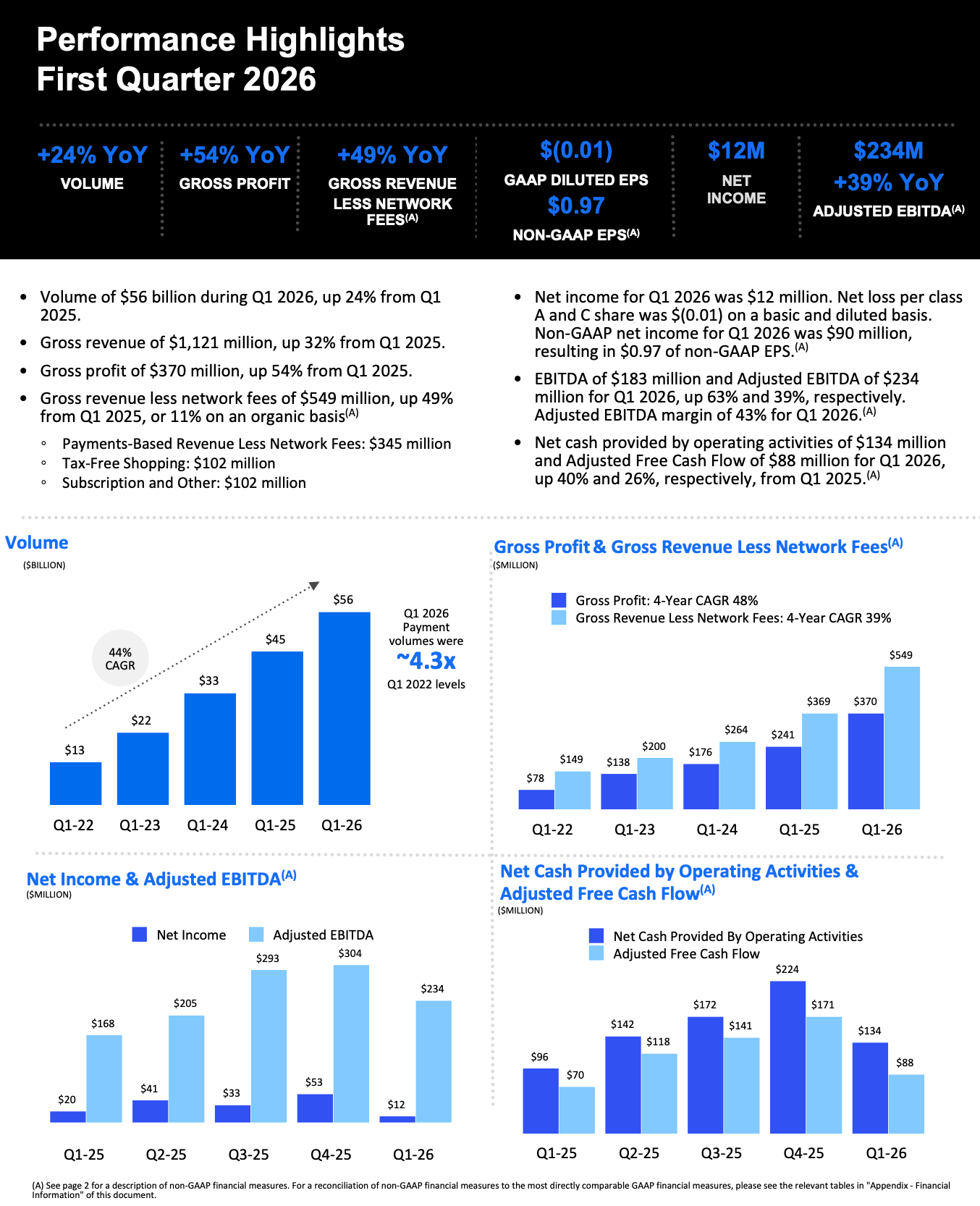
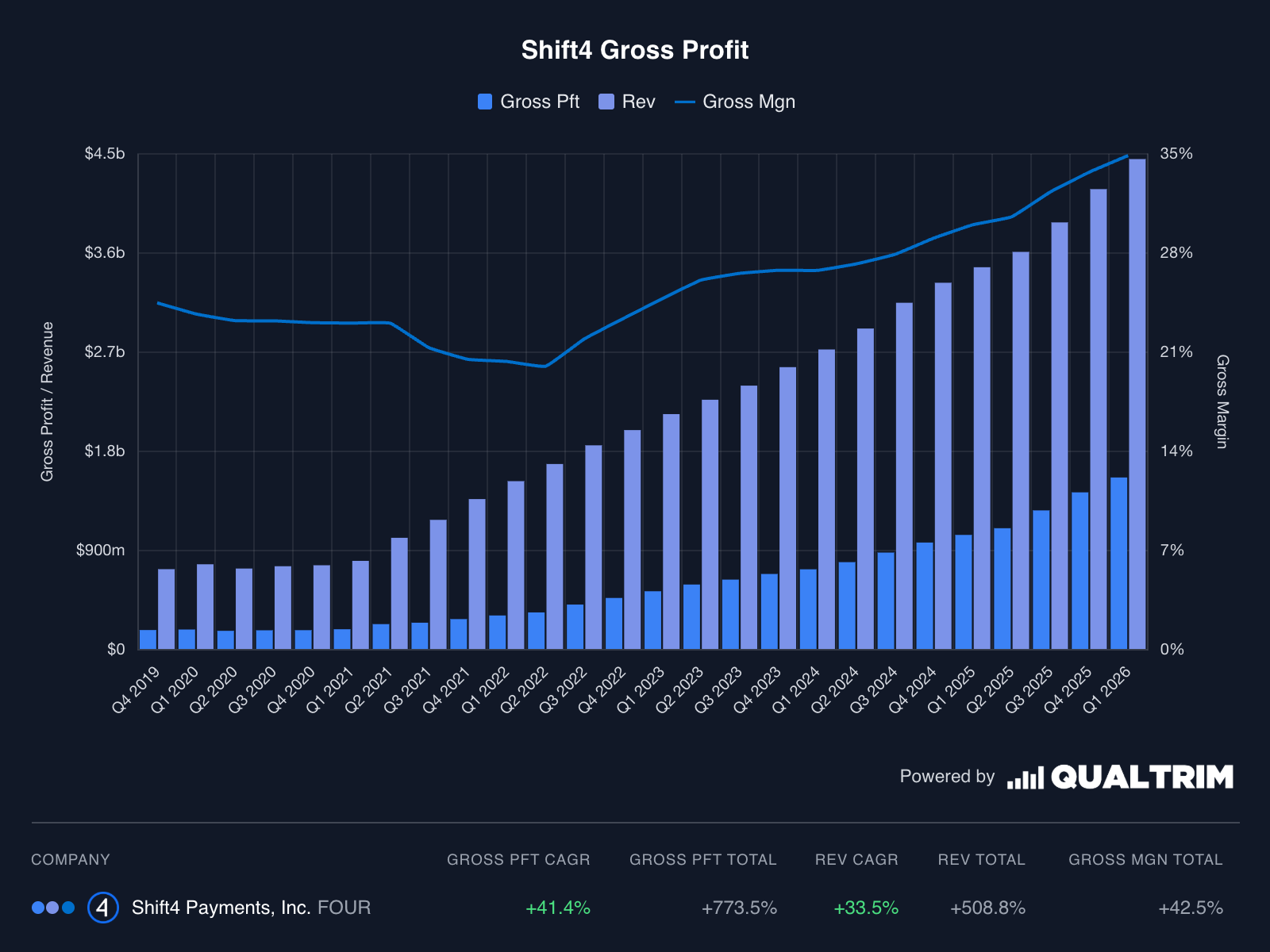
Given their Q1 2026 performance their Gross Profits is growing above 50% which shows immense operating leverage of the business that the bottom line is growing even faster than the top line.
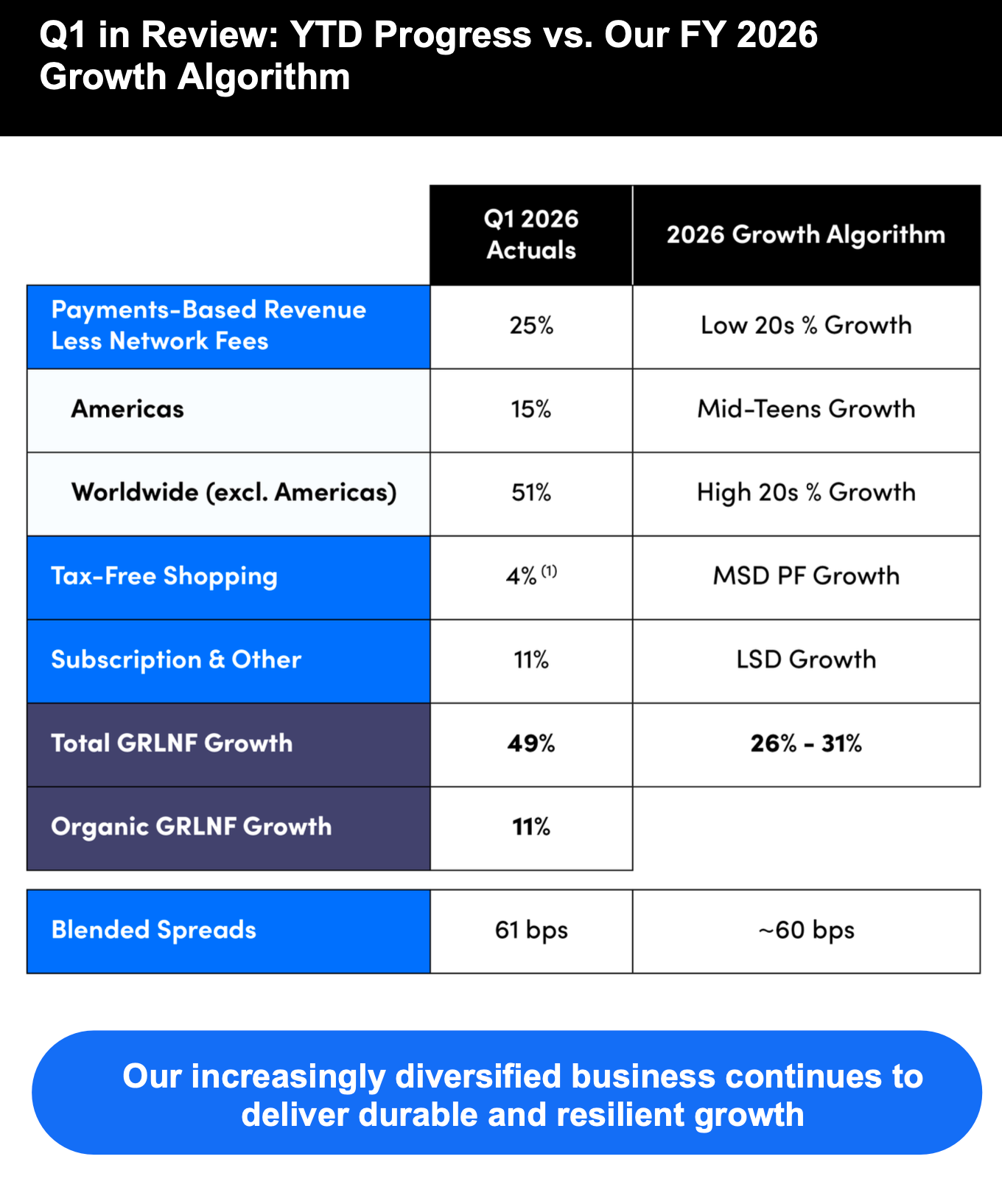
Another important thing to highlight is how fast Shift4 is growing internationally despite headwinds coming from the war with Iran. 11% Organic GRLNF (Gross Revenue Less Network Fees) was supposed to be 15% given that ~400 basis points drag was caused from intentionally deprecated legacy revenue streams which Shift4 is now prioritizing merchants to install their high margin products Shift4One and Shift4Dine.
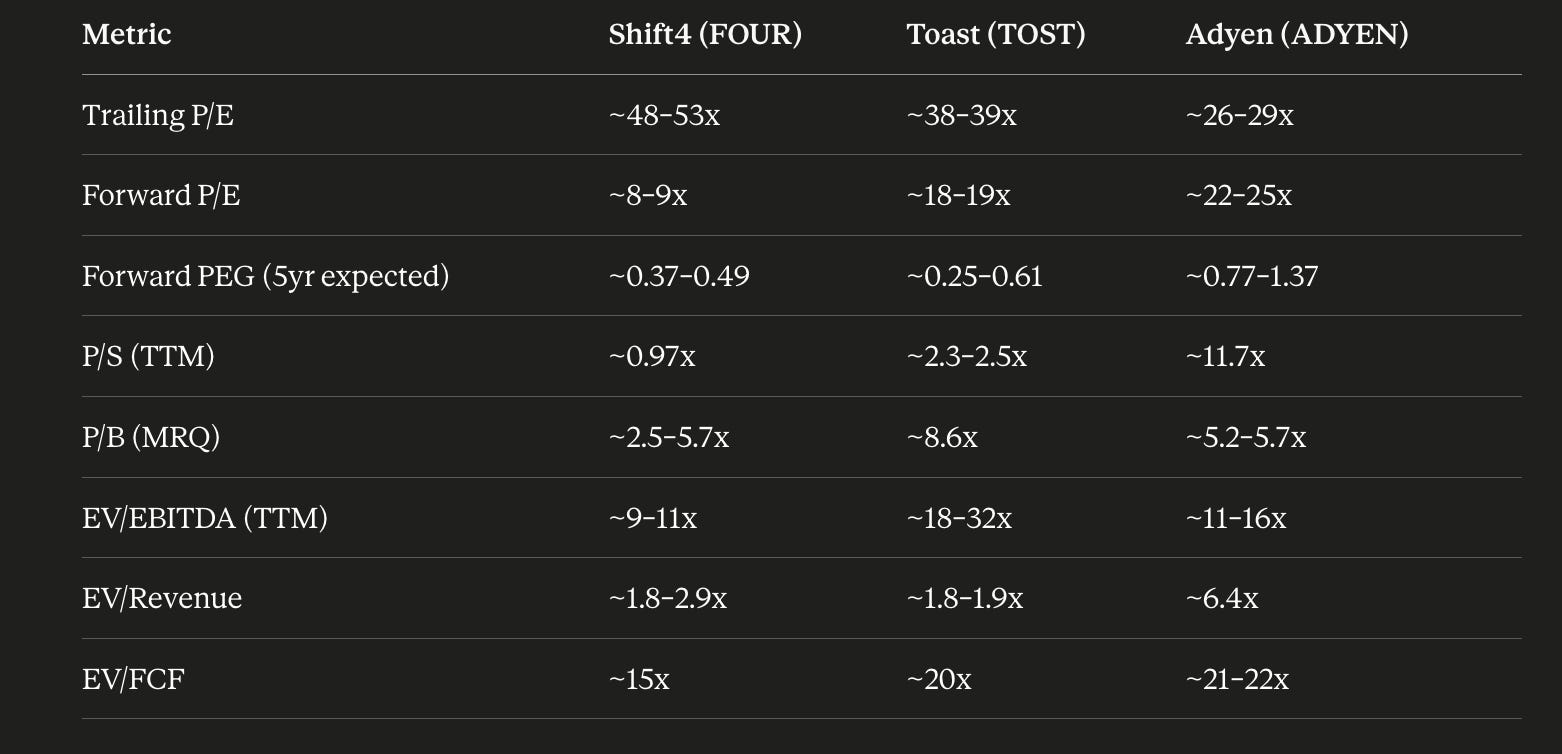
In terms of other valuation metrics we can compare Shift4 with competitors like Toast and Adyen. I asked Claude to pull up a table with different valuation metrics to compare with these companies and you can see the complete disconnect Shift4 is at compared to competitors:
Revenue is growing very nicely for Shift4 while the gross profit is growing even faster and at 35% gross margins already:
Operating cash flow of the business is compounding very nicely as well and the operating cash flow per share is growing as well:
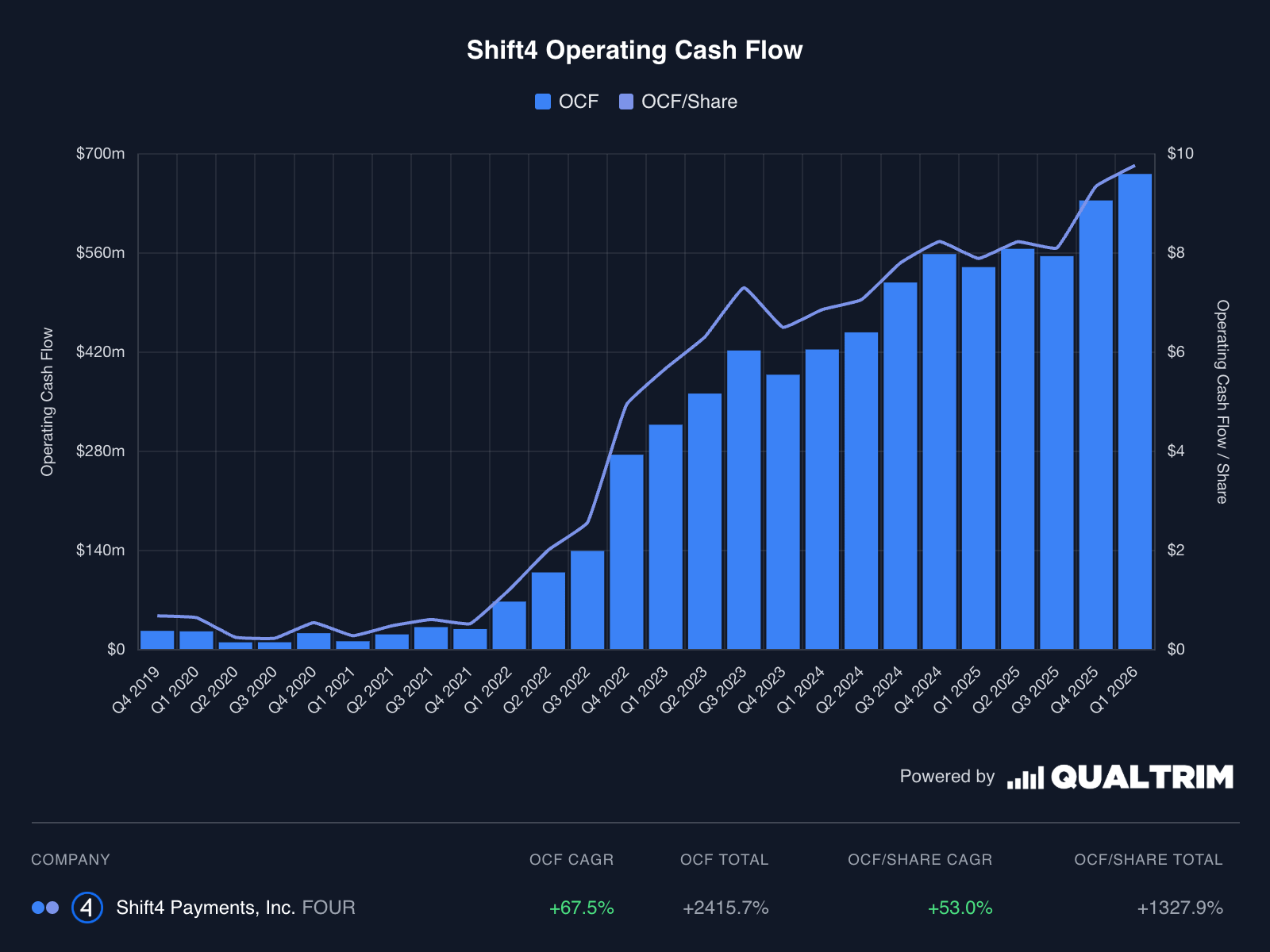
Why do I use Operating Cash Flow? Because right now there’s a lot of accounting noise on the GAAP basis where Shift4 has integration costs, interest expenses, other M&A strategies and more.
Looking at Operating Cash Flow shows the core business is very healthy and compounding very nicely and I think it’ll continue until Shift4 reaches a $1 billion ARR while trading below 4$ billion market cap.
So right now, we have Shift4 trading at about $9.77 P/OCF which the OCF multiple is roughly 5x times which to me it makes zero sense. Just reaching a 10x times OCF the stock will double and still be considered cheap.
Short Interest
Another thing I want to point out is the short interest sitting at around 38% of the entire public float which is about 16.5M shares outstanding.
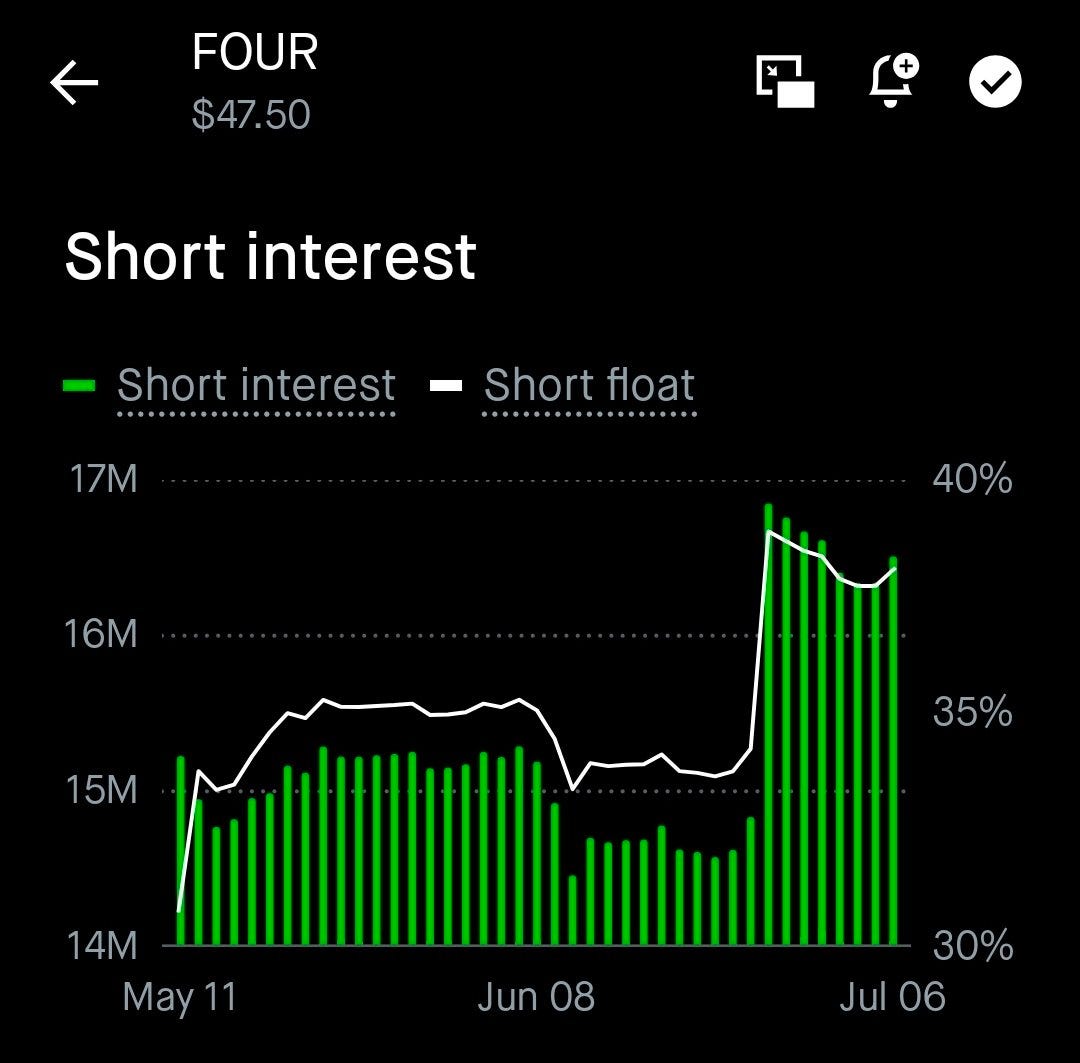
So let’s do some basic math and look from the entire 79.33M public float who owns Shift4 shares compared to shares being shorted, which are locked and which can change:
The "Locked" Holders (Minimal to Zero Circulating Supply)
Jared Isaacman - owns 22.71M shares and continues to be an avid buyer of the stock especially at the $40-$50 range and he ain’t selling.
Insiders of Shift4 excluding Jared own roughly another 9-10% of the company which is about another 7 Million Shares.
Ensign Peak Advisors, Inc.: 3.11 Million Shares (~3.92%)
The private investment manager representing large institutional family trust assets, functioning as a quiet, long-term block holder.
Durable Capital Partners, LP: 6.17 Million Shares (~7.77% of outstanding shares)
Led by veteran investors who specialize in secular compounding compounders, Durable has consistently maintained a massive long stake, looking right past the short volatility. They are not entirely locked, but are longterm holders.
The "Dynamic Active Traders" (Active Buying & Selling)
Darlington Partners Capital Management, LP: 6.58 Million Shares (~8.29% of outstanding shares)
Darlington acts as one of the largest fundamental, high-conviction institutional anchors in Shift4, viewing it as a deeply mispriced merchant acquirer.
Wasatch Advisors LP: 4.21 Million Shares (~5.20% of Class A outstanding shares) A highly respected small/mid-cap growth manager. Wasatch serves as a prime example of why the institutional float is dynamic rather than locked; they aggressively trimmed their position by roughly 2.5 million shares (down from 6.7 million) over recent quarters. This fluid movement highlights that active institutional sentiment shifts constantly, acting as an occasional supply tap for public market liquidity.
Neuberger Berman Investment Advisers LLC: 2.52 Million Shares (~3.18%)
They run specialized global megatrend and thematic equity mandates, capturing Shift4’s expansion across the international enterprise software footprint.
The "Passive Index Pool" (Never Sell, But They Lend to Shorters)
BlackRock, Inc.: 6.45 Million Shares (~8.14% of Class A outstanding shares) A massive presence, driven heavily by their iShares Core S&P Mid-Cap ETF ($IJH$), which alone holds roughly 2.29 million shares. While BlackRock’s positioning provides a permanent, non-discretionary index floor, it is crucial to recognize that these shares are not locked away. Institutional giants like BlackRock run massive securities lending programs, frequently lending their passive blocks out to short sellers to pocket low-risk lending fees—effectively fueling the very short interest we see today.
Vanguard Group: ~4.31 Million Total Shares collectively across entities (~5.43%)
Split primarily between Vanguard Capital Management (2.29M shares) and Vanguard Portfolio Management (2.02M shares). Because Shift4 is deeply integrated into the Vanguard Total Stock Market ETF ($VTI$) and Vanguard Small-Cap ETF ($VB$), these shares are entirely locked out of the circulating lending float—passive indexers do not sell based on short-seller narratives.
State Street Global Advisors (SSGA): 2.07 Million Shares (~2.61%)
Mainly held via their SPDR S&P MidCap 400 ETF Trust ($MDY$) and related core mid-cap indexing pools.
UBS Asset Management AG: 3.28 Million Shares (~4.14%)
A large European-anchored global mandate allocation.
So roughly 39 Million Shares are already locked by insiders, about 13.31 Million Shares are owned by active hedge funds that can increase or decrease their positions like Wasatch Advisors did before and the rest like Blackrock and Vanguard just have Shift4 as part of the S&P Mid-Cap ETF which is about 10-15 Million Shares.
This is not fully accurate, but what I find interesting here is that the Founder, Management and Employees have massive skin in the game.
Let’s assume roughly 20 Million Shares remain of the entire public float given hedge funds sometimes buy and sell versus 16.5 Million Shares being shorted. This screams for a short squeeze because shorts have around 9 days to cover their positions while the amount shorted is nearly the entire lending pool available to purchase. I don’t know what shorts are thinking, but it only takes one good catalyst for the company to have the stock jump violently. Not to mention, buybacks are still in effect.
If the short interest drops to 28% which is still incredibly high and Shift4 beats on their Q2 2026 earnings and raises guidance, the stock could reach easily to $62 – $68 range, so margin of safety is real here.
Risks
Despite Shift4’s robust gross revenue scaling and international growth, the company faces distinct macroeconomic and balance sheet risks that could compress valuation multiples and pressure equity returns. From a macroeconomic standpoint, Shift4's revenue is heavily tied to the "experience economy"—primarily discretionary spending within the restaurant, hospitality, and travel-heavy luxury sectors. A prolonged restrictive economic cycle or recessionary downturn would directly squeeze merchant transaction volumes, especially given the company’s recent exposure to volatile global travel trends through its Global Blue acquisition. This macro vulnerability is further amplified on the balance sheet by Shift4's highly acquisitive growth strategy, which has left the company with roughly $4.5 billion in long-term debt and a leverage profile sitting in the 4.0x EBITDA range. While a significant portion of their principal debt rests in fixed-rate notes, any sustained period of higher interest rates dramatically increases the cost of refinancing near-term maturities and elevates the borrowing costs on their floating-rate Term Loan facilities. Consequently, higher interest rates could force a larger share of free cash flow away from shareholder-friendly share buybacks or high-ROI product integrations, leaving the company with diminished capital flexibility if macroeconomic head-winds materialize.
Even though Shift4 has $1 billion in active rate-sensitive debt from their initial Term Loan B, and their newly proposed $750 million term loan which the floating rate exposure is $1.75 billion compared to their overall $4.5 billion of debt, it’s still important to be aware of the risks here.
My Own DCF Estimates
I did my own DCF estimates on a FCF per share basis, so take these estimates at face value. The numbers can change so it’s important to remember that a model is only as good as its inputs. Even slight adjustments to long-term growth assumptions or the discount rate will shift the implied intrinsic value, which is why I prefer to bake in a wide margin of safety. Rather than trying to pinpoint an exact target price down to the penny, the goal here is to stress-test the math to see if the market's current pricing of the stock actually makes sense relative to Shift4's true cash-generation power.
My base case:
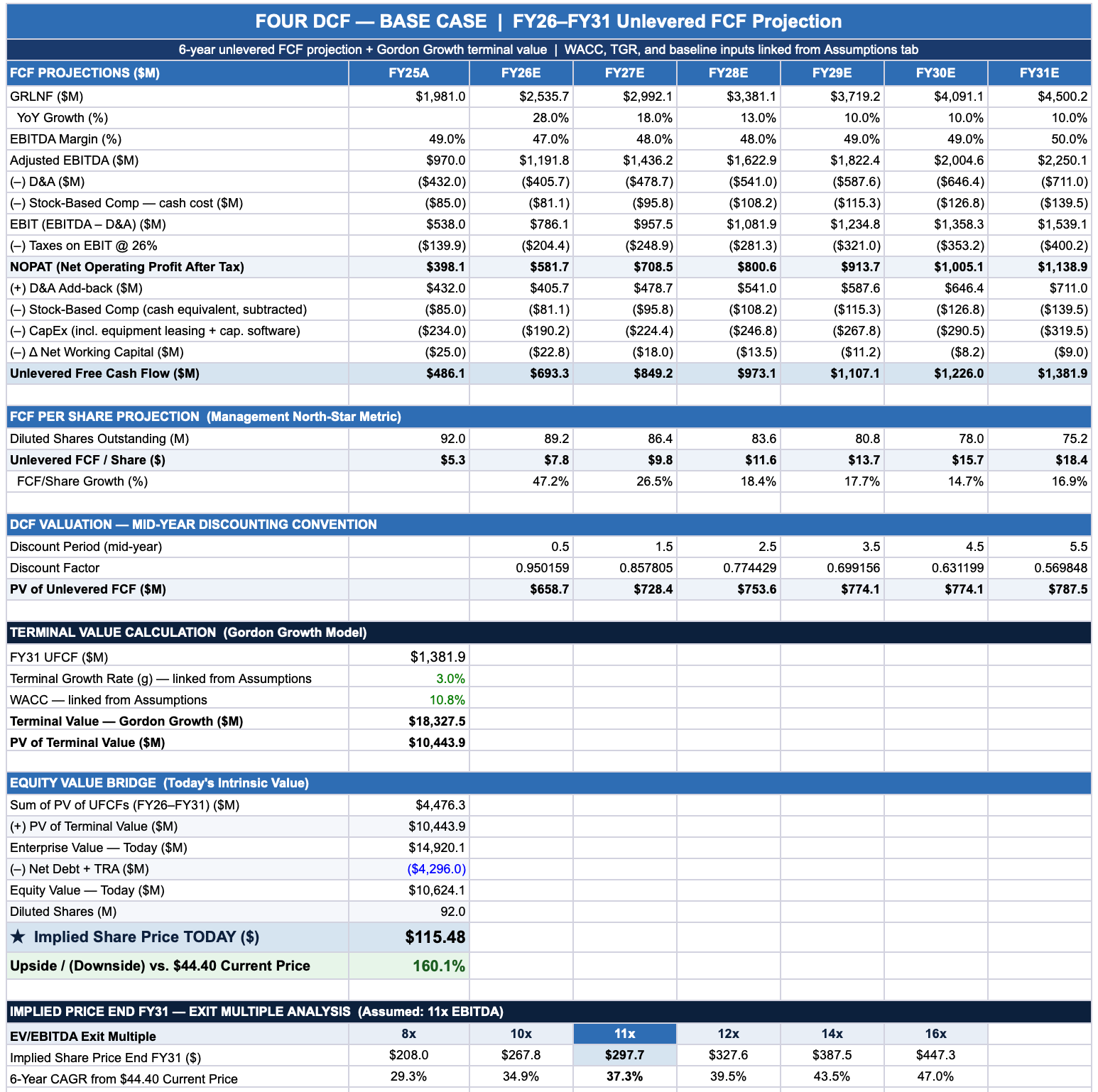
These assumptions basically bake management’s own guidance where I believe the numbers are very achievable and that Global Blue can provide a meaningful addition to the top and bottom lines. Un-levered FCF means adjusted FCF which I expect to be about $7.8 this year.
My Bear case:
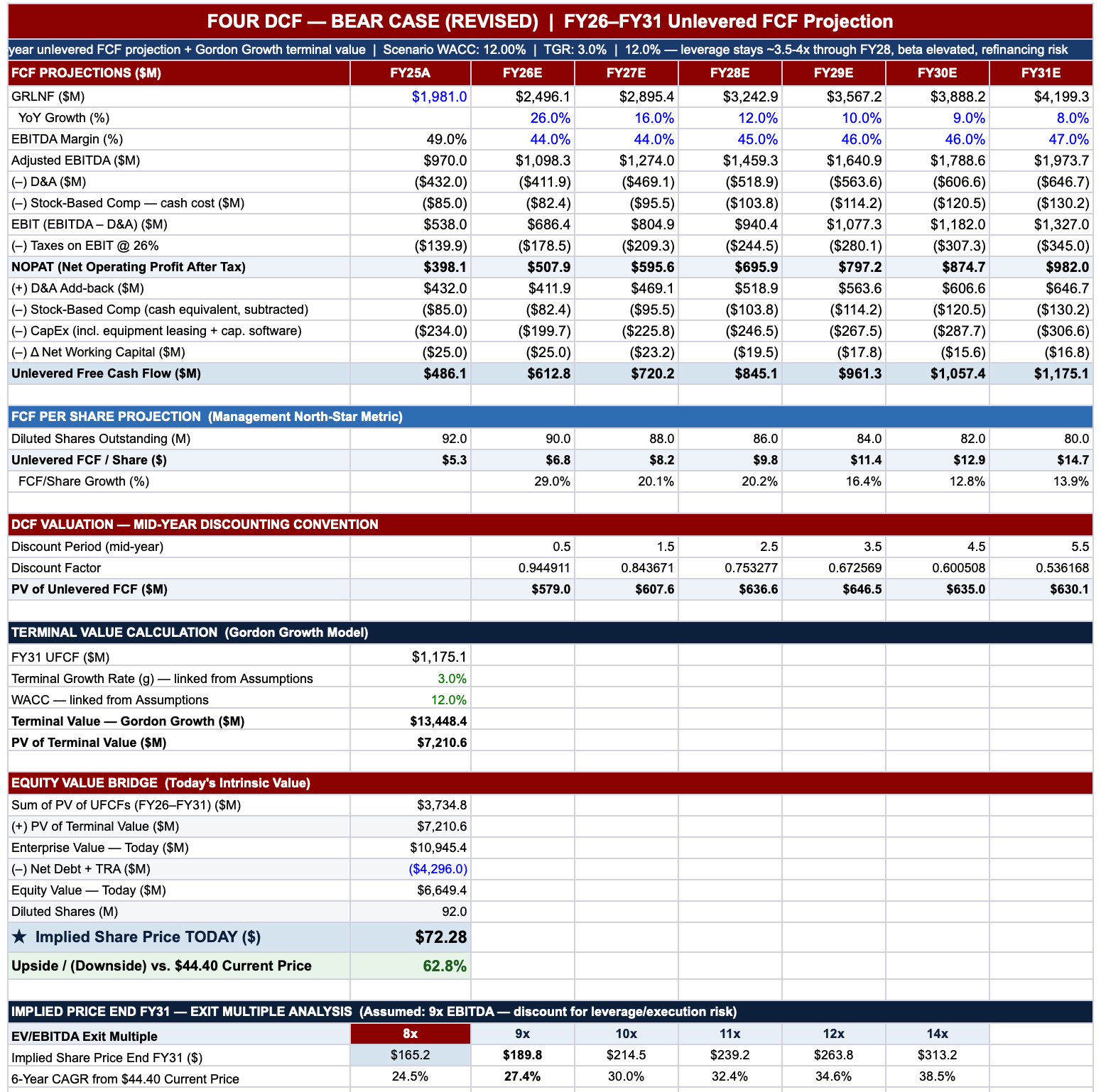
Even with the bear case where I modeled that the Global Blue integration will become a complete flop and debt is going to eat the company’s earnings, I still get a massive margin of safety despite those risks.
The Bull case is irrelevant to share because I don’t want to sound too bullish about the company :)
Final Thoughts
I hope I was able to provide a clear explanation of the company and share why I think it’s a compelling investment.
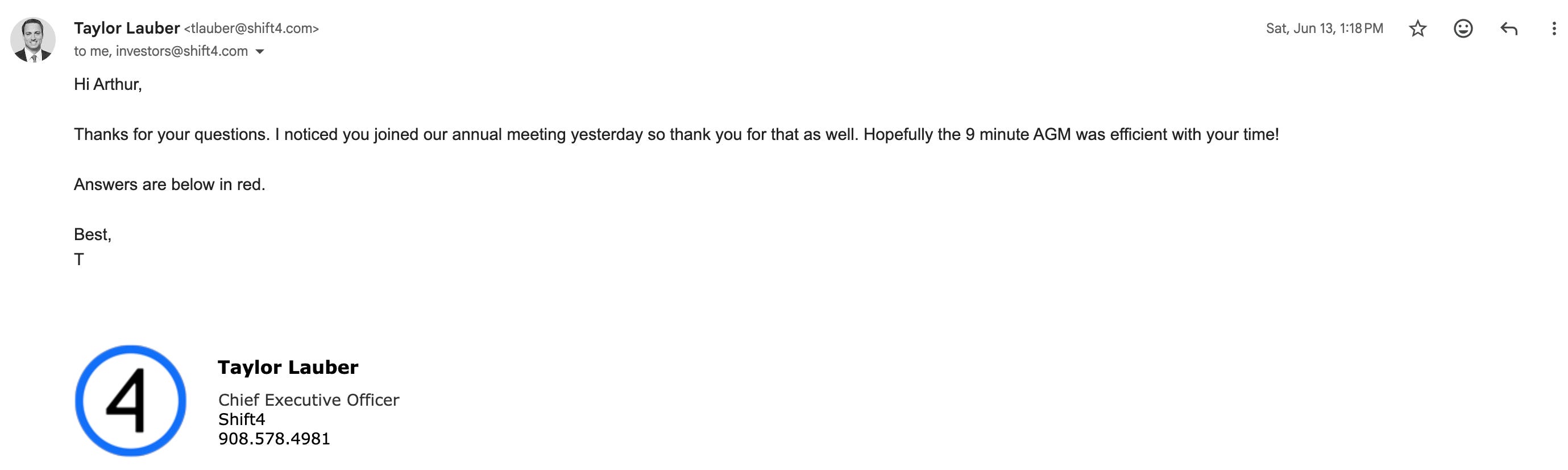
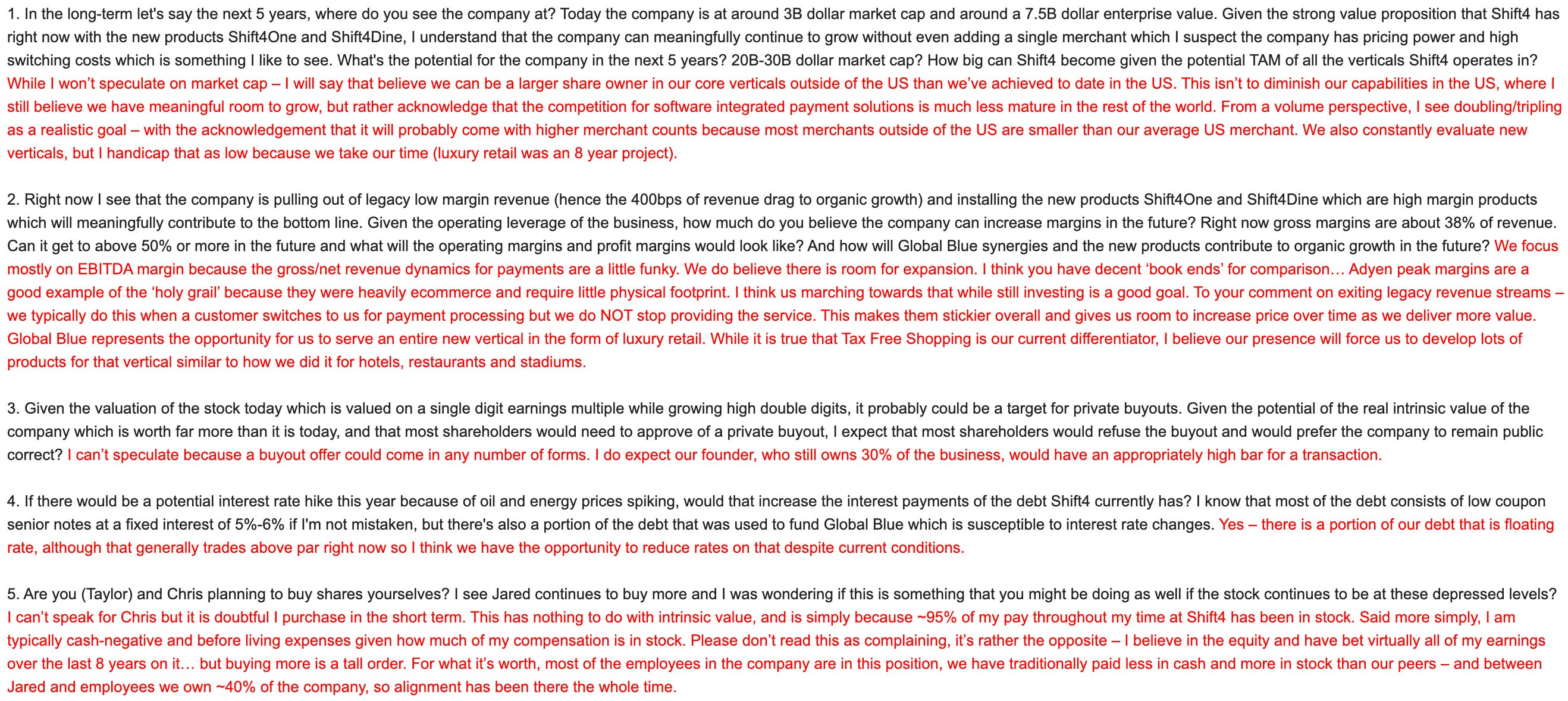
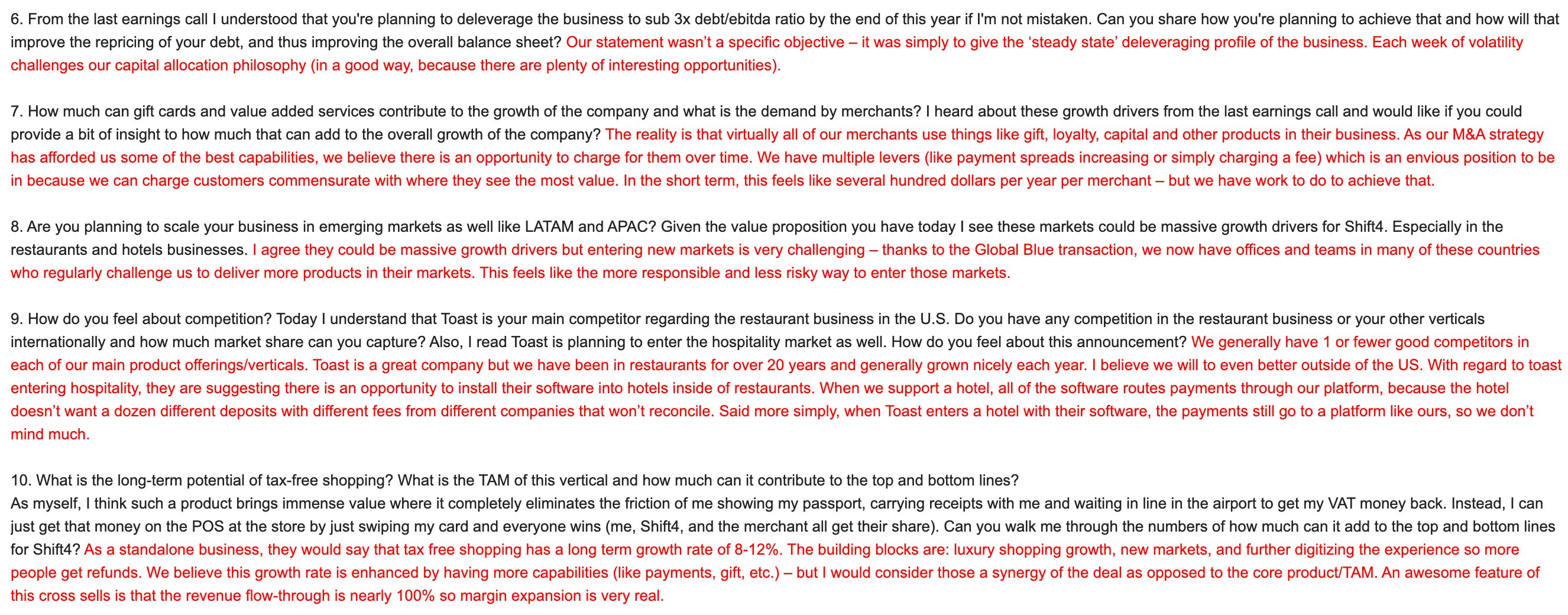
I want to close this piece by highlighting some specific questions I personally asked Taylor—addressing the exact areas where I found most investors had the greatest concerns. I want to sincerely thank Taylor for being so candid with his answers. I have strong conviction that Taylor and CFO Christopher Cruz will successfully navigate the company along the right path and continue delivering significant value for long-term shareholders.
If you enjoyed this deep dive, please consider liking this post and leaving a comment with your thoughts on Shift4. If there’s any wrong information in the article please let me know so that I can apply the fixes needed.
Disclaimer: I own shares of Shift4 at a $44 cost basis. This is not financial advice, nor am I telling you to buy the stock. You must do your own due diligence and determine for yourself if you are comfortable investing in this company given its debt profile and international integration risks.
From what I have read so far fantastic post and am super excited to read the rest.
Am unfortunately super busy currently so leavinging a comment here to make sure I get back to it!
Put another way (follow up to my prior quote), if Shift4 earns a HSD ROIC, which is slightly above cost of capital, its worth a modest premium to invested capital. Its invested capital is approx $7B. If their small ROIC spread justifies a slight premium, say theyr'e intrinsically worth 1.15x invested capital = $8B. Less net debt, the company should be worth about $3.5B.
Exactly where it trades today.
Market isn't missing it by a wide mark here.