
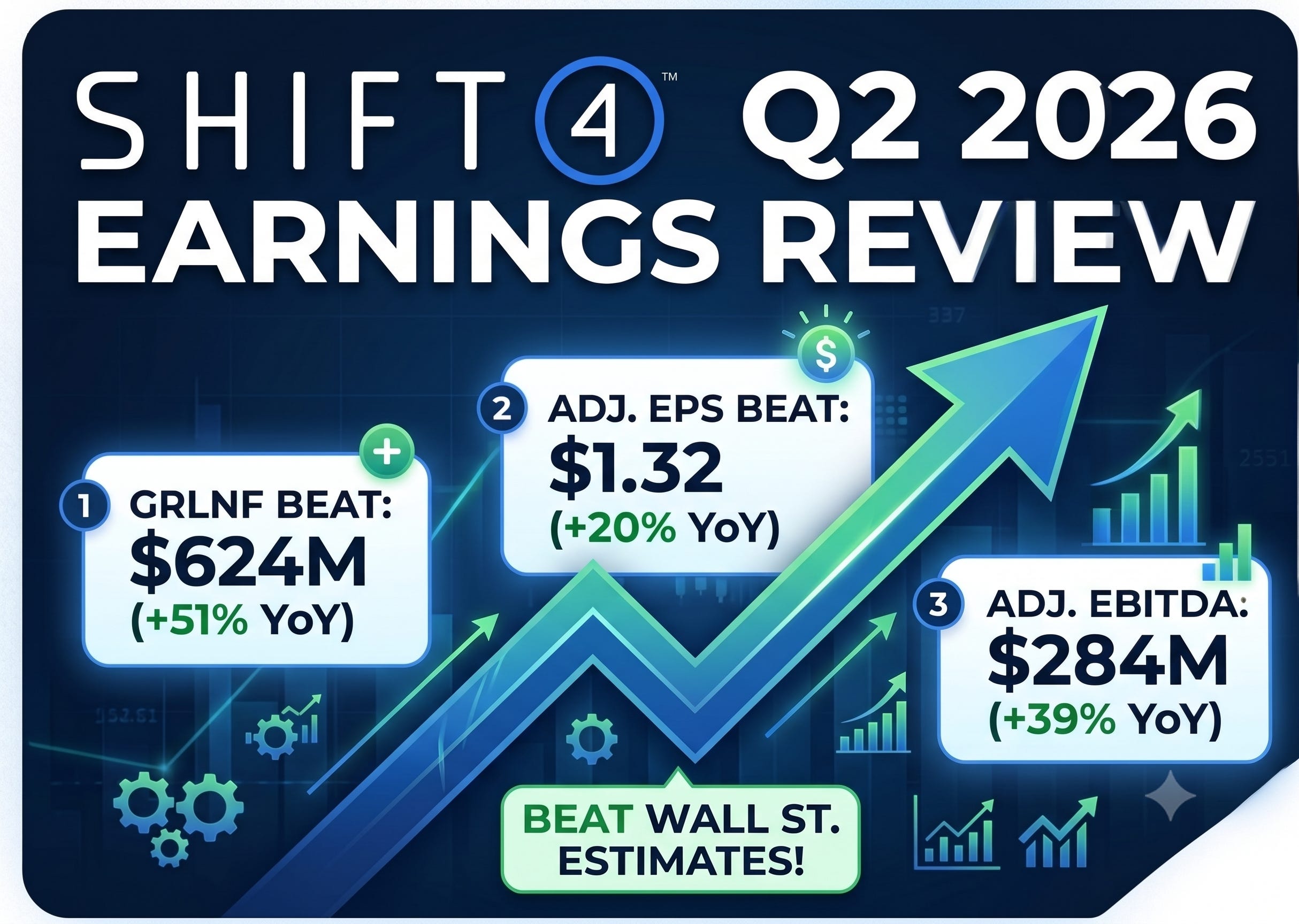
I’ll be frank, the report was pretty okay. Shift4 management did beat on all the metrics for Q2:
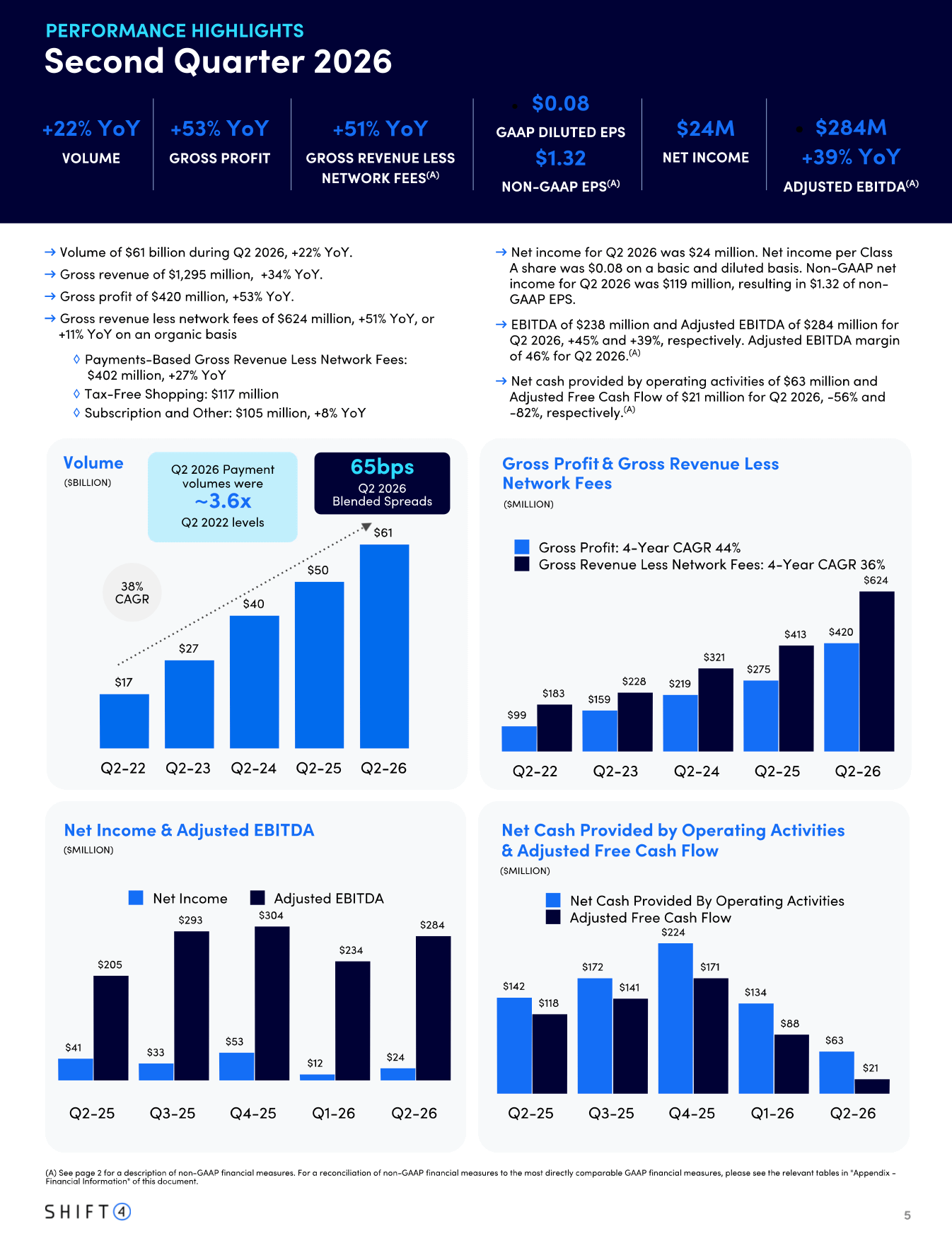
Earnings Results:
🔹 Revenue: $1.3B (Est. $1.24B) 🟢; +34% YoY
🔹 Adj. EPS: $1.32 (Est. $1.25) 🟢; +20% YoY
🔹 Adj EBITDA: $284M (Est. $275M) 🟢; +39% YoY
🔹 GRLNF: $624M (Est. $614.34M) 🟢; +51% YoY
🔹 Gross Profit: $420M; +53% YoY
🔹 Adjusted EBITDA Margin: 46%
🔹 Net Cash From Operations: $63M; -56% YoY 🔴
🔹 Adjusted FCF: $21M; -82% YoY 🔴
Segment Net Revenue:
🔹 Payments-Based GRLNF: $402M; +27% YoY
🔹 Tax-Free Shopping: $117M
🔹 Subscription & Other: $105M; +8% YoY
Volume is very healthy growing 22% YoY. Gross profits grew 53% YoY, highlighting the operating leverage inherent in the business as top-line gains increasingly flow down to the bottom line. So far the results were good this quarter.
The operating cash flow and adjusted free cash flow going down is not great to see at all. But Management highlighted that 2026 is a heavy investment year. Capital spending and integration costs are front-loaded to support rapid international expansion (such as scaling Shift4 One into 15 countries) and major product launches like Shift4 Dine in new markets. So, once the integration of Global Blue is complete, operating cash flow and adjusted free cash flow should ramp up.
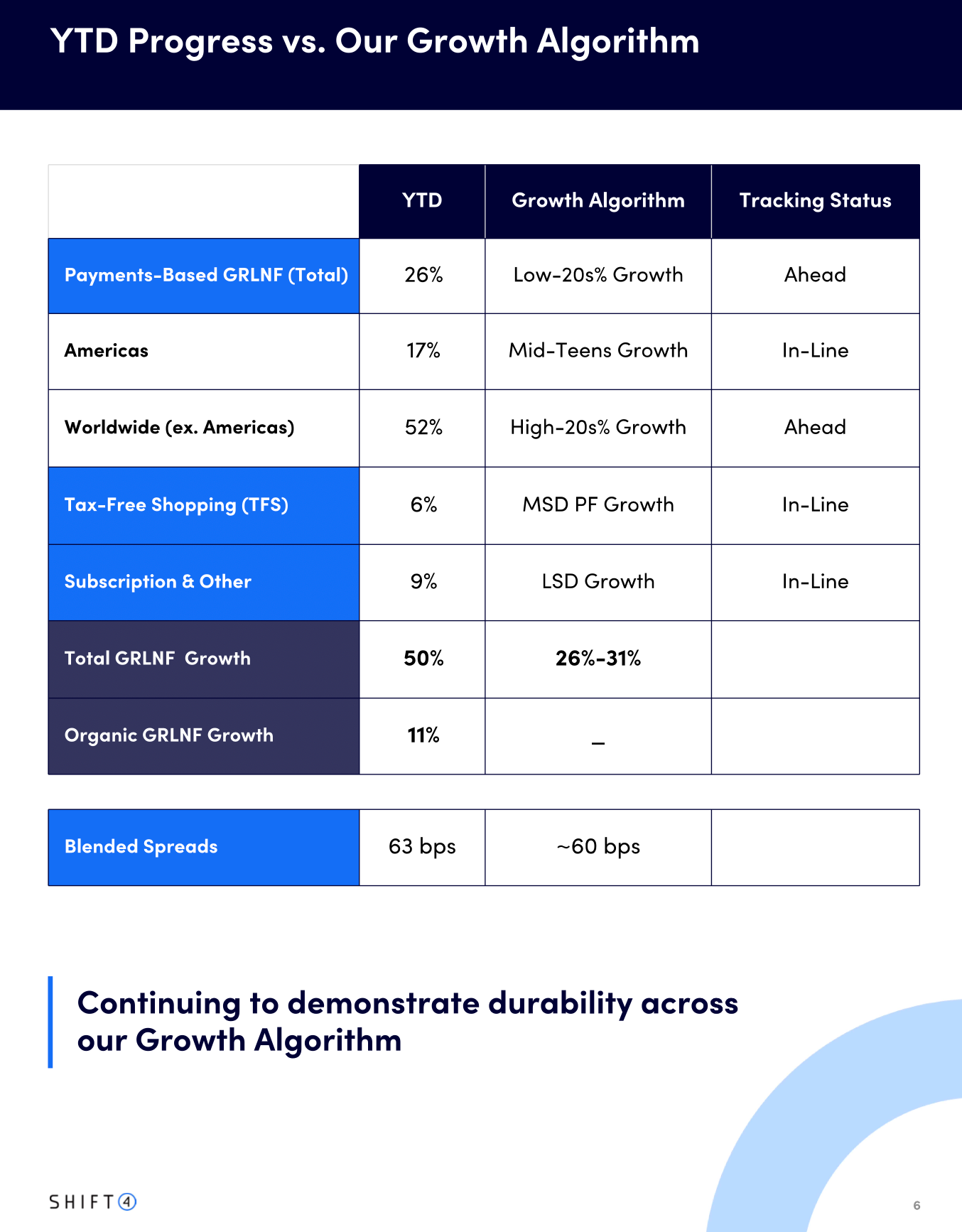
Looking at the broader Q2 print, management is largely tracking at or above its target growth algorithm. Gross Revenue Less Network Fees (GRLNF)—essentially Shift4's gross profit after paying network fees to Visa and Mastercard—grew over 20%. Geographically, the Americas expanded by a solid 17%, while Worldwide revenue surged 52%. That said, performance wasn't uniform across every segment: Tax-Free Shopping was somewhat soft at 6% growth, and Subscription revenue came in at a modest 9%. Overall organic growth landed at a steady, if uninspiring, 11%—neither a runaway success nor a cause for concern, but a stable baseline nonetheless.
So the numbers look strong on the surface and just from these numbers the stock should’ve gone up right? Well…
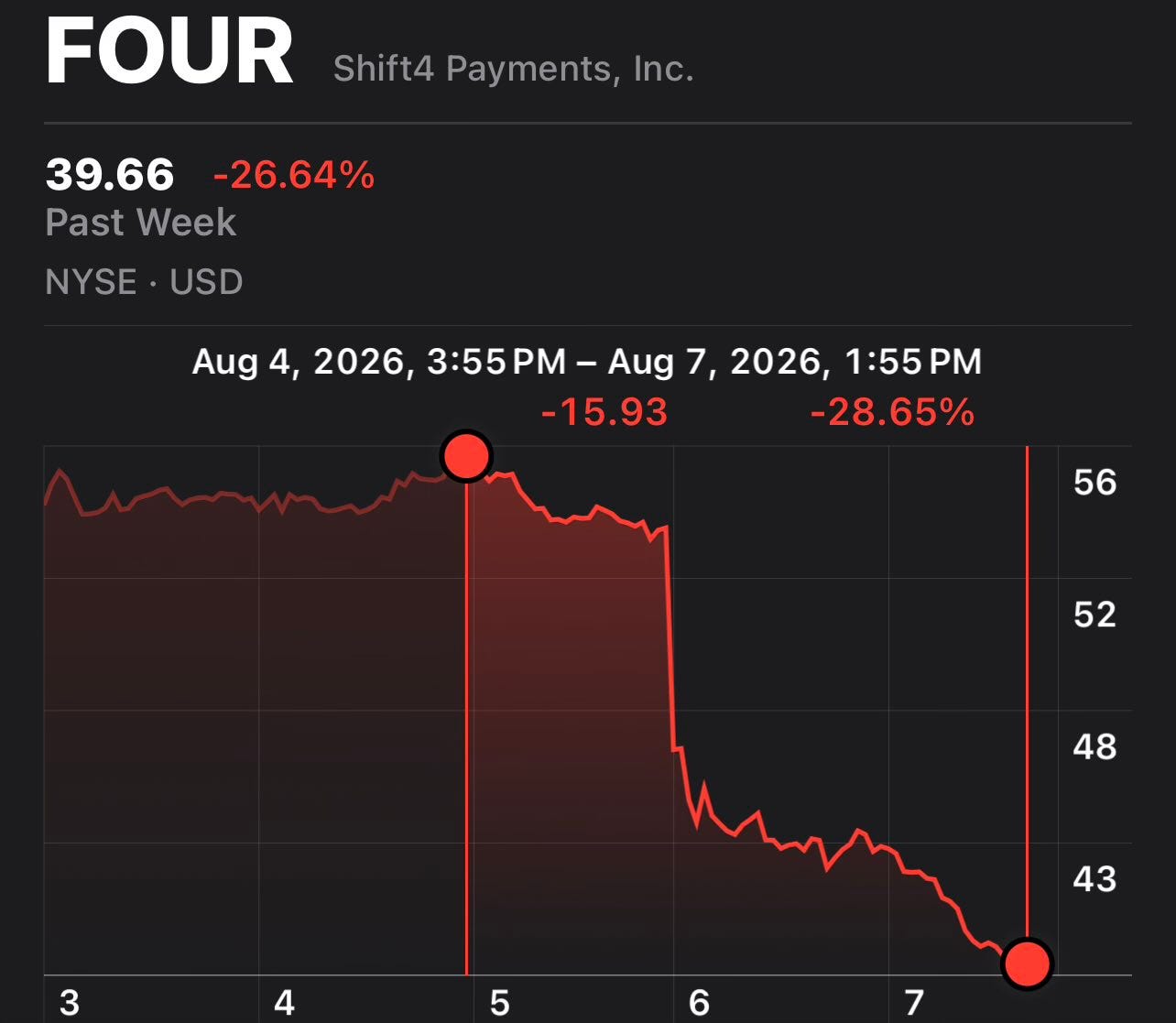
The market clearly didn’t like the results Shift4 delivered and as investors we need to understand what the market sees that we’re missing and whether it makes sense for the stock to drop like that or not. I personally think the stock did deserve to drop. Not sure if it deserved to drop this much, but it definitely did not deserve to go up.
So, why did the stock tank? Usually it has to do with guidance so let’s have a look what Shift4 guided for FY26:
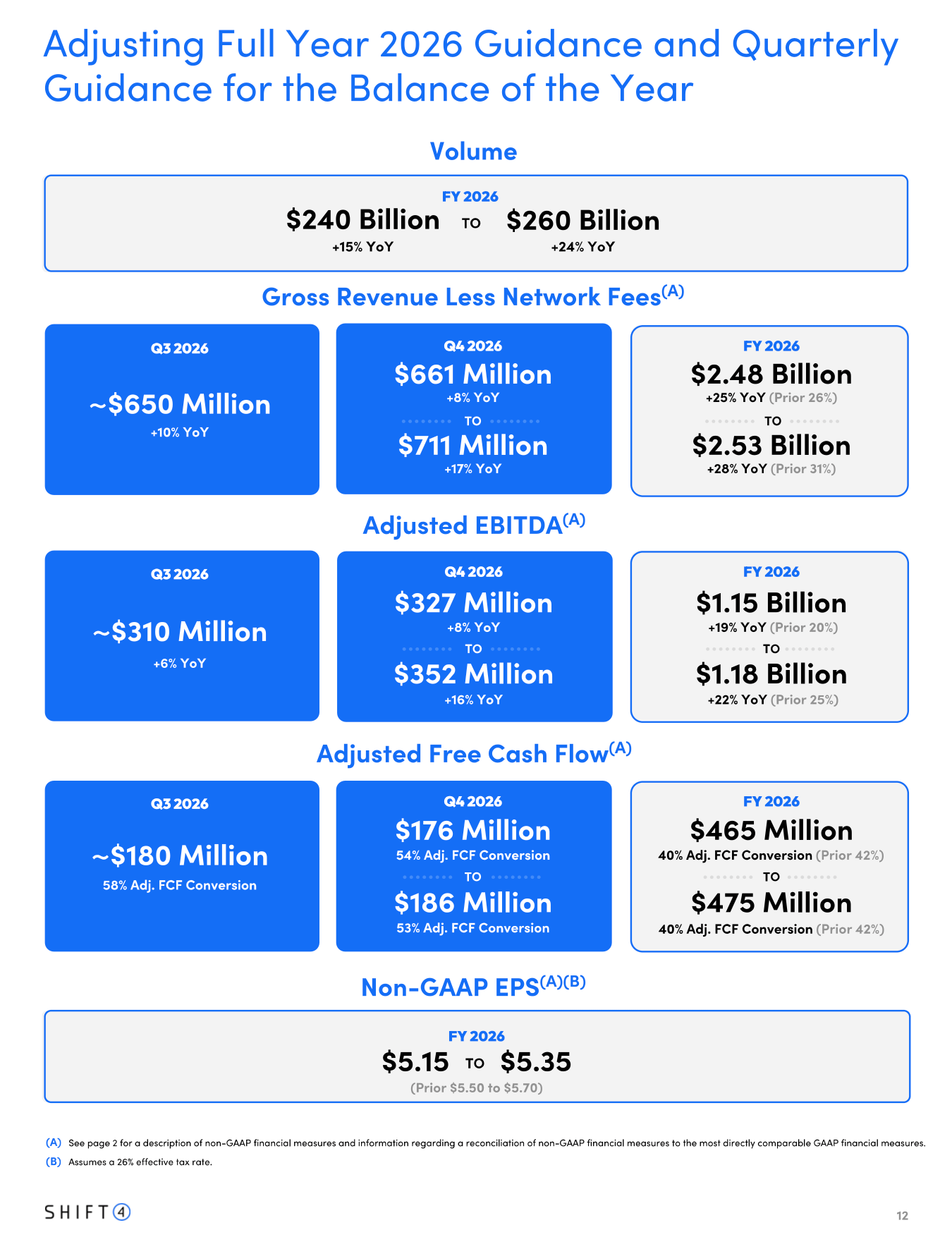
You see the first problem here. Management lowered guidance for the full year of 2026. Although the guidance was not lowered that drastically, it is the second time they lowered guidance this year which is not ideal at all.
🔹 Adj. EPS: $5.15-$5.35 (Est. $5.56) 🔴
🔹 Volume: $240 Billion-$260 Billion 🟢;
🔹 Gross Revenue Less Network Fees: $2.48 Billion-$2.53 Billion 🔴; (Est. $2.50 Billion-$2.60 Billion)
🔹 Adjusted EBITDA: $1.15 Billion-$1.18 Billion 🔴; (Est. $1.165 Billion-$1.215 Billion)
🔹 Adjusted Free Cash Flow: $465 Million-$475 Million 🔴; (Est. $490 Million-$510 Million)
Here are a few words from Taylor Lauber the CEO of Shift4 to shareholders:
Dear Fellow Shareholders,
The second quarter of 2026 reinforced three themes: the durability of our growth, the global appetite for our products, and the strength of our position at the center of the experience economy. Each of these themes showed up clearly in our results, and should give conviction as to the plan we’ve been executing successfully against.
Shift4 was center stage during the quarter as over a million fans visited the U.S. for the World Cup and experienced our technology at thousands of restaurants, hotels and every match venue in the U.S. and Canada. High volume and most importantly, in-person, payments demand innovative and resilient technology and expertise across myriad operating models. I’m proud to say that both our products and team executed flawlessly.
In addition, our international expansion continues to scale nicely, even against the backdrop of ongoing Middle East-related travel disruptions. We are having tangible success expanding our Shift4 One product into more markets across Europe and remain on track to be live in a total of 15 countries by the end of this year, with 12 countries live today. As a reminder, Shift4 One allows retailers to consolidate payments, tax-free shopping, and dynamic currency conversion capabilities within a single device. This takes what would otherwise be a complex process spanning multiple vendors and lots of human intervention and simplifies it into a simple hand-held device where we can deliver the entire value chain to both our customer and the consumer. And in what is truly the Shift4 way, we also launched Shift4 Dine in Spain and Australia.
In terms of quarterly results, here are some highlights:
Gross revenue was $1.3 billion, up 34% year over year; Gross revenue less network fees was $624 million and gross profit was $420 million, up 51% and 53% year over year, respectively. When adjusting for acquisitions and divestitures, our organic growth was 11% year over year.
Net income was $24 million for the quarter. EBITDA was $238 million and Adjusted EBITDA was $284 million. Each was up 45% and 39% respectively.
Lastly, net cash from operating activities was $63 million and Adjusted Free Cash Flow was $21 million.
These results underscore the increasing diversity of our business and the durability of our growth.
Our north star remains payments-based revenue less network fees, which grew 27% this quarter. That combination of both great products and disciplined capital allocation continues to be the engine behind our results.
We are often asked about why a merchant chooses Shift4 and the answer is how we deliver in the moments that matter. The businesses we serve span many verticals but ultimately want their customers to have a great in-person experience. We help them deliver that and have a lot more work to do around the globe.
As I noted last quarter, we are not immune to the ongoing conflict in the Middle East, and our thoughts remain with those in harm’s way. The conflict continues to have a meaningful negative impact on tax free shopping albeit with slightly more positive performance in Q2 than originally anticipated. We expect that will continue as the conflict persists and are revising our guidance to reflect the likelihood of continued travel disruption in the upcoming third quarter. To that end, we are lowering the midpoint of our full-year 2026 Gross Revenue less Network Fees by ~200bps to reflect approximately $25 million of Middle East influenced travel disruption in the upcoming third quarter and roughly $20 million of FX translation impact. We’ve also included the impact of our recent financings in our free cash flow and earnings per share guidance.
This guidance update reflects what I believe is appropriate caution related to the ongoing travel disruption; however, they are also quite temporary in their nature. We remain confident in the long term growth and durability of the Tax Free Shopping business, and excited about the large opportunity in front of us to combine payments and tax free shopping across luxury retail and the broader experience economy.
This explains why the stock took a hit after the print. Lowering guidance for a second time is never a good look, even if the cut itself was fairly small. The issue stems from the Middle East conflict causing travel disruptions, which directly drags on the Global Blue business. For anyone invested in Shift4, that’s a real risk to keep in mind—if international travel softens, the business suffers, and that’s something management simply can’t control.
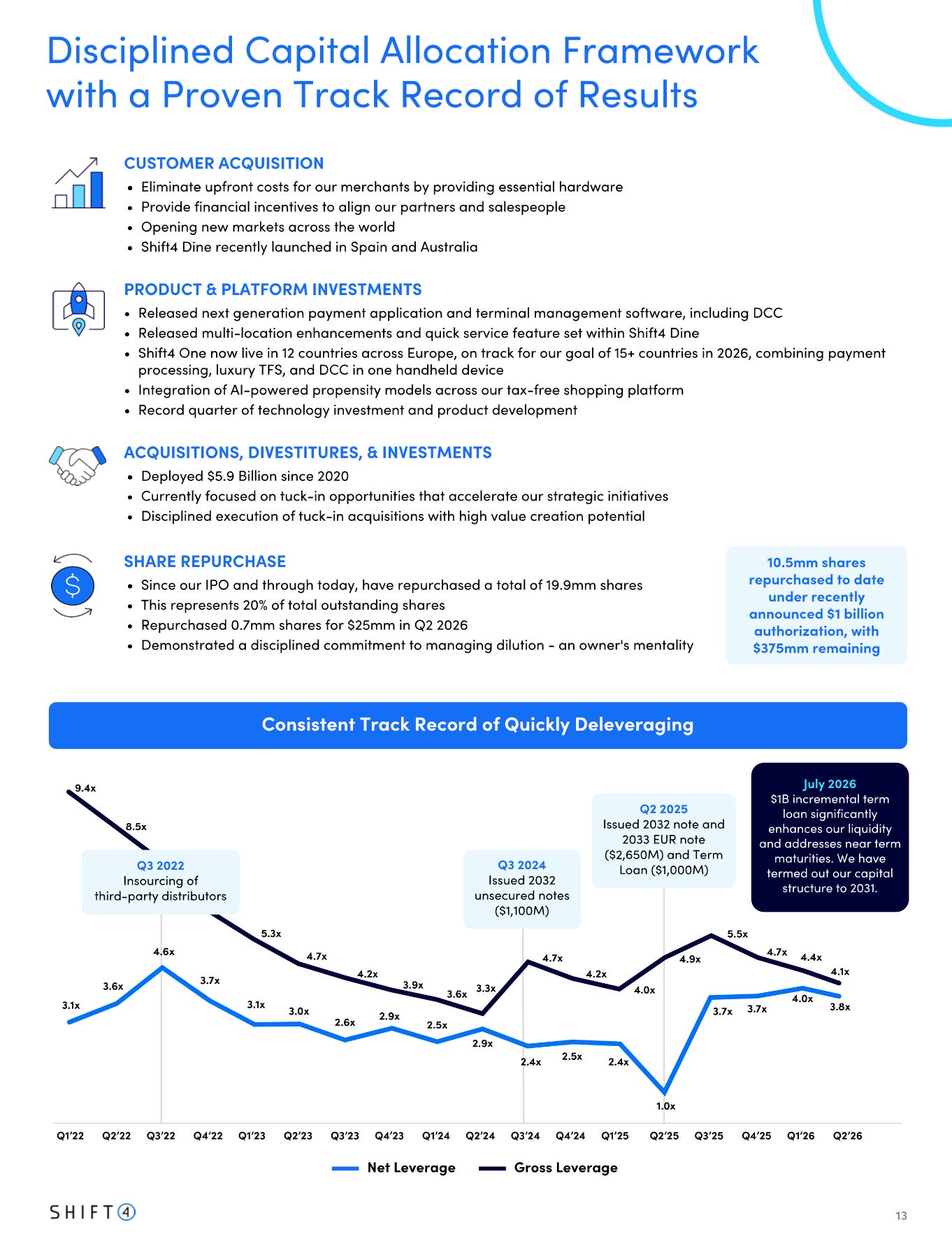
Another issue is that net leverage barely ticked down. Sure, progress is better than nothing, but it remains a stretch from management’s stated target of reaching ~3.0x by the end of 2026—and they only have two quarters left to get there.
But the biggest red flag—and what I think truly spooked the market—was the share buyback activity. Management repurchased just 0.7 million shares for $25 million at an average price of around $38. This is genuinely concerning. When the stock was trading below $40, it was the ideal opportunity to deploy capital aggressively. The fact that management didn’t have the cash reserves to capitalize on that discount is actually the main reason I exited my entire position at $51 as soon as I read the report. It immediately signaled a red flag to me, and I knew the market would punish the stock heavily—which, in hindsight, proved to be the right call.
Looking back at their capital allocation history, ever since launching that $1 billion buyback program, management nearly depleted their entire cash reserves to buy back stock—and unfortunately, they did so at much higher prices than where the stock trades today:
Q4 2025 (Nov-Dec under the $1B program): 4.35M shares at $70.06 avg, $305M spent.
Q1 2026: 5.485M shares at $53.82 avg, $295M.
Q2 2026: 0.652M shares at $38.32 avg, $25M.
No further reported activity in Q3 2026 yet. $375M remains available.
In only two quarters, management spent over half of the authorized buyback funds at significantly higher prices, leaving them unable to aggressively buy back shares once the stock dropped below $40. And since short sellers are aware of this information, they have nothing to worry about a short squeeze for the next 3 months till Shift4’s next earnings.
Let’s look at their current balance sheet:
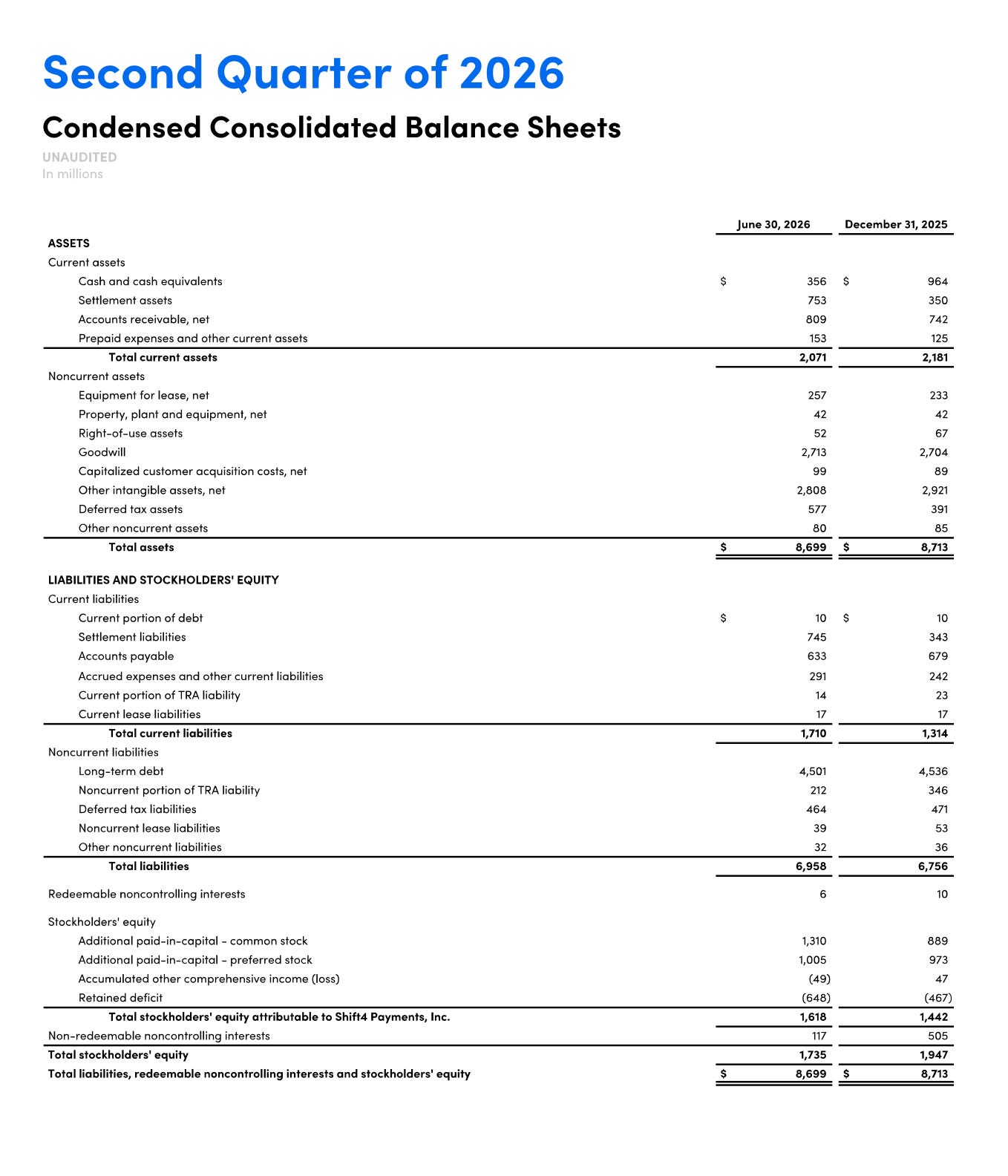
1. Cash Position & Liquidity
Cash Depletion: Cash and cash equivalents fell sharply from $964M at year-end 2025 to $356M in Q2 2026—a $608M cash draw down (-63%).
Settlement Assets & Liabilities: Settlement assets rose from $350M to $753M, matching a similar increase in settlement liabilities from $343M to $745M. This reflects higher processing volume held in transit around quarter-end rather than usable cash.
Working Capital Compression: Total current assets fell to $2,071M while total current liabilities expanded to $1,710M (driven mostly by settlement obligations). This squeezed net working capital from $867M down to $361M.
2. Debt & Capital Structure
Long-Term Debt Load: Long-term debt remains heavy at $4,501M (down slightly from $4,536M in December 2025). Current portion of debt sits at $10M.
TRA Liabilities: The Tax Receivable Agreement (TRA) liabilities decreased across both current ($14M vs. $23M) and noncurrent portions ($212M vs. $346M), reflecting ongoing settlements or tax adjustments.
3. Intangible Heavy Balance Sheet
Goodwill & Intangibles: Goodwill sits at $2,713M and other intangible assets total $2,808M.
Asset Base Concentration: Combined, goodwill and intangibles equal $5,521M, accounting for ~63.5% of total assets ($8,699M). This reflects Shift4’s aggressive historical M&A activity (including Global Blue and other roll-ups).
4. Equity & Retained Deficit
Retained Deficit Widens: Retained deficit expanded from -$467M to -$648M, reflecting net income items and accounting adjustments over the six-month period.
Stockholders’ Equity: Total stockholders’ equity attributable to Shift4 rose from $1,442M to $1,618M, primarily driven by additional paid-in capital expansion. However, total stockholders’ equity (including noncontrolling interests) contracted from $1,947M to $1,735M as non-redeemable noncontrolling interests decreased from $505M to $117M.
The primary drawdown in unrestricted cash explains why management was unable to deploy meaningful capital into share repurchases below $40—they simply didn’t have the cash reserves left after earlier allocations.
With pro forma net leverage sitting at 3.7x and target leverage at ~3.0x by year-end 2026, management has limited room for error. Any headwinds to top-line organic growth directly impair their ability to meet that leverage target.
Given that over 60% of assets sit in goodwill and intangibles, driving cash conversion out of recent acquisitions (like Global Blue) is critical to restoring cash reserves without resorting to dilutive capital raises or further debt issuance.
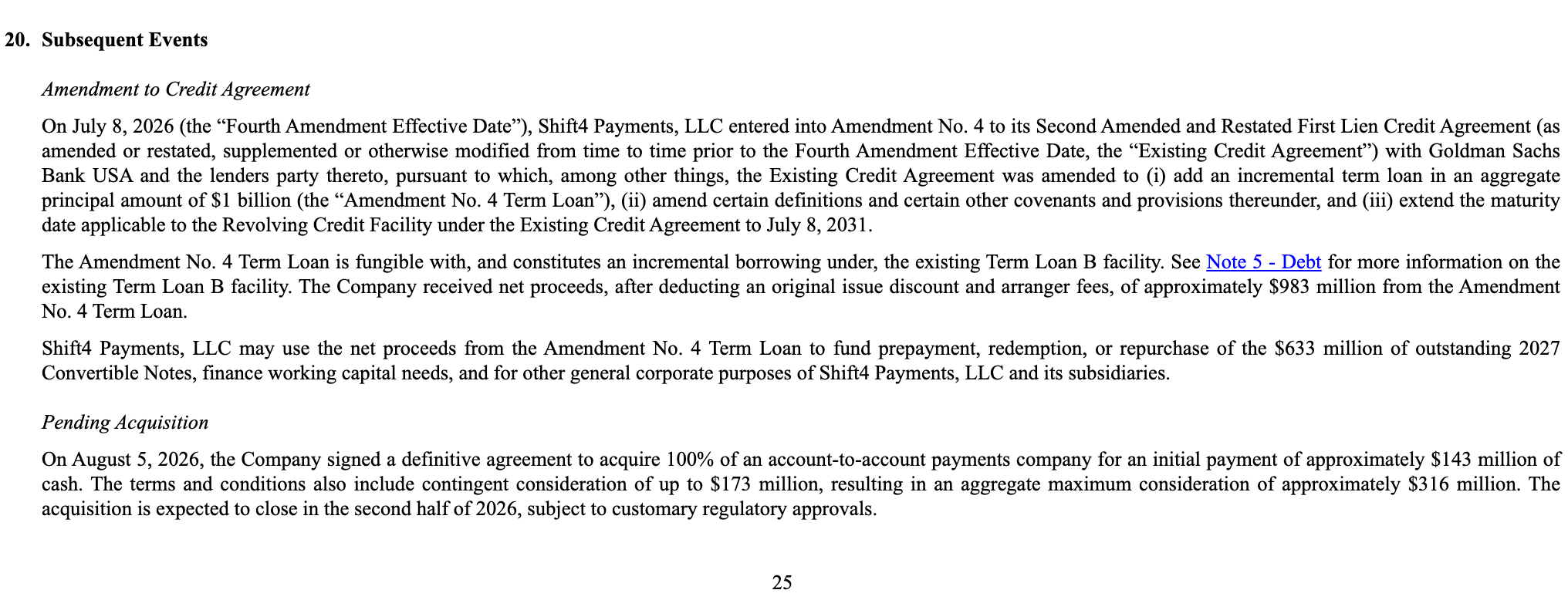
Another key takeaway is that management is continuing its playbook of tuck-in M&A. On August 5th, 2026, Shift4 agreed to acquire an account-to-account (A2A) payments provider. The deal structure requires $143 million in upfront cash, with the remaining $173 million structured as an earn-out tied directly to performance milestones over a set timeframe post-closing.
Account-to-account (A2A) payments bypass traditional credit card networks (like Visa and Mastercard) via direct bank transfers. Buying an A2A provider expands Shift4's capabilities into lower-cost rail alternatives, though spending $143M upfront in cash further tightens their post-Q2 cash balance. It could be massive for Shift4 expanding their overall margins. We’ll have to wait and see how this deal goes through.
All in all, I just can’t bring myself to be bullish on these results. In fact, I’m actually starting to lean a bit bearish—which isn’t a fun conclusion to reach because I genuinely believe Shift4 is a great business with a real competitive moat in the POS space. I still believe in the long-term potential of the company, but only at the right valuation. If the stock pulls back into the $30–$35 range, I’d seriously consider building a position again.
If you want to check out my original investment thesis and how I view the core business long term, you can read it here:
My Investment Thesis of Shift4

In 2026 a lot has happened in the first half of the year. The market has exceeded my wildest expectations about all the things that could go wrong despite having a good investment thesis of buying high quality compounding companies at attractive valuations.
All that said, credit needs to be given where it's due. On the operational front, management is rolling out Shift4 One and Shift4 Dine at an impressive pace—and they may very well be pacing ahead of the full-year distribution milestones they set for themselves.
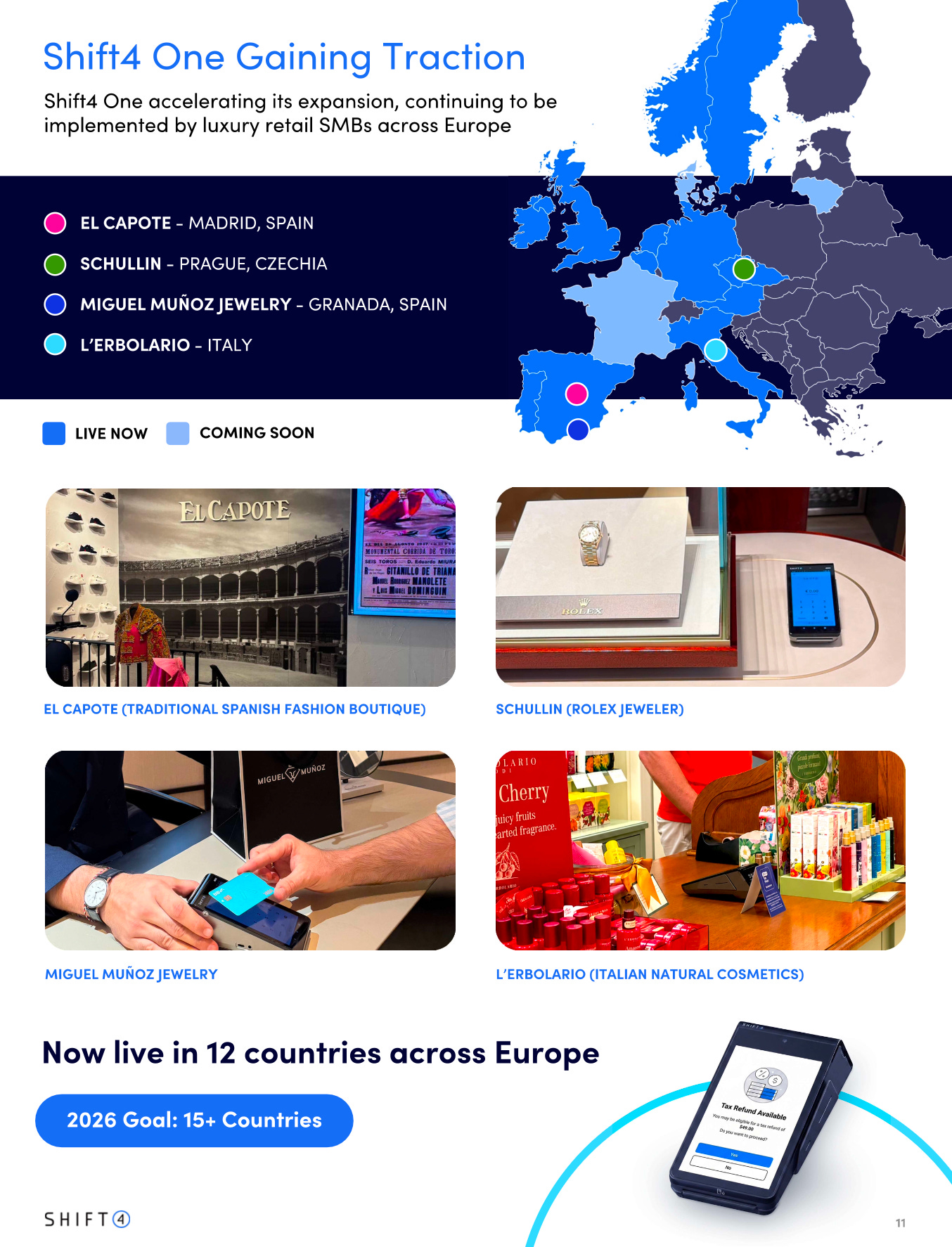
On the product side, Shift4 One is expanding fast. It’s currently live in 12 countries, up from 7 last quarter, putting management well on track to reach their 15-country goal ahead of schedule—likely in Q3. That’s a clear operational win.
I’d highly encourage you to listen to the call or read through the transcript—it gives a solid grounding for where the company is headed into 2027 and beyond. Management clearly views 2026 as a heavy investment phase focused on scaling new products like Shift4 One and Shift4 Dine. On that note, there was one key quote from the call I wanted to share with you:
Taylor Lauber
One thing I want to layer into it, because fully acknowledged, Global Blue is a little bit of a different opportunity than we’ve had in the past. Typically, whether it’s any of the cross-sells I described in Tim’s question, it’s almost an immediate incremental revenue opportunity on an existing customer, and that revenue’s nearly 100% flow through to the bottom line on a net-to-EBITDA basis. One thing that’s different about Global Blue is we are deliberately investing in meaningful sales build-outs across all the countries that they operate in that we see opportunity. That’s because they’re not just going to go after Global Blue retail customers, Global Blue SMB customers. They’re going to offer all of our other products in those countries.
While this early cross-sell motion is great and we’re seeing great momentum, some of the costs associated with that mask what a typical cross-sell might look like. It’s all for the right reasons, and that’s kind of why when we even first signed and announced the Global Blue transaction, we talked about meeting the whole synergy benefit in 2027. It’s because I think it’s very balanced, but it’s an investment year to make sure we have all of the infrastructure we want in these countries and as much of our full product suite available as possible.
Taylor also stated in the earnings call that they’ve 8x the business with only 15% dilution in seven years which is very commendable and impressive nonetheless.
My DCF Estimates
Bear Case:
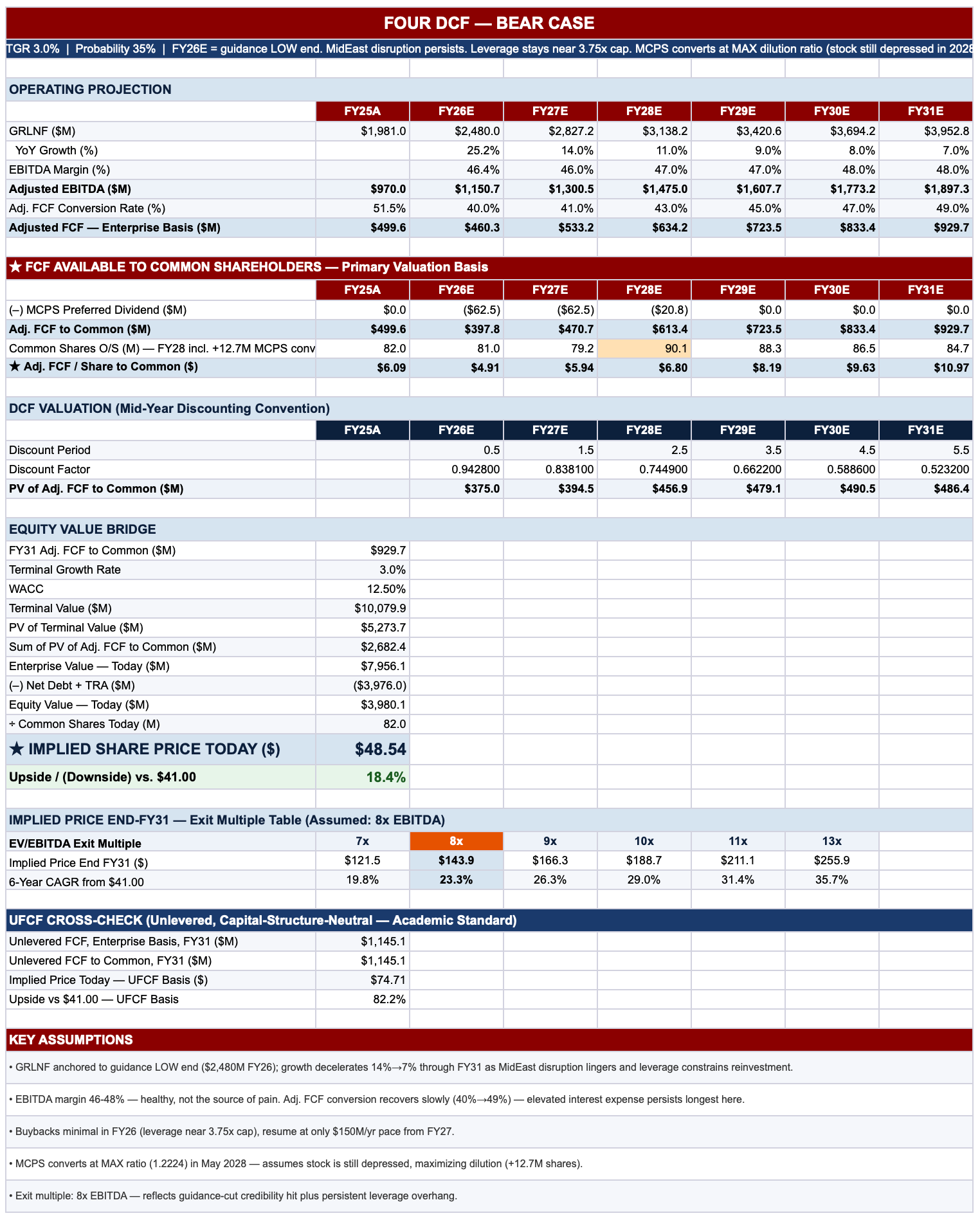
Shift4's Q2 guidance cut wasn't really about growth breaking — GRLNF is still tracking ~26% year-over-year and margins actually held up fine at 46%. What broke is the balance sheet story. Leverage sits at 3.7x, right against the company's own 3.75x ceiling, which forced buybacks to collapse from $295M in Q1 to just $25M in Q2. On top of that, the $1B Term Loan raised to refinance the 2027 convertible notes adds real interest expense, and a mandatory preferred stock conversion in 2028 will add roughly 11-13 million new shares regardless of what the stock does between now and then. In the bear case, none of that resolves quickly — leverage stays elevated through 2028, buybacks stay throttled, and the market keeps charging a steep discount rate for the risk. Even in this case the stock isn't worthless — the underlying business still generates real cash — but the balance sheet drag caps how much of that cash ever reaches shareholders per share.
Base Case:
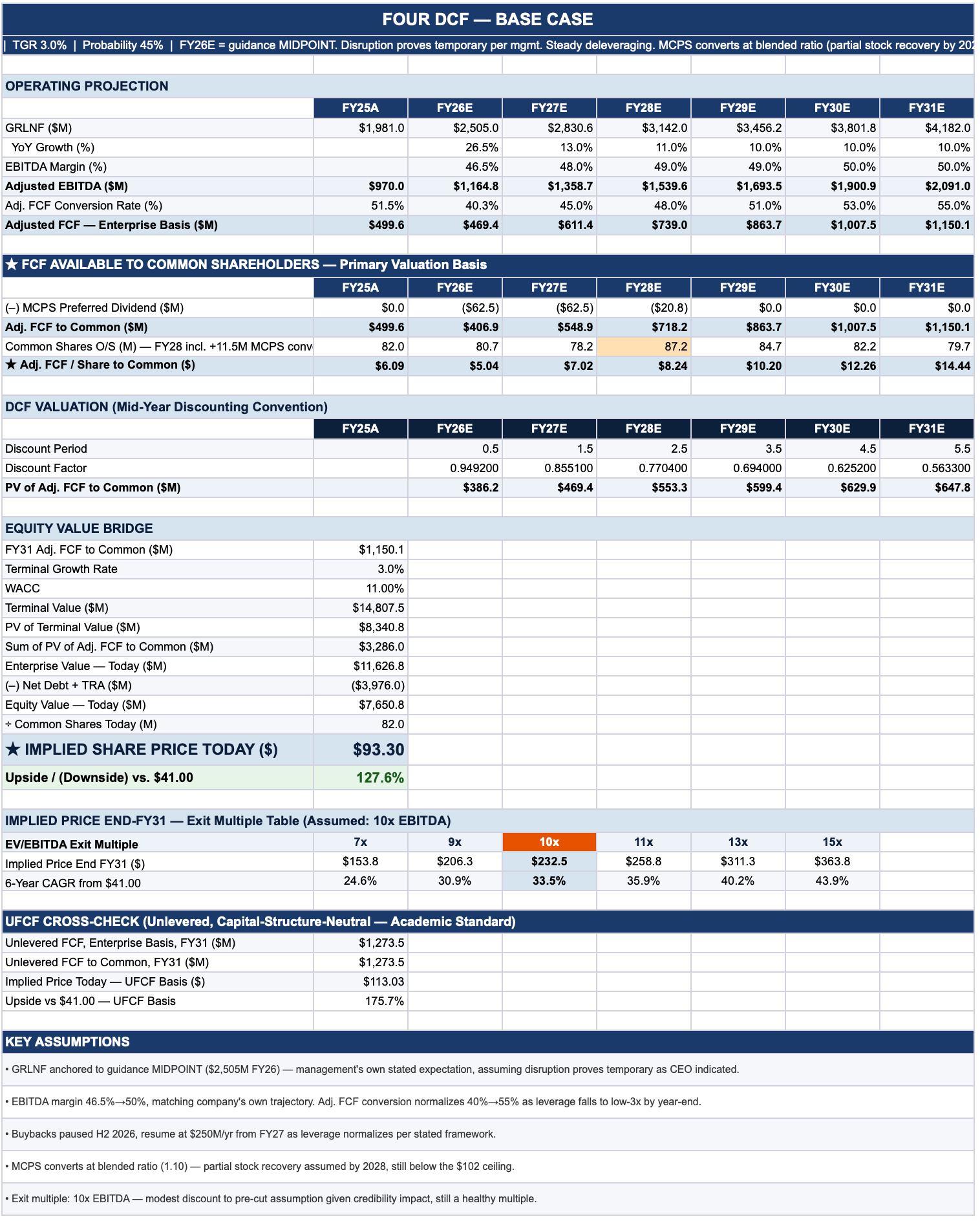
The base case is really just "management delivers what they guided." GRLNF lands at the midpoint of the cut range, margins expand modestly as Global Blue integration matures, and — critically — leverage actually falls to the low-3x range by year-end like management said it would. That's the hinge the whole case swings on: once leverage eases, buybacks resume at a real pace, interest expense stops eating into free cash flow growth, and the market has less reason to apply a distressed discount rate to the stock. None of this requires a growth miracle. It requires the deleveraging path management has already committed to actually happening on schedule.
I’m not adding the Bull Case because it’s clear that execution is lacking at the moment and I personally feel like we’re more closer to the bear case than the base case until I’m proven otherwise by management.
These valuation estimates have only one purpose and that is to give you a rough estimation of what price is an attractive price to buy the stock with enough margin of safety. Keep in mind, this assumes that Revenue, EBIDTA and FCF continue to grow because if the business starts to deteriorate, then the math completely changes here.
Final Thoughts
So there you have it—full synergies from these investments and rollouts aren't expected to materialize in the numbers until 2027. Given the near-term noise, some investors might view this pullback as a chance to slowly accumulate. For me, though, I'm waiting for a wider margin of safety. I’d be much more comfortable accumulating shares in the $30 to $35 range before stepping back in.
Also, I encourage you to read Best Anchor Stocks article regarding Shift4’s earnings as well as he added interesting details from management’s earnings call, what competitors delivered and his overall conclusion about the earnings:

If you enjoyed this deep dive, please consider liking this post and leaving a comment with your thoughts. If there’s any wrong information in the article please let me know so that I can apply the fixes needed.
Disclaimer: This is not financial advice, nor am I telling you to buy the stock. You must do your own due diligence and determine for yourself if you are comfortable investing in this company given its debt profile and international integration risks.
awesome write up as usual Arthur! exiting at $51 was a great call. of course having a good entry at this company when it trades low $40 is a good idea as the company does have potential in the mid-long term, it is just matter of how shift4 handles the debt they are carrying.
Why not use fully diluted share count in your DCF? (Pref dilution)