
Now that all the hyperscalers have reported earnings, we can finally take a breath, zoom out, and reassess the market dynamics surrounding AI.
The hyperscalers have provided a clear look at where the future of compute is heading—and spoiler alert: the AI infrastructure boom is far from over. Demand continues to outpace supply across the board. CEOs across Microsoft, Alphabet, Meta, and Amazon elevated their capital expenditure outlooks to account for rising memory prices and the massive, multi-gigawatt compute buildouts required to secure future supply. The race for compute capacity has become an essential economic imperative—not just for corporate market share, but to ensure U.S. infrastructure keeps pace with global capacity expansion.
Earnings Call Transcripts & Direct Quotes
1. Microsoft — Satya Nadella (CEO)
On Supply-Demand Imbalance & Capacity Buildout: “The situation is clearly that demand still exceeds our available supply... Demand continues to outpace available capacity, and this supply-demand imbalance is not expected to ease in the short term. We added 31 new data centers across five continents this quarter, bringing the total to 88 this year. We added another gigawatt of compute capacity this quarter and remain on track to roughly double our total compute capacity in just two years.”
2. Alphabet (Google) — Sundar Pichai (CEO)
On Compute Constraints & Market Demand: “We are compute-constrained in the near term. Our cloud revenue would have been higher if we were able to meet the demand... We remain supply constrained, which is a sign of momentum... There are many attributes on which we are still at the frontier; there are areas where we’ve acknowledged we need to improve... but Gemini models now process billions of tokens a minute, and enterprise adoption is accelerating rapidly.”
3. Meta — Mark Zuckerberg (CEO)
On Massive Infrastructure CapEx vs. Short-Term Profits: “Current computing power is far from meeting all demand. Simply selling all of our compute capacity for short-term profit would be foolish. We believe the profit margins on selling intelligence will remain significantly higher than directly selling compute capacity. I understand it’s a huge investment and a big bet, but my personal bet is that those who invest in this will be rewarded and feel very good about it over time.”
4. Amazon — Andy Jassy (CEO)
On Rising Memory Costs & Multi-Year Shortages: “Rising memory prices have pushed up our capital expenditure outlook... Even at our expanded CapEx levels, our capacity this year will still be insufficient to meet all demand. I believe this situation will persist into 2027 as well, with notable demand signals already stretching out to 2028. Enterprise customers using AI inference in production applications are still at a very early stage.”
And there you have it.
The infrastructure expansion is in full swing and shows no signs of slowing down anytime soon. Across the board, every hyperscaler delivered solid financial results, with several showing noticeable growth acceleration this quarter.
A quick note before we dive in: this article isn’t meant to be a granular DCF valuation or price-target model. Instead, it’s designed to highlight the latest earnings results, break down the key trends, and map out where the hyperscalers are heading next.
If you’d like to read a more detailed breakdown on Meta or Amazon, I published deep-dive analyses on both companies prior to earnings—feel free to check them out here:
Meta Primed to Surprise the Market

The market has caught many value investors off guard in 2026—and not in a good way. Stock pickers who missed the semiconductor rally last year, or even earlier this year, have likely underperformed the broader market by a wide margin. In fact, many find themselves firmly in the red or, at best, hovering slightly above breakeven.
Why Amazon is the Ultimate ETF Stock

Amazon is widely regarded as one of the most dominant businesses on the planet, with its annual revenue run rate on track to approach 1 trillion dollars by the end of 2028.
Google’s Earnings
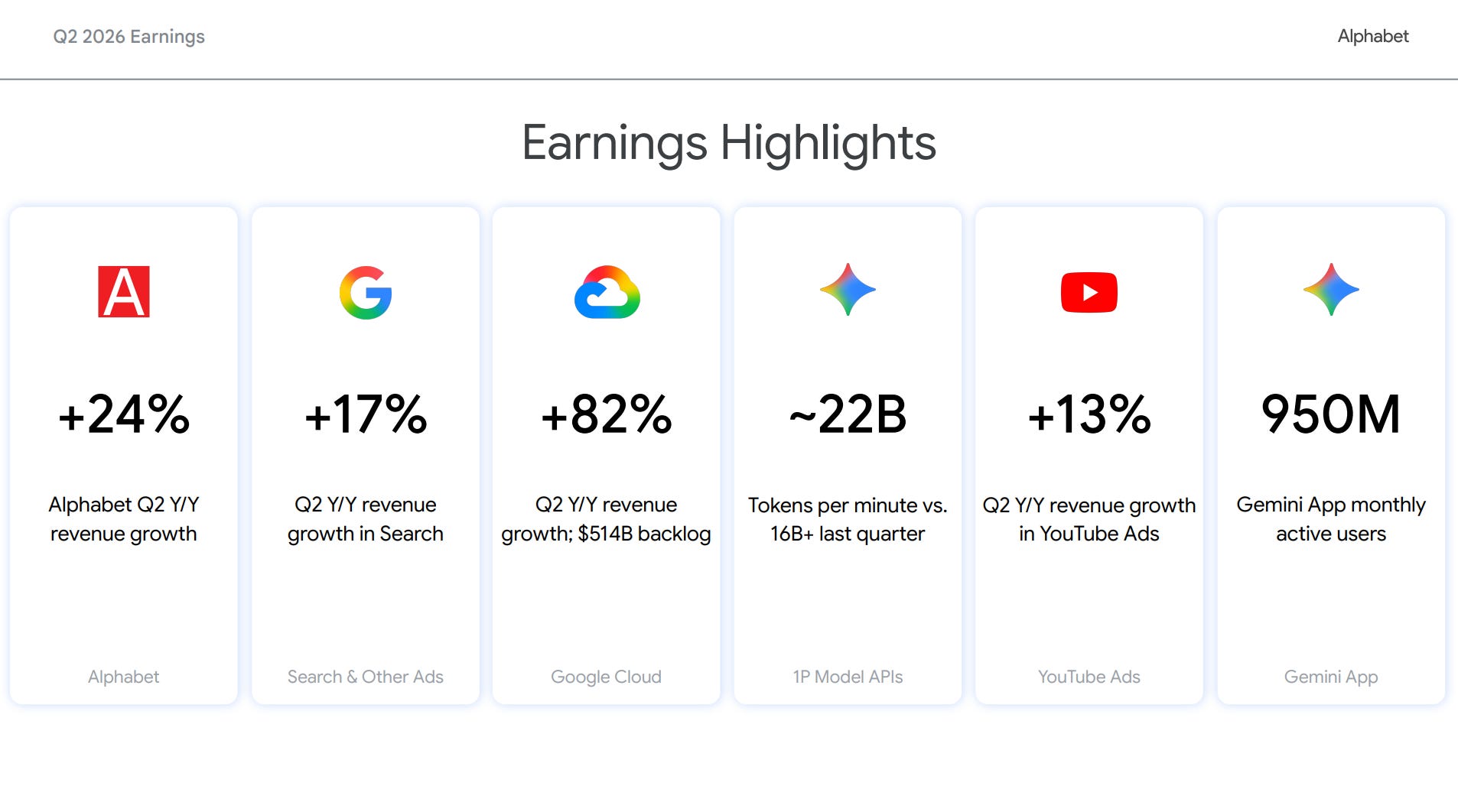
Google was the first of the hyperscalers to report, and there’s really no other way to put it: they delivered a absolute monster of a quarter.
Revenue: Up 24% YoY
Search: Up 17% YoY
Google Cloud: Up a staggering 82% YoY
Gemini: Closing in on 1 billion monthly active users
Google’s Q2 Income Statement:
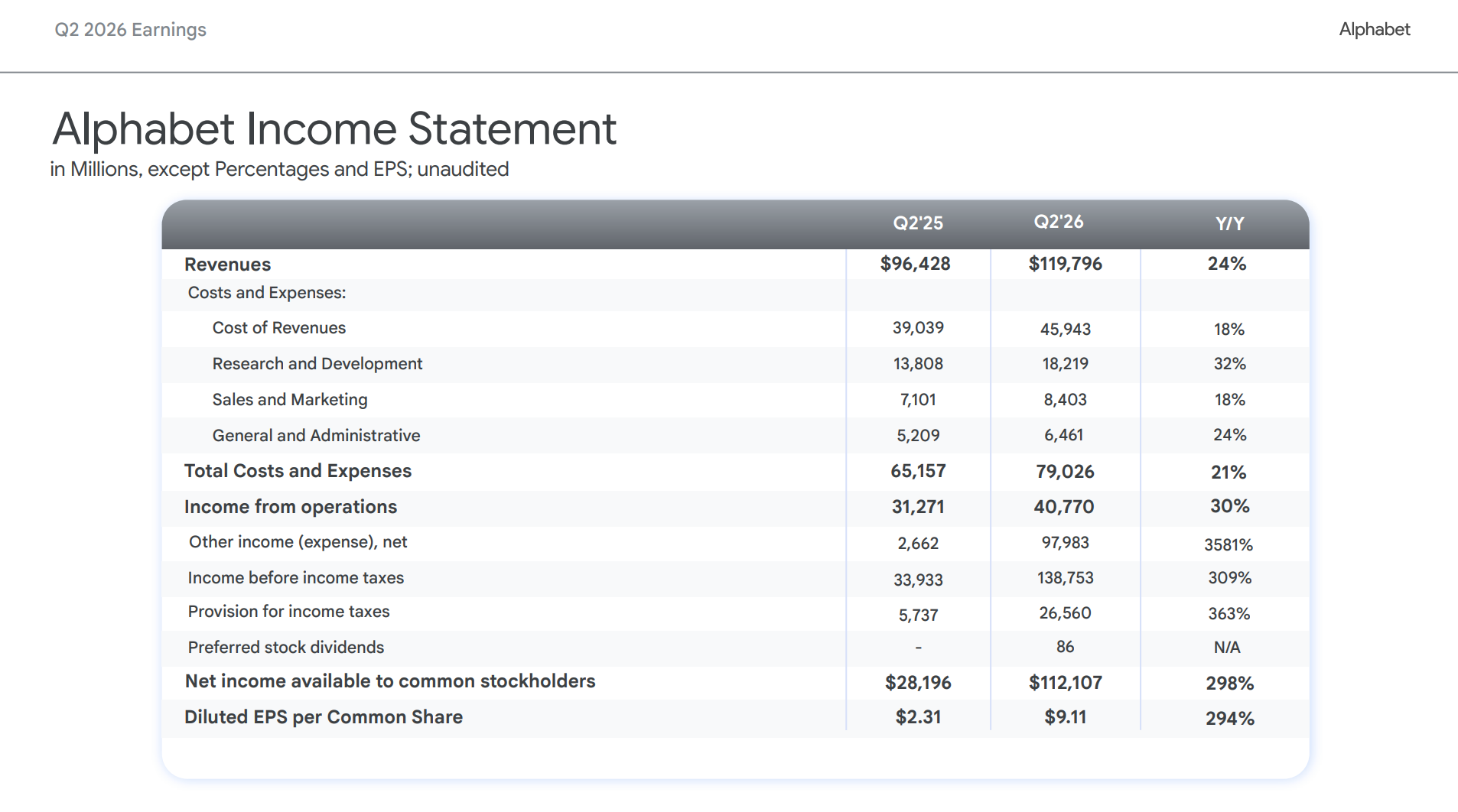
If you ignore the bottom-line explosion for a second and look strictly at operations, Google’s core business delivered solid performance across the board:
Top-Line Growth: Revenue reached $119.79B (+24% YoY), showing strong top-line momentum.
Operating Efficiency: Total costs and expenses grew 21% YoY ($79.03B), expanding slower than top-line revenue (24%).
R&D Acceleration: R&D saw the largest expense spike, jumping 32% YoY to $18.22B, directly reflecting high investments in AI talent and infrastructure development.
Operating Income: Core Income from Operations hit $40.77B, up 30% YoY, pushing operating margins up to 34.0% (up from 32.4% in Q2’25).
In the line of Other income (expense), net Google recorded $97.98 billion in this single non-operating line item—reflecting massive unrealized paper gains on equity securities or valuation adjustments. So just be aware of that.
To see what Google actually earned from running its businesses (Search, YouTube, Cloud, Hardware), we have to strip out the paper gains.
I used Gemini to help me find out what is the actual EPS that was reported instead of the $9.11 of EPS in this quarter which includes the SpaceX unrealized gains.
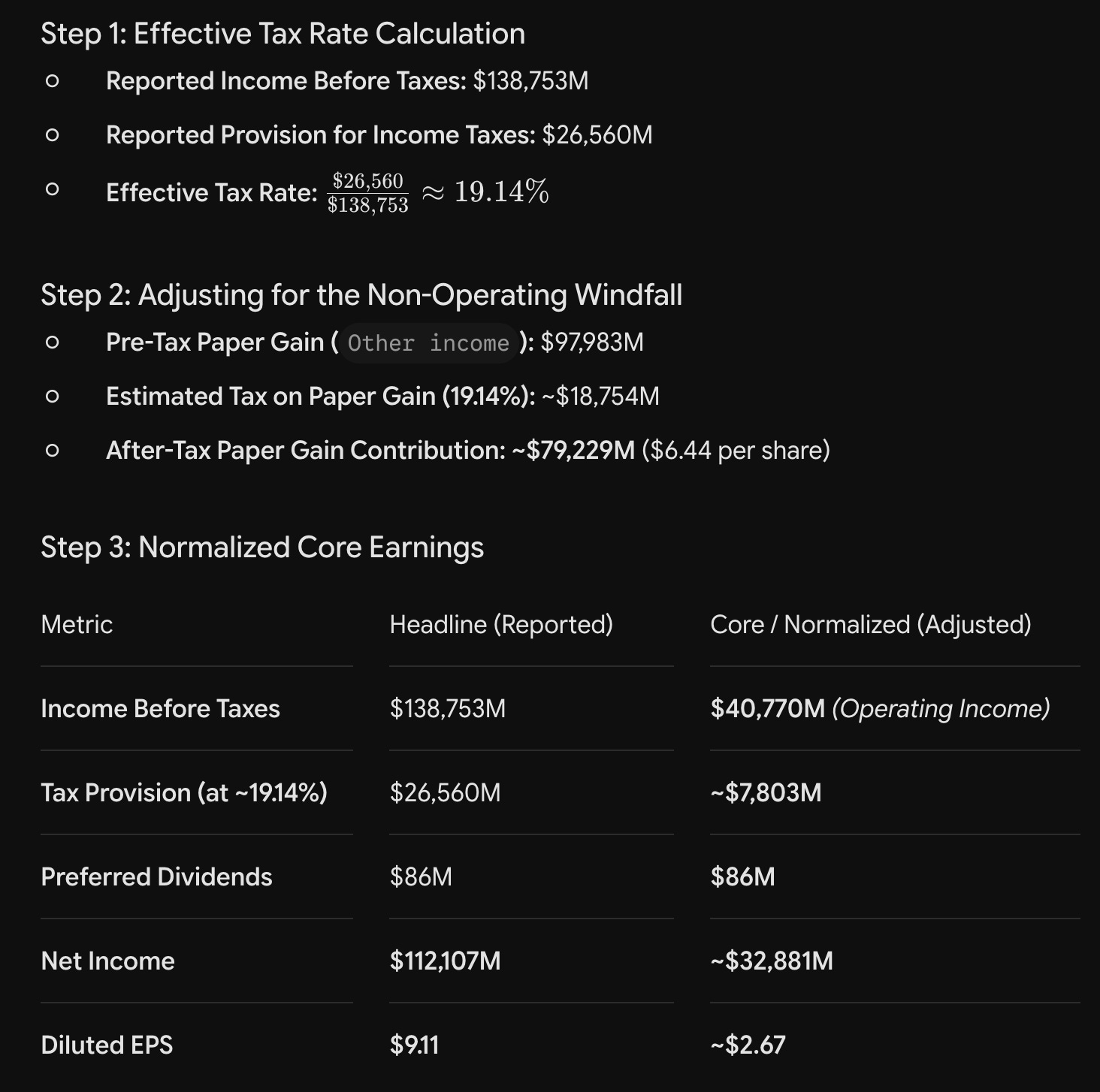
After adjusting for the tax provision on core operating income, Google’s true net income lands at $32.88 billion—or $2.67 in EPS generated directly by the core business. All in all, these results are still stellar in my book, and I’m not losing sleep over the non-cash SpaceX paper gains.
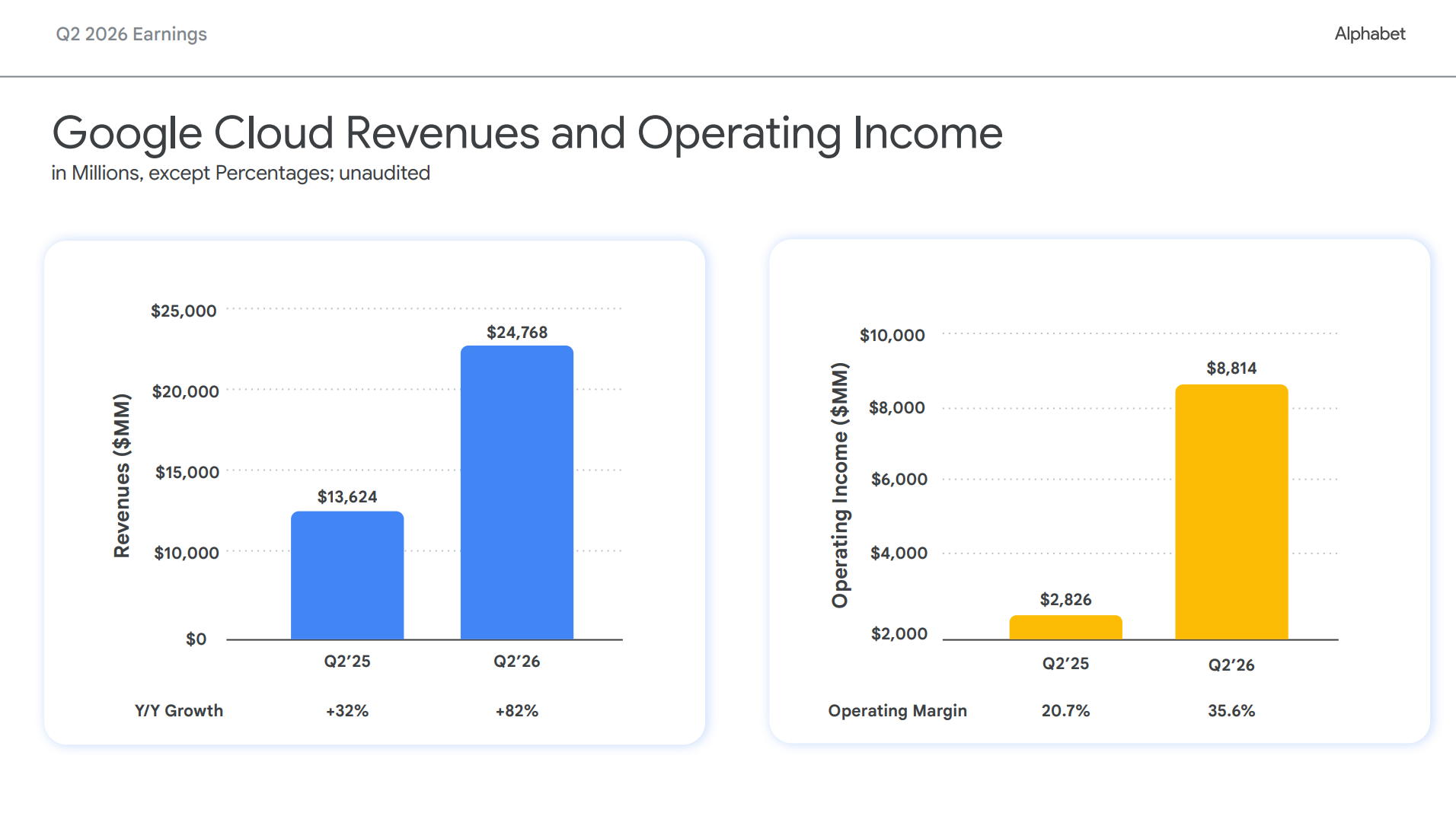
Another cool thing to see is that Google Cloud’s operating margins jumped from 20.7% to 35.6% in just one year! This is massive as Google’s Cloud business is seeing some serious operating leverage kick in and as investors this is something we all want to see.
Looking at these metrics alone, it’s hard to imagine how anyone could stay bearish on Google. Yet, the market reacted with a sharp sell-off—dragging the rest of the hyperscaler cohort down with it.
The narrative shifted rapidly away from top-line momentum and focused entirely on two main concerns: a steep CapEx hike and negative Free Cash Flow.
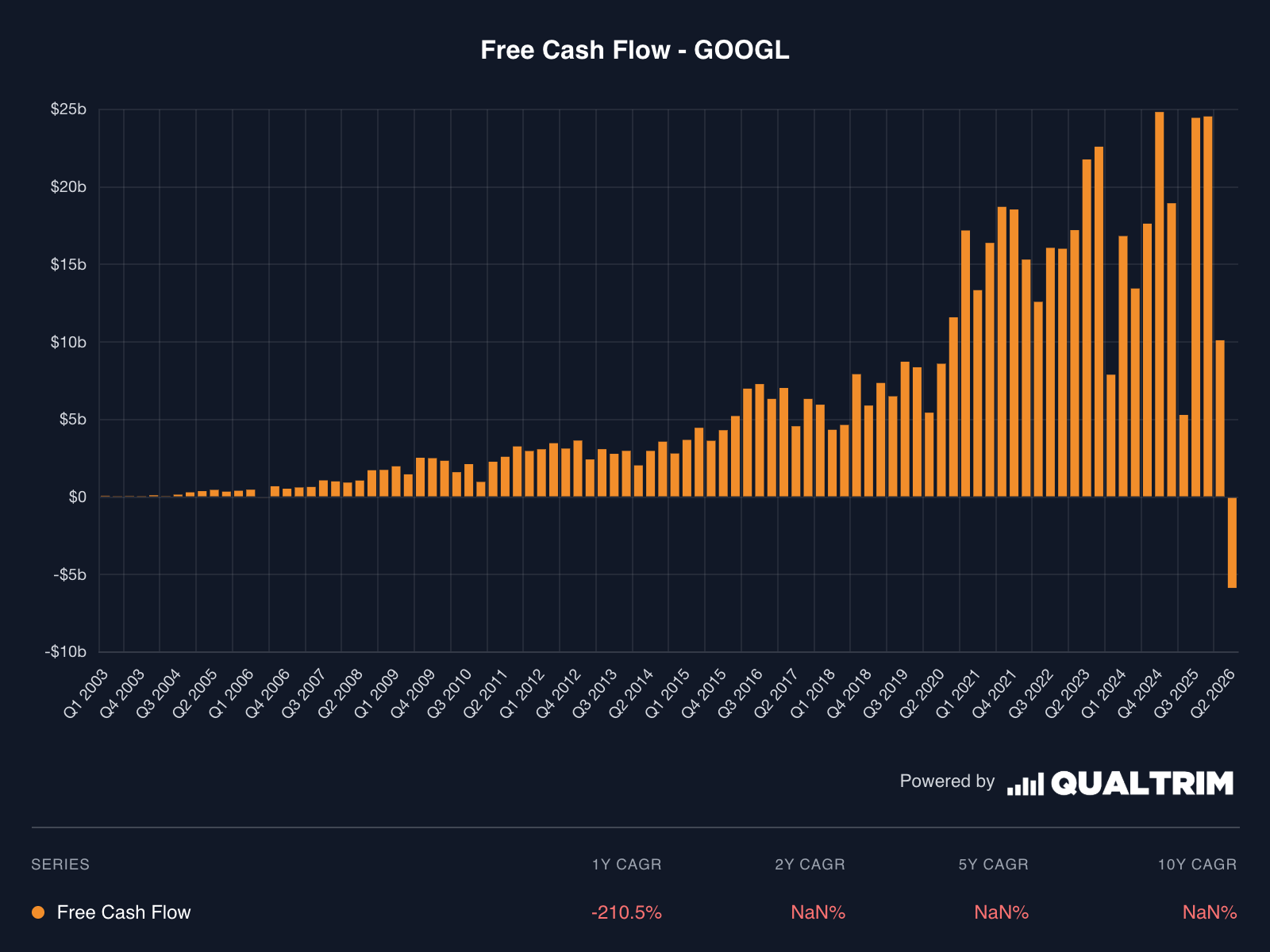
For the first time in its history as a public company, Google reported negative free cash flow.
That single metric spooked Wall Street, sending the stock sliding nearly 10% and pulling Amazon, Microsoft, and Meta down in its wake. The market quickly extrapolated Google’s results across the entire group, fearing that rising CapEx commitments through 2026 and beyond would squeeze free cash flow across all the hyperscalers.
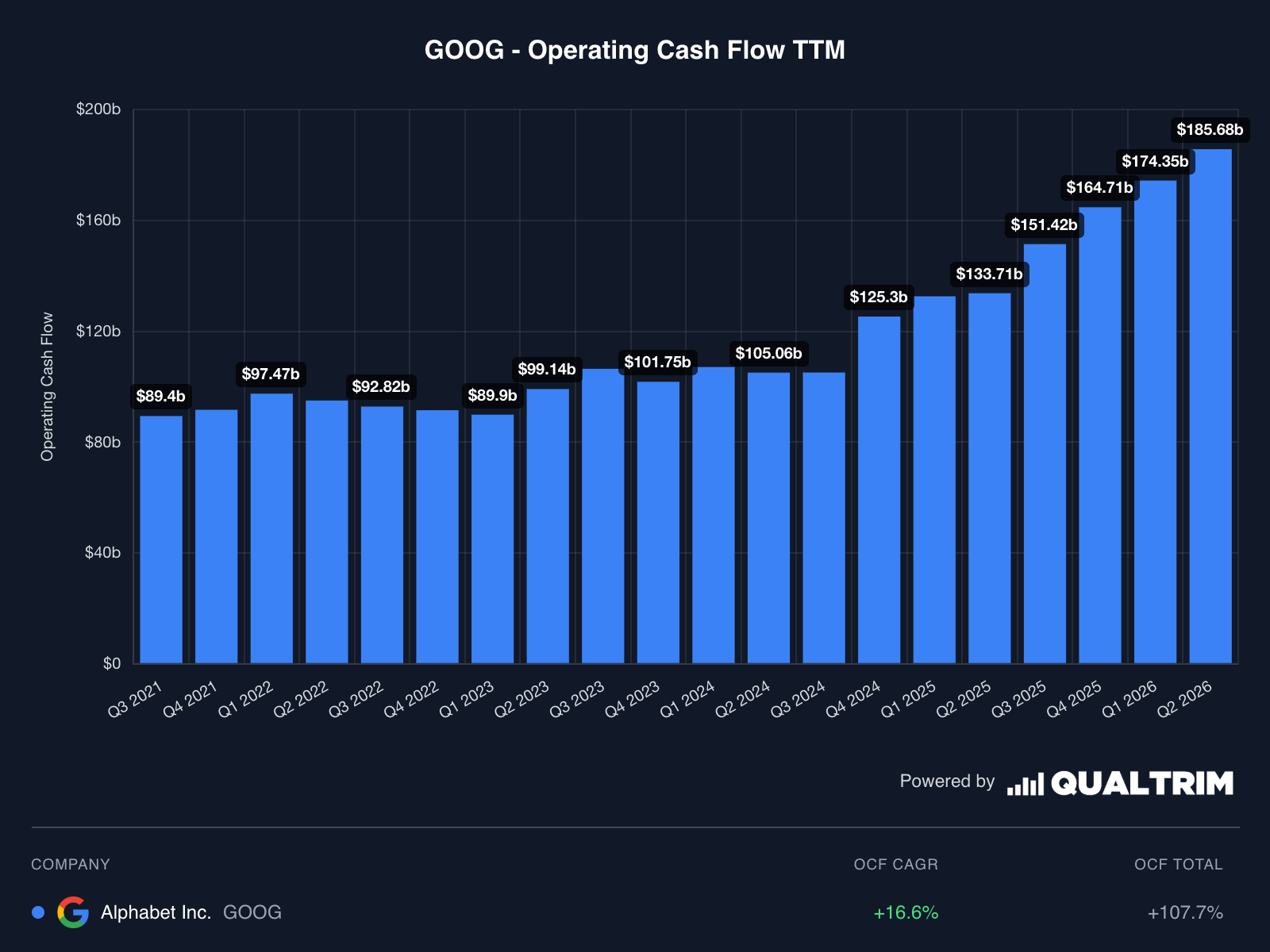
However, operating cash flow is still rapidly growing which shows that the underline business is still growing very fast and that’s very good to see.
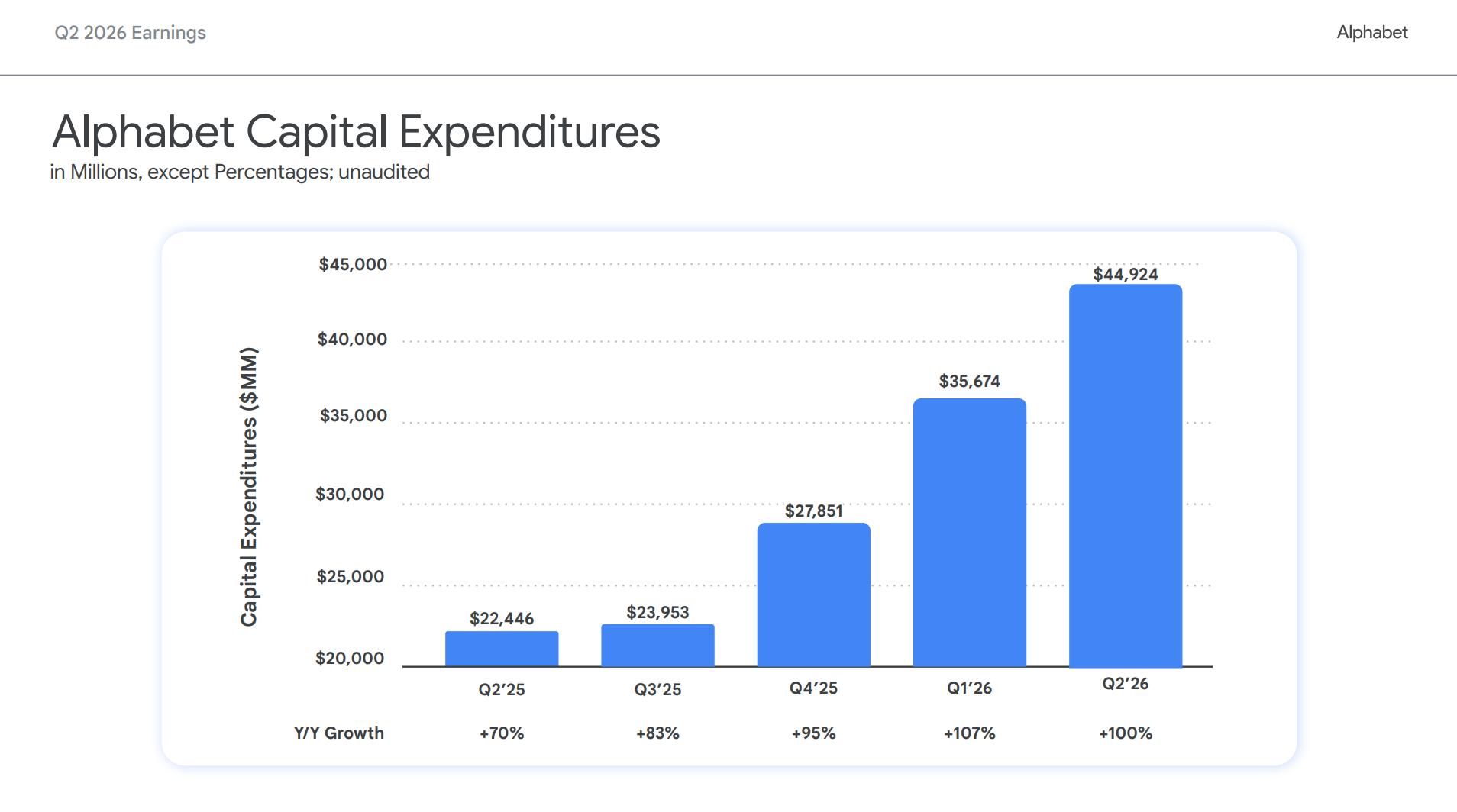
Capital expenditure was raised from the $180B–$190B range set in Q1 to $195B–$205B for full-year 2026, driven by a massive $44.9 billion in CapEx spent during Q2 alone.
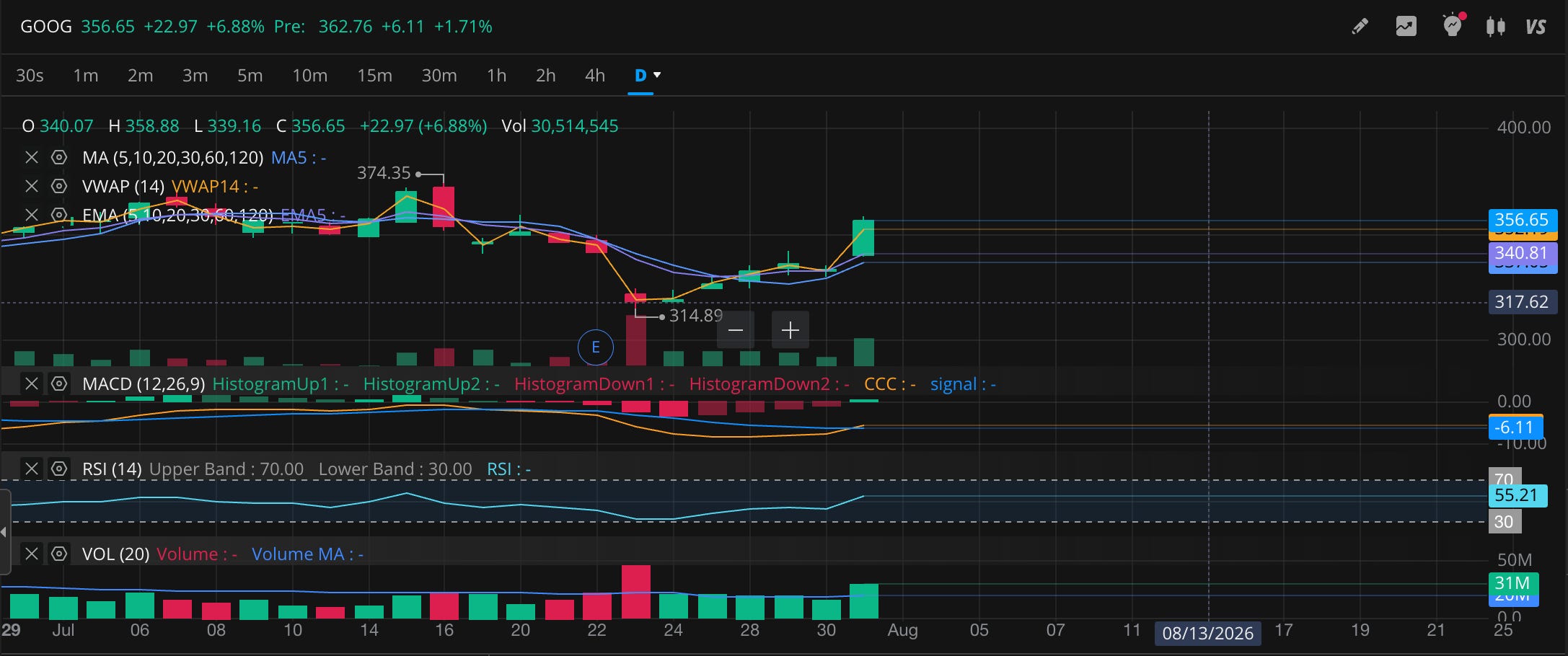
Wall Street saw the CapEx spike and basically had an emotional reaction, completely ignoring what Google actually just pulled off.
82% Cloud growth is just insane. Seriously, for a company this massive to be pulling off startup-level acceleration and growing total revenue over 20% YoY... and the stock gets hammered for it? That is wild to me.
But as usual, the panic didn’t last. The stock dipped down toward $315 and literally erased the entire sell-off in just five days. If you stepped up and bought that dip, huge congratulations to you!
Microsoft’s Earnings
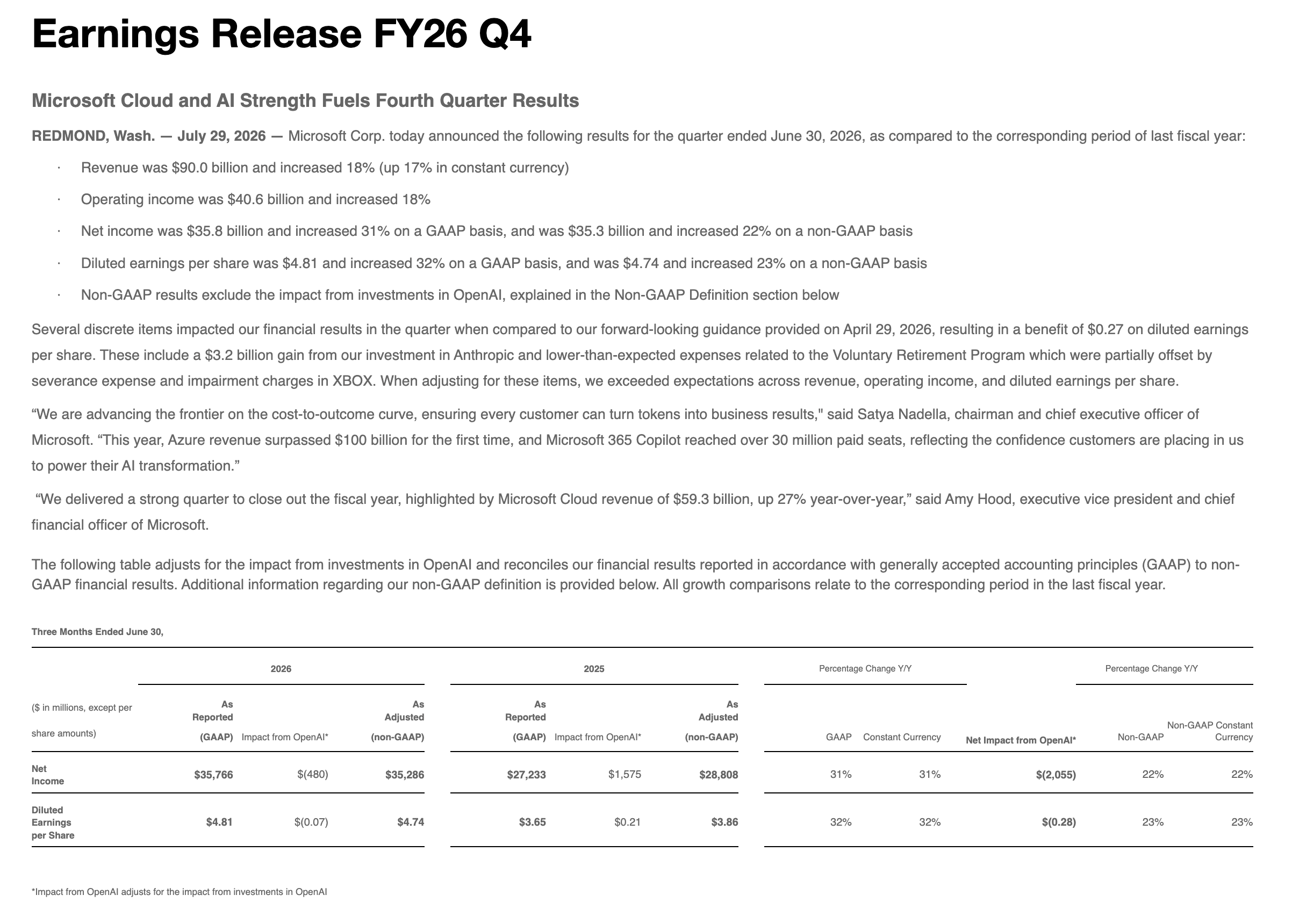
Microsoft’s Q4 earnings were stellar across the board, topping analyst estimates on both top and bottom lines.
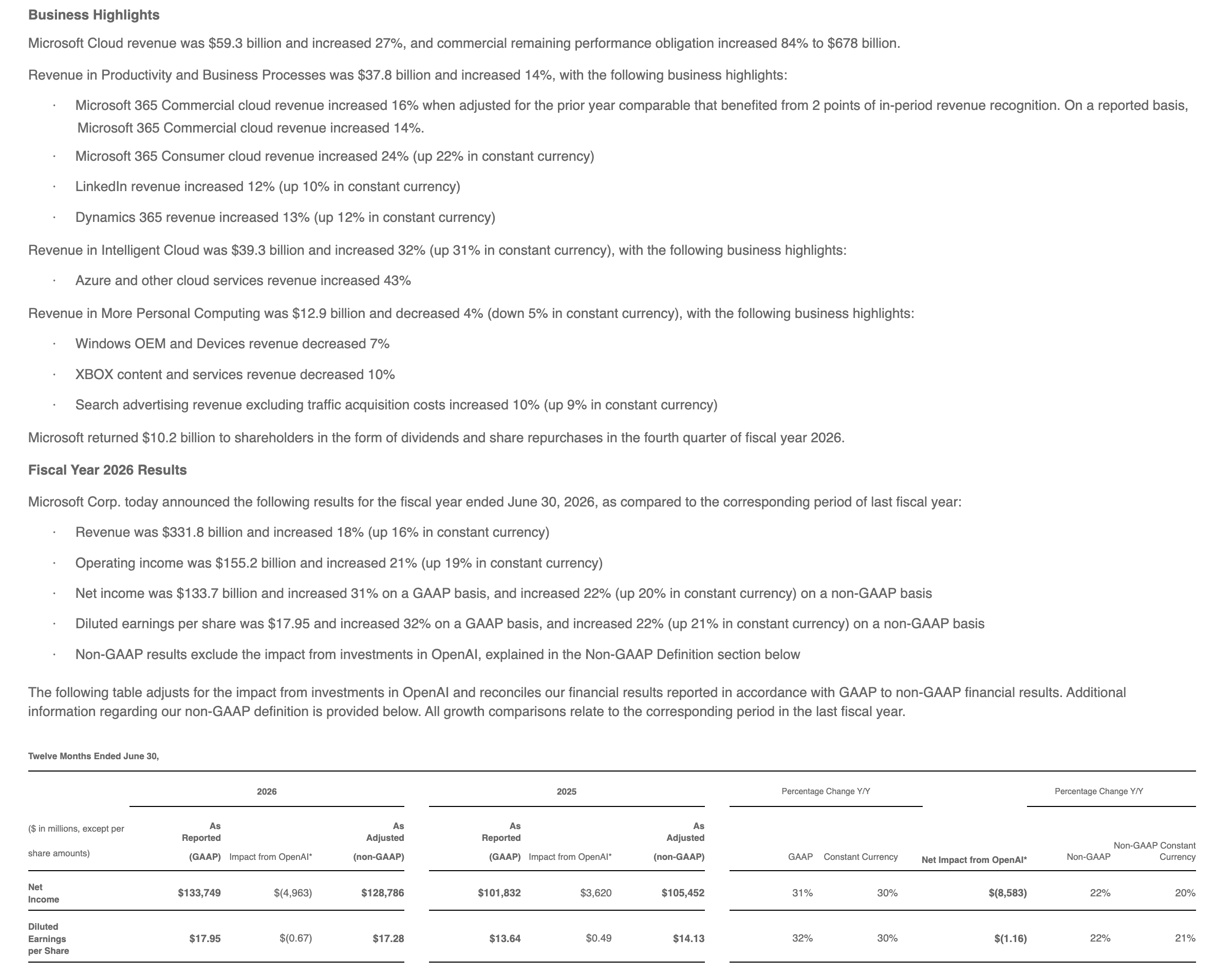
Revenue grew 18% YoY, backed by 27% growth in Microsoft Cloud. The standout highlight? Azure officially crossed a $100 billion annual run rate for the first time ever, accelerating at 43% YoY. Microsoft Cloud revenue was $59.3 billion and increased 27%, and commercial remaining performance obligation increased 84% to $678 billion. Just insane to see those numbers. The backlog continues to grow rapidly as demand for inference and compute is not slowing down.
Cost of revenue did rise slightly faster than overall revenue, but given the scale of their buildout, that’s not concerning to me at all. Net income surged 31% YoY with diluted EPS up 32%. All in all, this was just another business as usual for Microsoft. Very solid company.

Keep in mind that headline EPS was slightly inflated by paper gains from their OpenAI and Anthropic investments. If we strip those non-cash windfalls out and focus strictly on core operating performance, Microsoft delivered an adjusted EPS of $4.47.
That still easily beat Wall Street’s expectation of $4.24 and represents a very solid 16% YoY growth. So don’t let the sensational headlines fool you into thinking core EPS grew organically by 32% YoY—the core business is doing great, but paper gains account for half that headline spike.
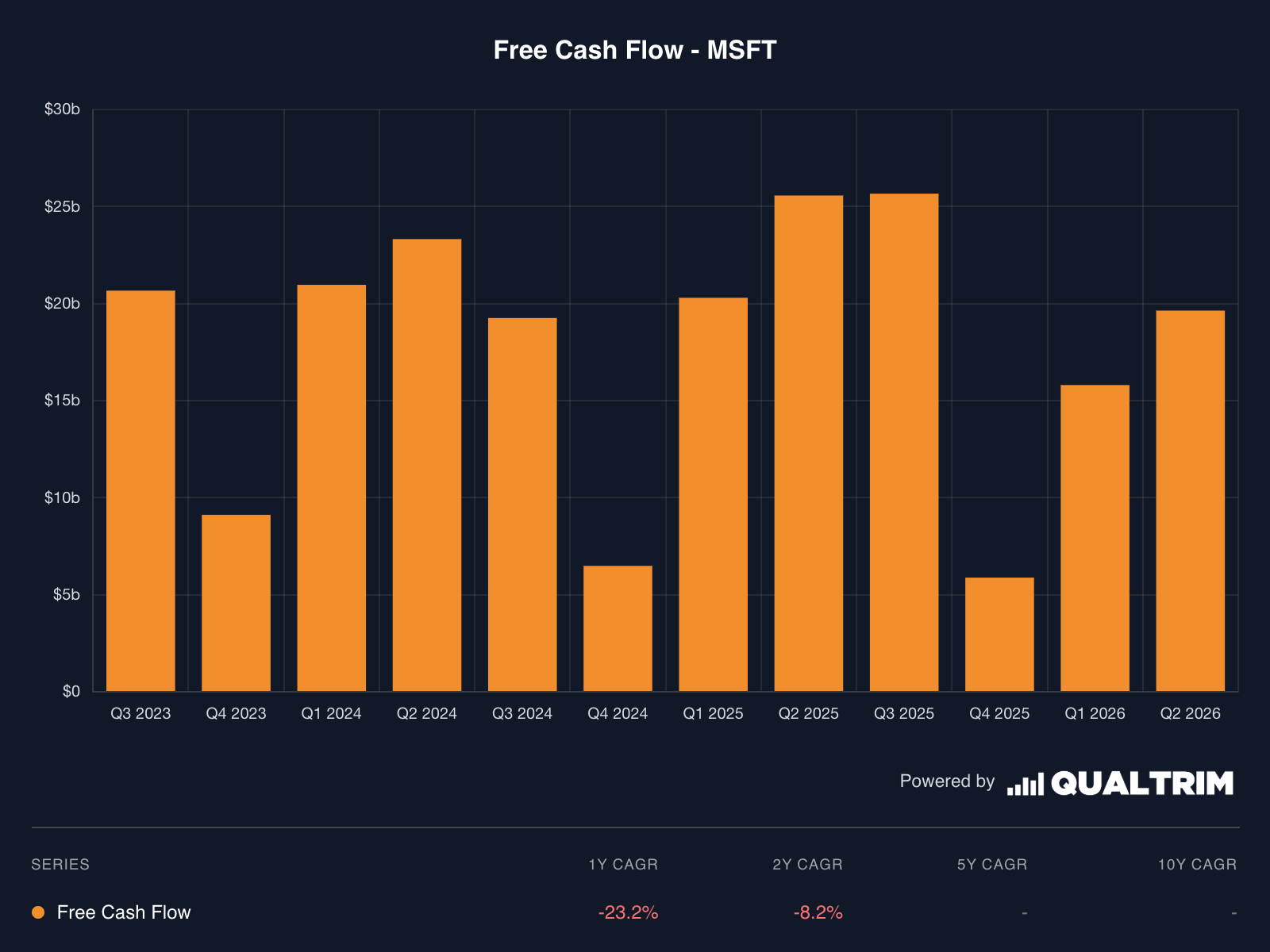
Microsoft was also the only hyperscaler that avoided negative free cash flow this quarter. Their FCF profile held up remarkably well—largely because a significant chunk of their infrastructure expansion is structured through finance leases rather than direct upfront cash CapEx.
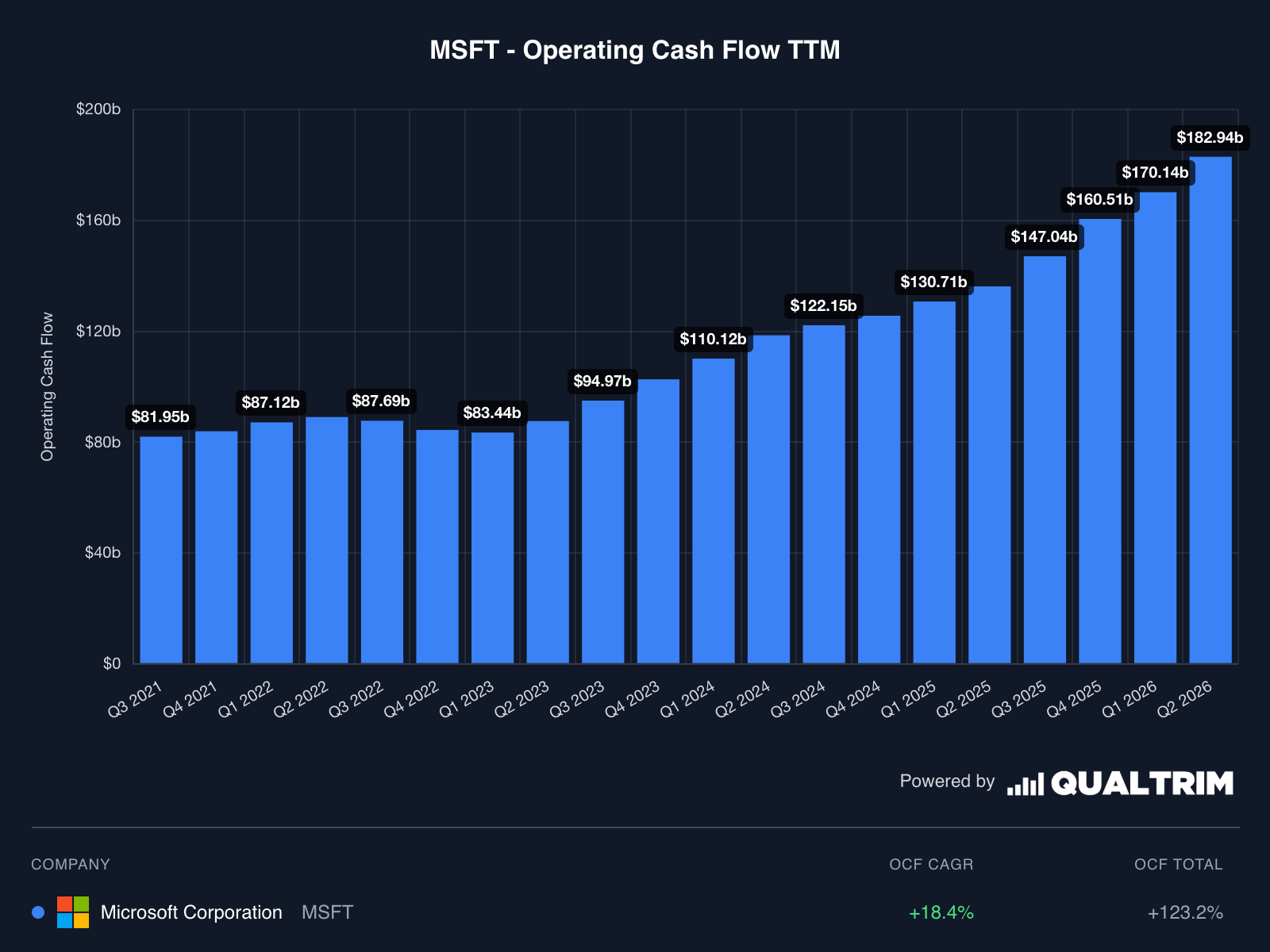
Microsoft’s operating cash flow also continues to grow very nicely same thing with Google which again shows that the underline business continues to generate cash.
Regardless of the accounting structure, Wall Street loved what it saw and bid the stock higher following the report. The market viewed Microsoft as the most disciplined hyperscaler when it comes to capital spending. And because the most important parts of it’s business see accelerating growth, the massive CapEx investments feel completely justified.
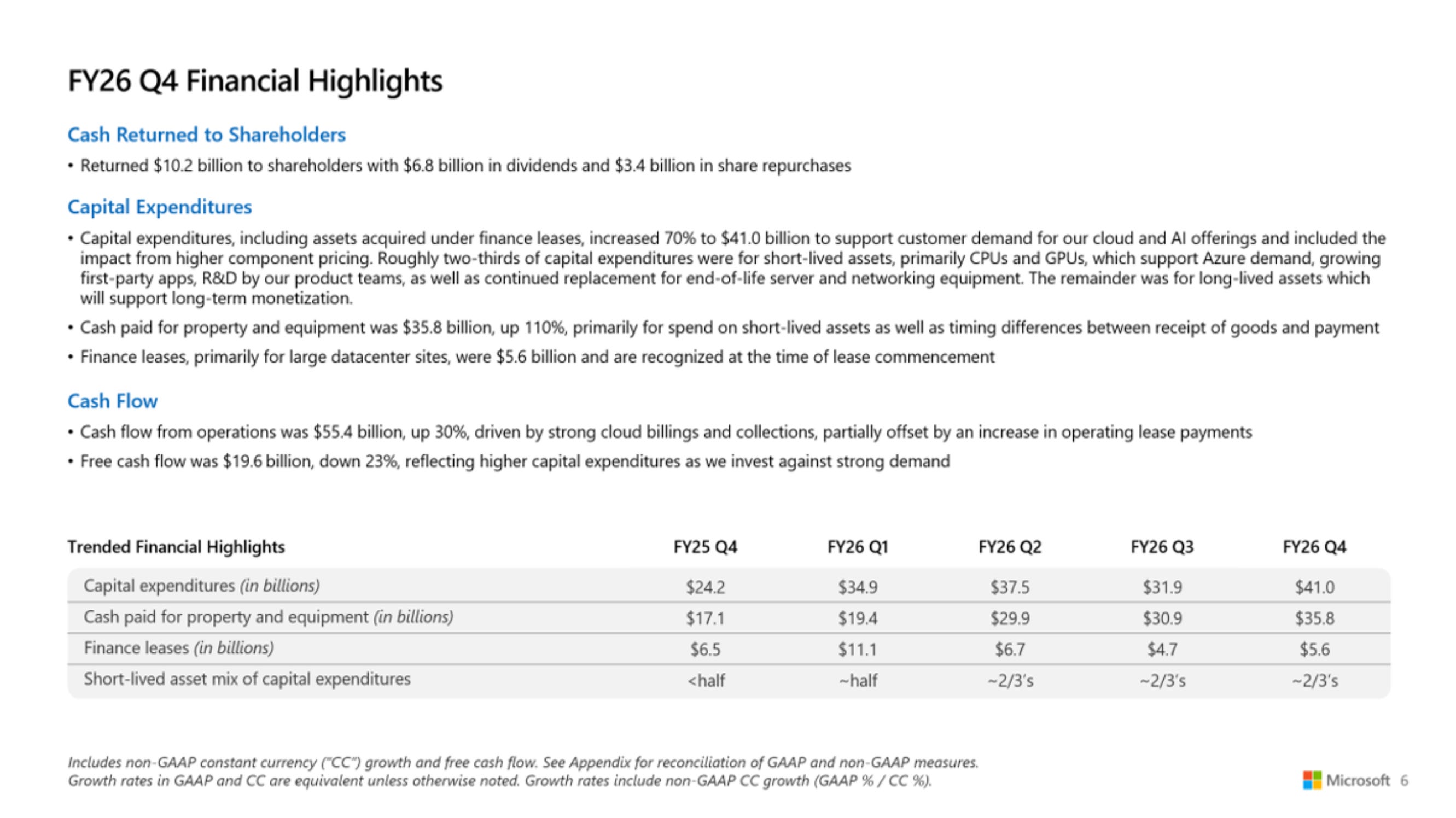
Microsoft also maintained its CapEx outlook rather than hiking it. For 2026 CapEx remains steady at around $175B–$190B (with the range reflecting adjustments for updated useful-life accounting of server and data center assets). In Q4 FY26, Microsoft reported $41 billion in CapEx, which actually came in slightly below consensus expectations ($42.37B). In addition, Microsoft also paid shareholders in dividends and share buybacks despite being in a heavy CapEx investment cycle and the market loved it.
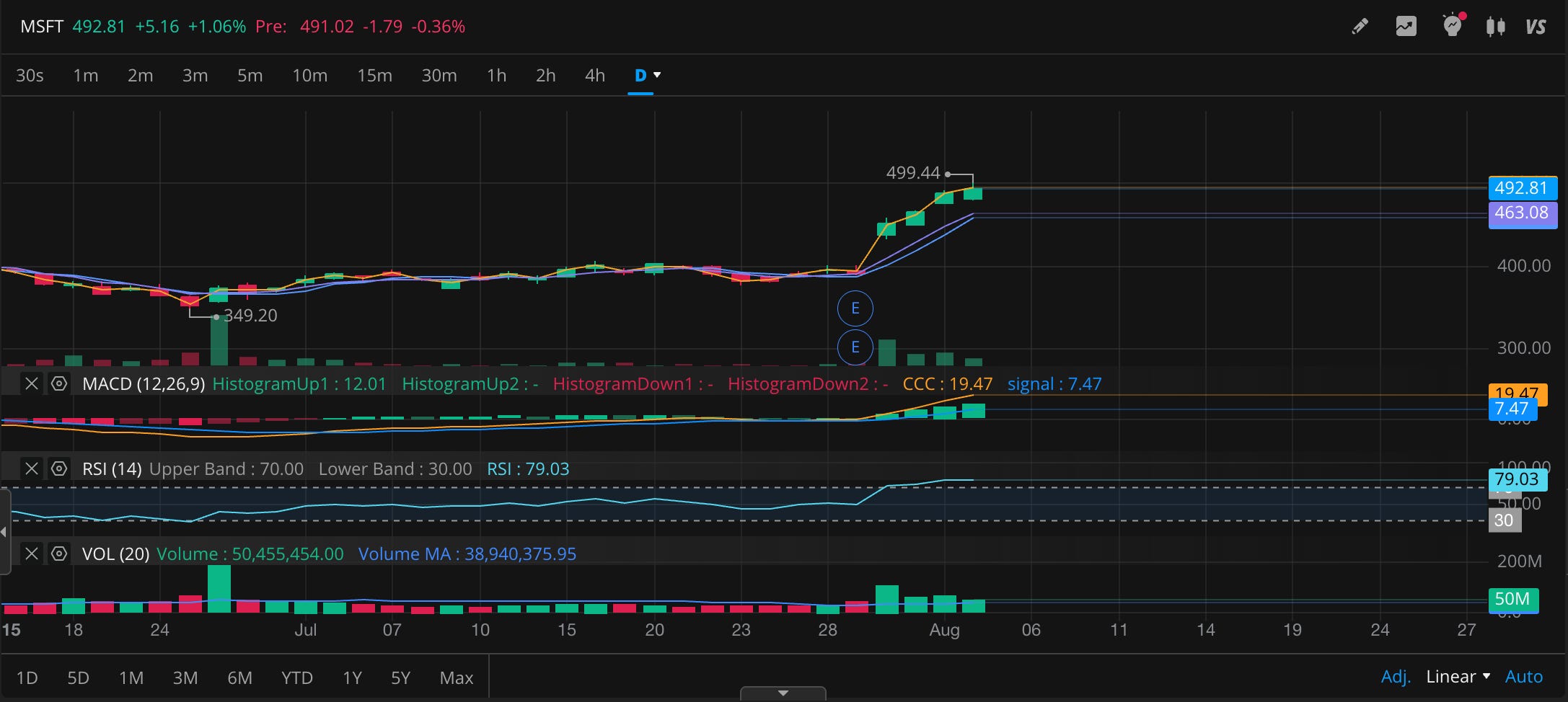
There’s not a lot to say about Microsoft. It’s the poster child of every investor’s dream to own such a high quality compounder in the longterm and for those who bought the stock below $400 have been rewarded handsomely so congrats to those who bought!
Amazon’s Earnings
This is a stock I own and boy did Amazon prove the market wrong! The report was so bullish that investors were literally knocking each off the stairs to be the first ones to buy the stock as it was racing higher.
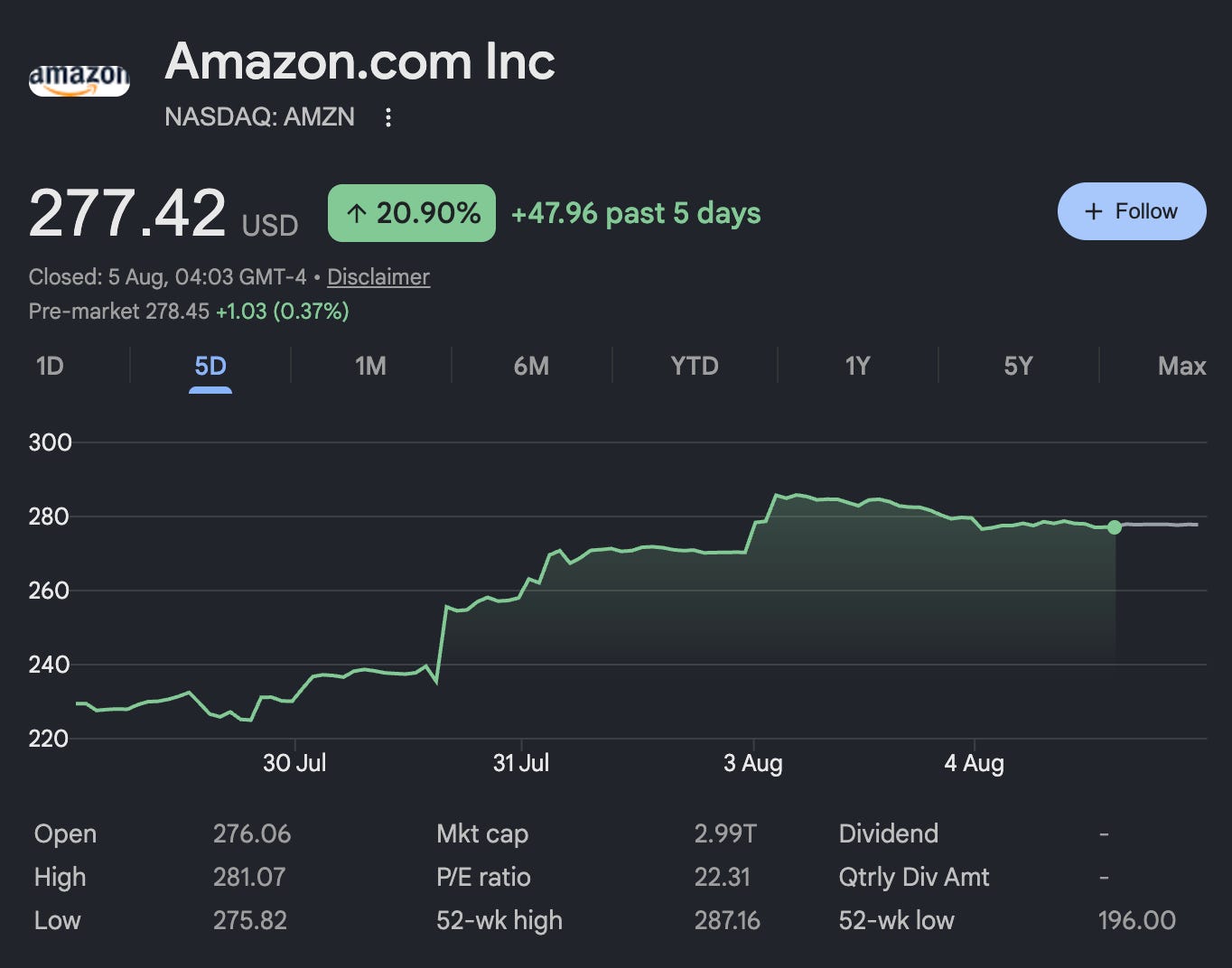
Amazon stock raced to 20% in just 2-3 days before and after their earnings. It was really funny to watch as WallStreet increased their price targets for Amazon and were anxiously trying to buy as much Amazon stock as they could before it raced even higher.
So what did Amazon deliver? Let’s have a look:
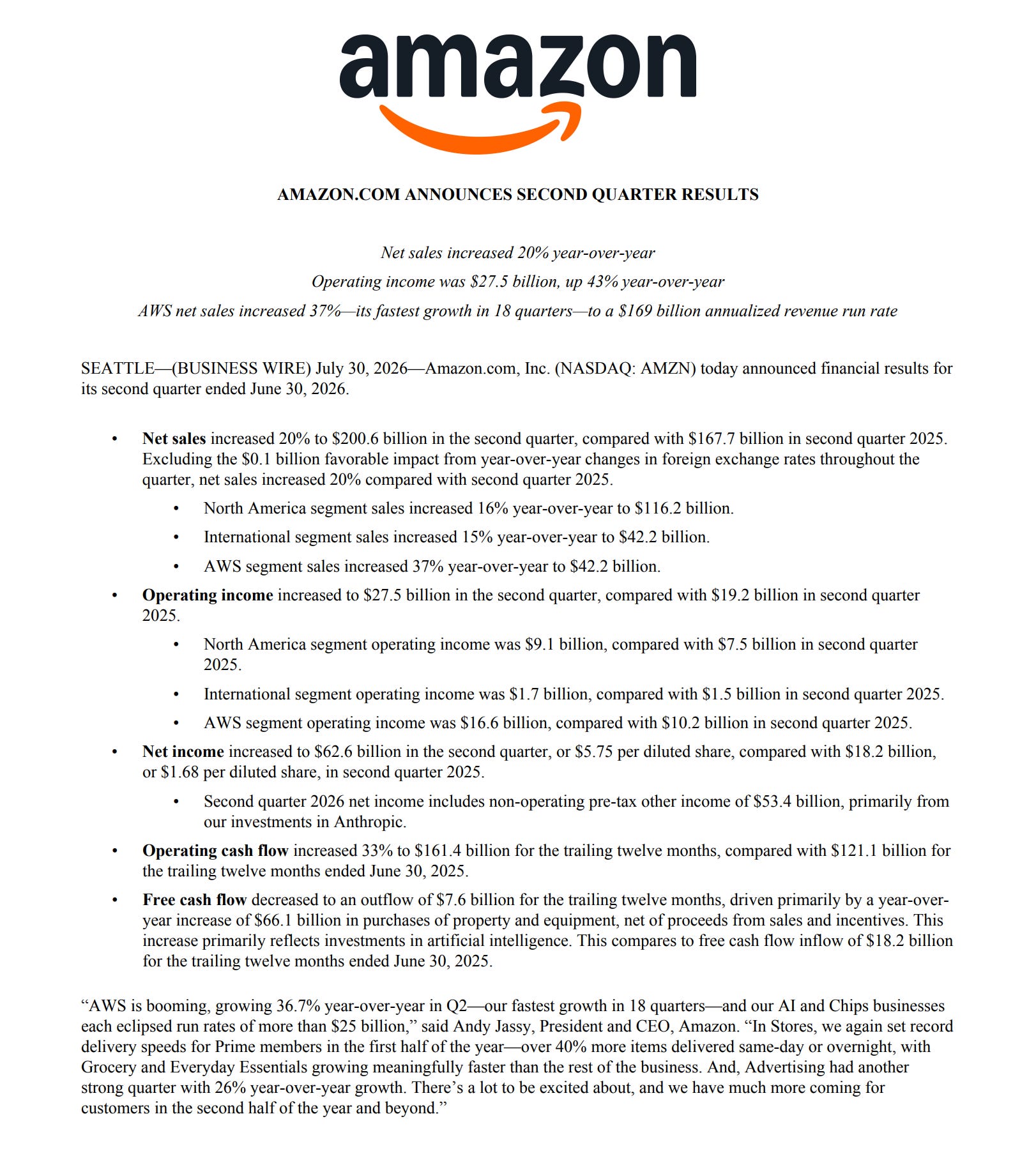
Just the first three lines:
Net sales increased 20% year-over-year
Operating income was $27.5 billion, up 43% year-over-year
AWS net sales increased 37%—its fastest growth in 18 quarters—to a $169 billion annualized revenue run rate
Like what??? Amazon that is set to reach 1 trillion dollars in revenue by end of 2028 is growing net sales by 20% and AWS accelerating 37% YOY. Not only did they grow this fast, but Amazon is growing profitability even faster at 43% which is just insane to see. This is literally everything an Amazon shareholder wants to see.
Andy Jassy on the earnings call even stated that they will not sacrifice profitability for growth and believes that Amazon today has the most lucrative business in the entire planet. And I agree with that statement. Amazon has so much optionality to grow it feels like it’s almost unfair to other companies.
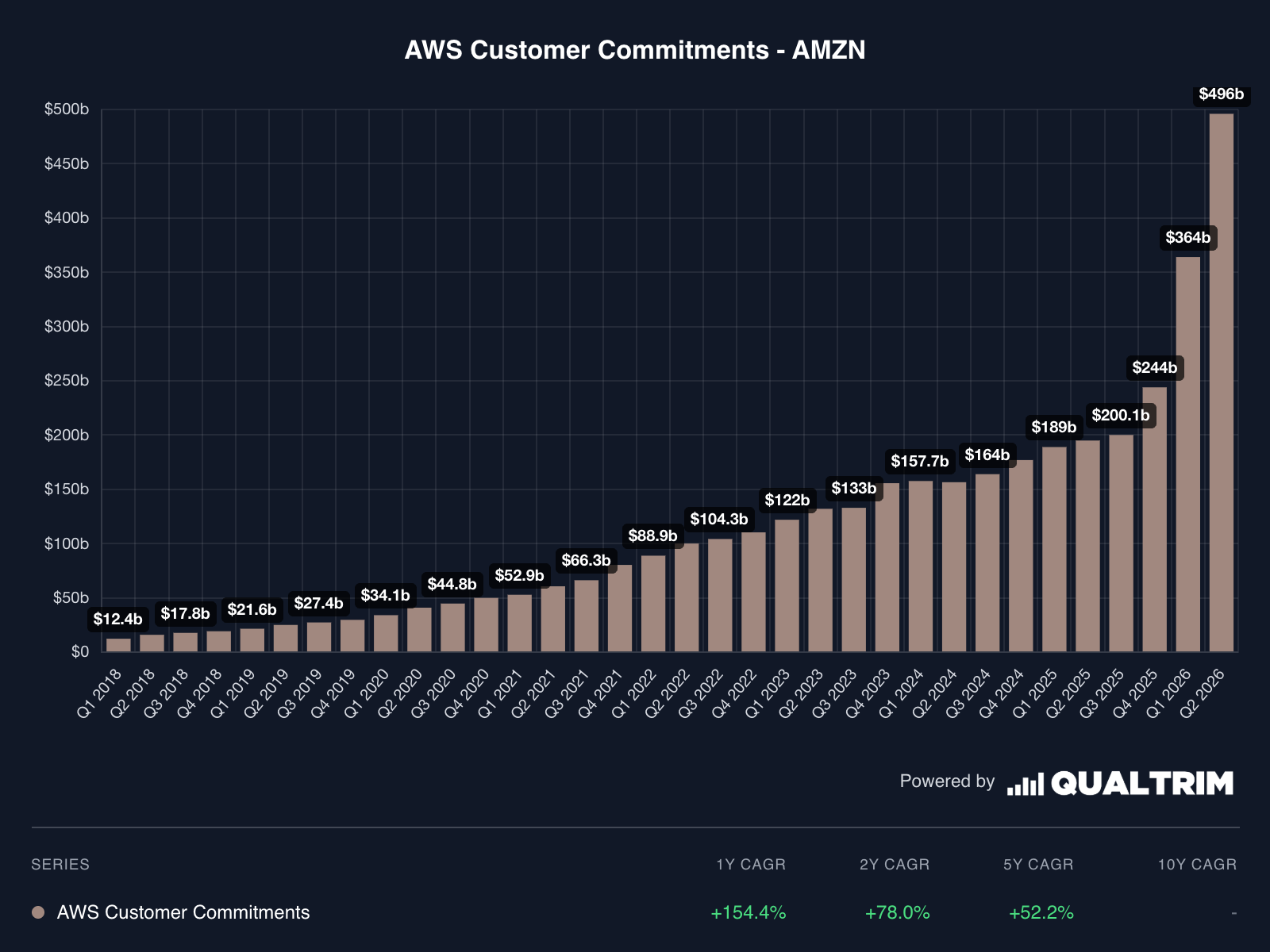
AWS’s backlog hit an all-time high, and it shows no signs of slowing down. Andy Jassy made it clear on the call that compute supply remains globally constrained—there simply isn't enough capacity on the ground to satisfy incoming demand. These massive customer commitments represent locked-in revenue that will be recognized in the income statement over the next 12 to 18 months, with longer-term deals spanning out over the next 3 to 5 years.
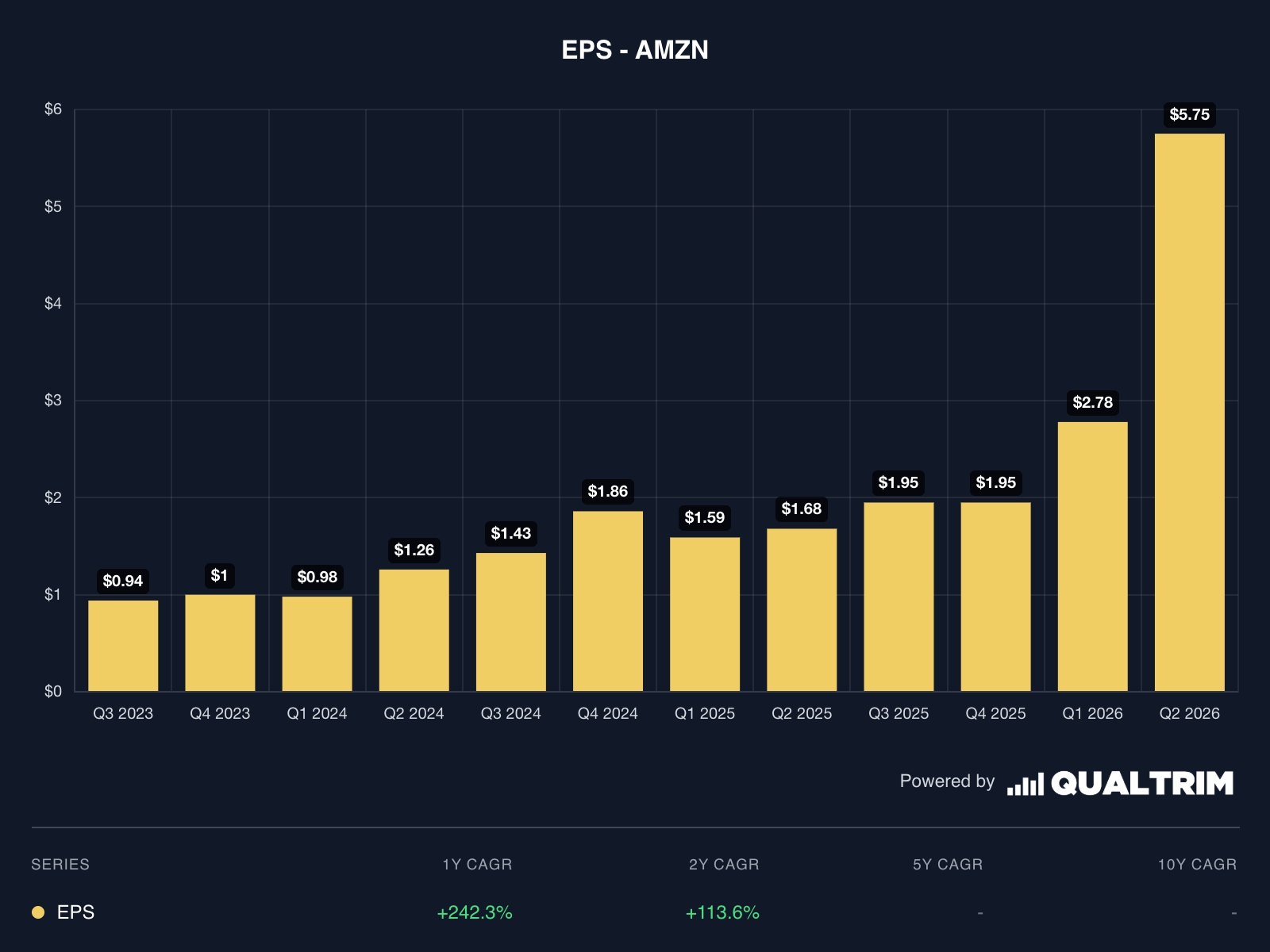
Amazon reported a headline GAAP EPS of $5.75, which was massively distorted by an accounting windfall.
Tucked into Amazon’s report was $53.4 billion in pre-tax non-operating income, driven primarily by unrealized mark-to-market valuation gains on their equity investment in Anthropic.
Stripping Out the Paper Gain: Real Operational EPS
To find what Amazon actually earned from running its core operations (AWS, retail, and advertising), we adjust for the Anthropic windfall:
Pre-Tax Non-Operating Benefit: ~$53.4 billion
After-Tax Benefit (estimating ~21% tax rate): ~$42.2 billion (~$3.88 per share)
Reported GAAP Net Income: $62.6 billion ($5.75 EPS)
Normalized Core Net Income: ~$20.4 billion
Amazon’s Real Operational EPS: ~$1.87
The Big Picture
Headline EPS: $5.75
Real Operational EPS: ~$1.87
Core Operating Performance: Operating income hit $27.5 billion (up 43% YoY), driven by AWS accelerating to 37% growth ($42.2B revenue).
Even after stripping away the $3.88 per share paper gain, Amazon’s core business still beat analyst expectations (which were around $1.82 EPS). The core operating engine is firing on all cylinders—it’s just masked by accounting noise.
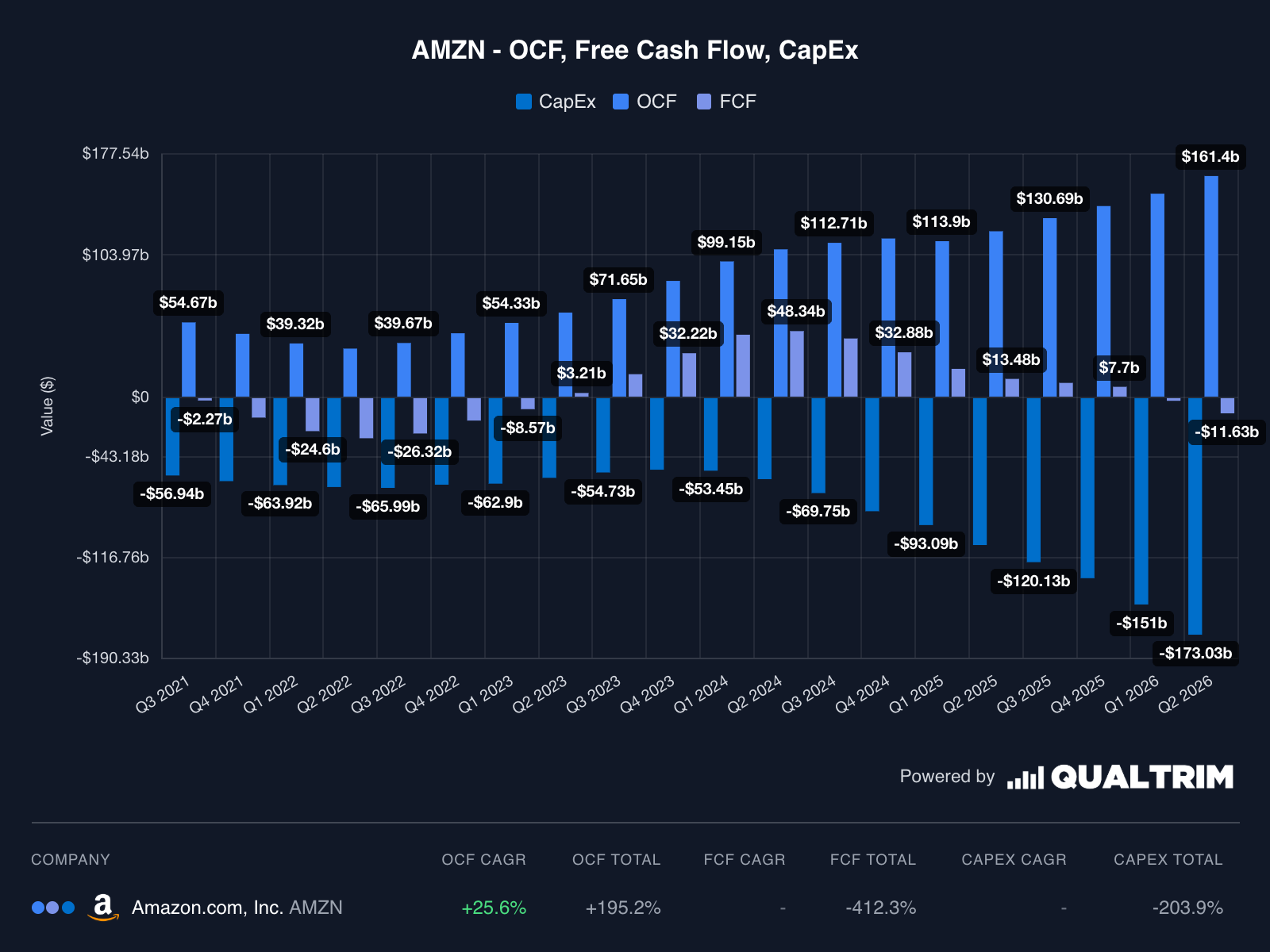
The ultimate engine driving Amazon—and every other hyperscaler—is operating cash flow. Without robust cash flow from core operations, funding these aggressive data center expansions wouldn't be possible. The fact that Amazon's business is accelerating while generating record operational cash proves that their heavy CapEx strategy are paying off.
I just want to share with you what was said in the earnings call, which I think is self-explanatory as to why Amazon is my favorite hyperscaler to invest in:
“We plan to spend approximately $220 billion in cash CapEx in 2026... At this level of spend, we have clear line of sight to strong financial returns. Data centers have 30+ year useful lives, which means we get at least five to six generations of server economics without having to repeat that upfront infrastructure cost. So while short-term CapEx creates temporary free cash flow headwinds until data centers come online, the long-term revenue, free cash flow, and return on invested capital will be exceptionally compelling.”
“AWS is now a $169 billion annualized revenue run rate business accelerating at 36.7% YoY, with a $496 billion backlog. Even at our expanded CapEx levels, we will still not have enough capacity to meet demand in 2026 or 2027—and the demand signals stretching out to 2028 are striking. We long believed AWS could become a few hundred-billion-dollar business, but we now see a path to it becoming a $1 trillion annual revenue business in time.”
So yeah. Amazon is probably one of the only stocks I might full port if it were trading at a very ridiculous valuation.
Meta’s Earnings
Last up, we have Meta—and it's easily the hyperscaler Wall Street loves to hate. Unlike Google, Microsoft, and Amazon, Meta doesn't have a public cloud business to directly monetize its infrastructure, which makes investors far more sensitive to its spending sprees. Even though top-line growth remained solid, the stock was hammered post-earnings. The results were overshadowed by couple of concerns like EPS miss, FCF soon going negative and operating margins collapsing to 30% due to heavy CapEx investments in compute. So let’s have a look at the results and see if the street overreacted on this one or not.
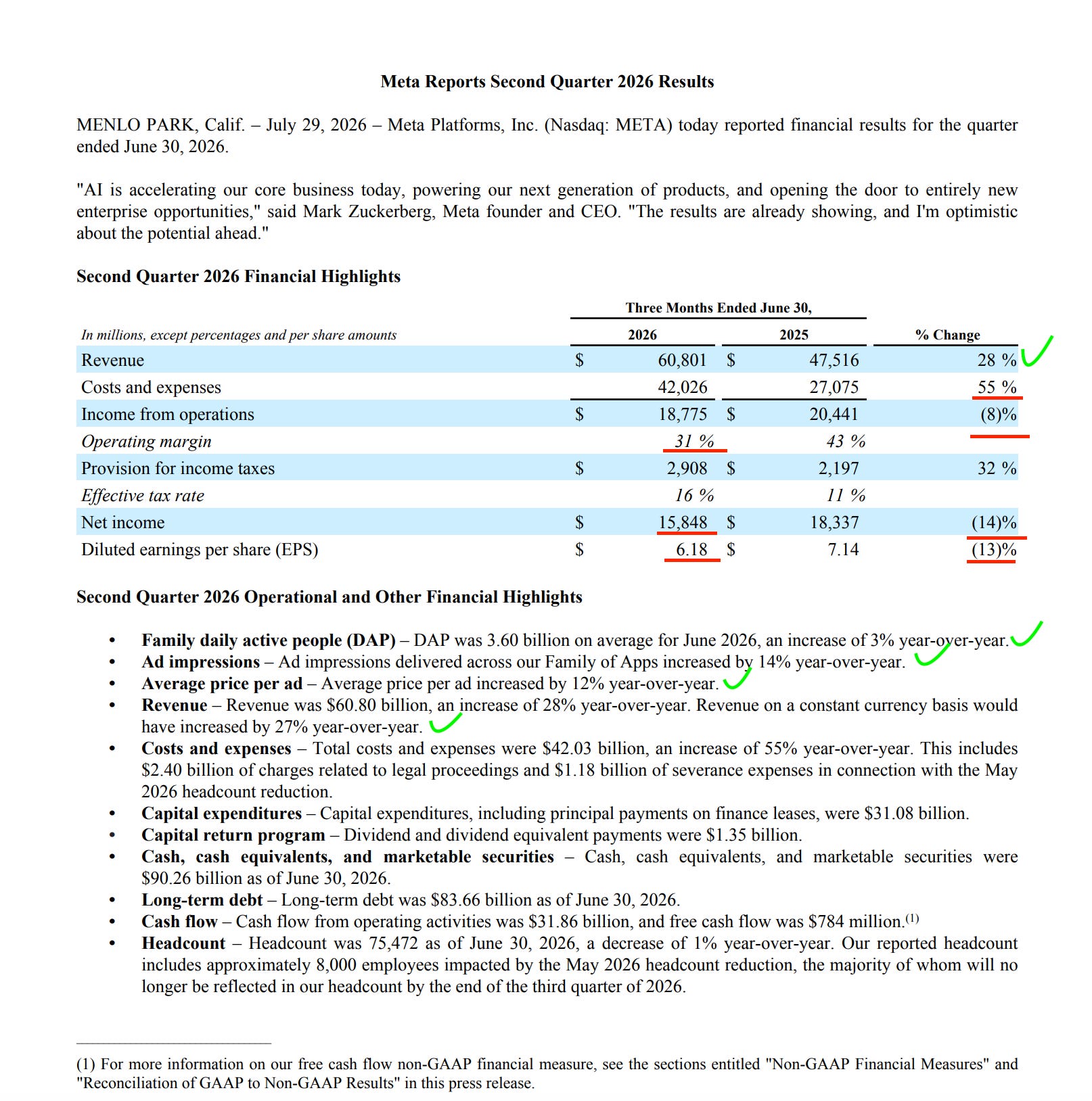
Looking at the income statement, it’s easy to see why the market panicked. Total costs and expenses surged 55% YoY—growing nearly twice as fast as revenue at 28%. Operating income dropped 8% YoY, operating margins contracted to 31% (down from 43% a year ago), and EPS fell 13% YoY to $6.18.
The drag on earnings wasn't caused by weak core advertising performance; rather, it was driven by a combination of one-time charges and expanding infrastructure expenses.
One-Time / Discrete Charges (~$3.58 Billion Total)
The single biggest contributor to the EPS miss was $3.58 billion in non-recurring charges hit directly in Q2:
$2.40 Billion Legal Charge: Meta booked a $2.4B legal proceeding charge/accrual during the quarter.
$1.18 Billion Severance Hit: Costs associated with the May 2026 workforce reduction (cutting ~8,000 positions, or ~10% of headcount) hit the income statement.
Key Takeaway: CFO Susan Li explicitly noted on the call that without these two specific charges, Meta’s operating income would have actually grown ~9% YoY instead of declining 8%.
So if we look into the one time charge Meta incurred that hit the bottom line, we can see how much additional earnings per share would’ve been added to earnings":
Total Pre-Tax Charge: $3.58 Billion
After-Tax Impact (at ~16% tax rate): ~$3.01 Billion
Diluted Share Count: ~2.56 Billion shares
Per-Share Drag on EPS: ~$1.17 to $1.20 per share
If we strip out the one-off legal and severance hit, Meta didn’t miss earnings—they beat consensus by about $0.18 to $0.21 per share and would’ve delivered ~$7.35 – $7.38 EPS against analyst expectations of $7.17.
Operating income would have actually grown 9% YoY instead of declining 8%, and normalized operating margins would have sat around 37% instead of 31%.
So despite the fear, we should not focus purely on margin compression, but what Meta is actually achieving. Family Daily Active People hit an all-time high of 3.6 billion, ad impressions grew 14% YoY, and average price per ad climbed 12% YoY. Despite the massive CapEx investments, the core advertising engine is firing on all cylinders—expanding user reach and driving Average Revenue Per User (ARPU) higher across every region. We can see that in their slides:
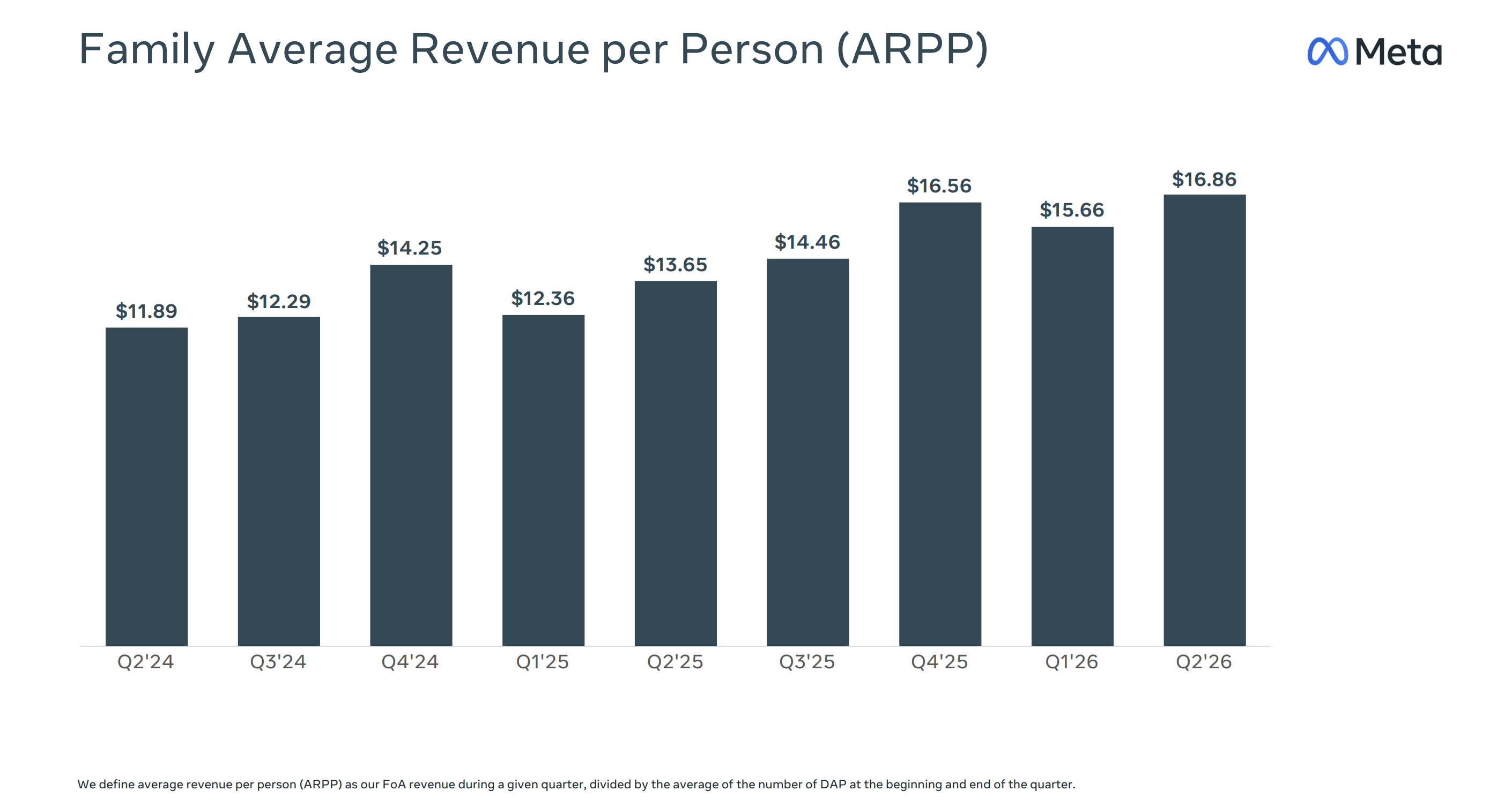
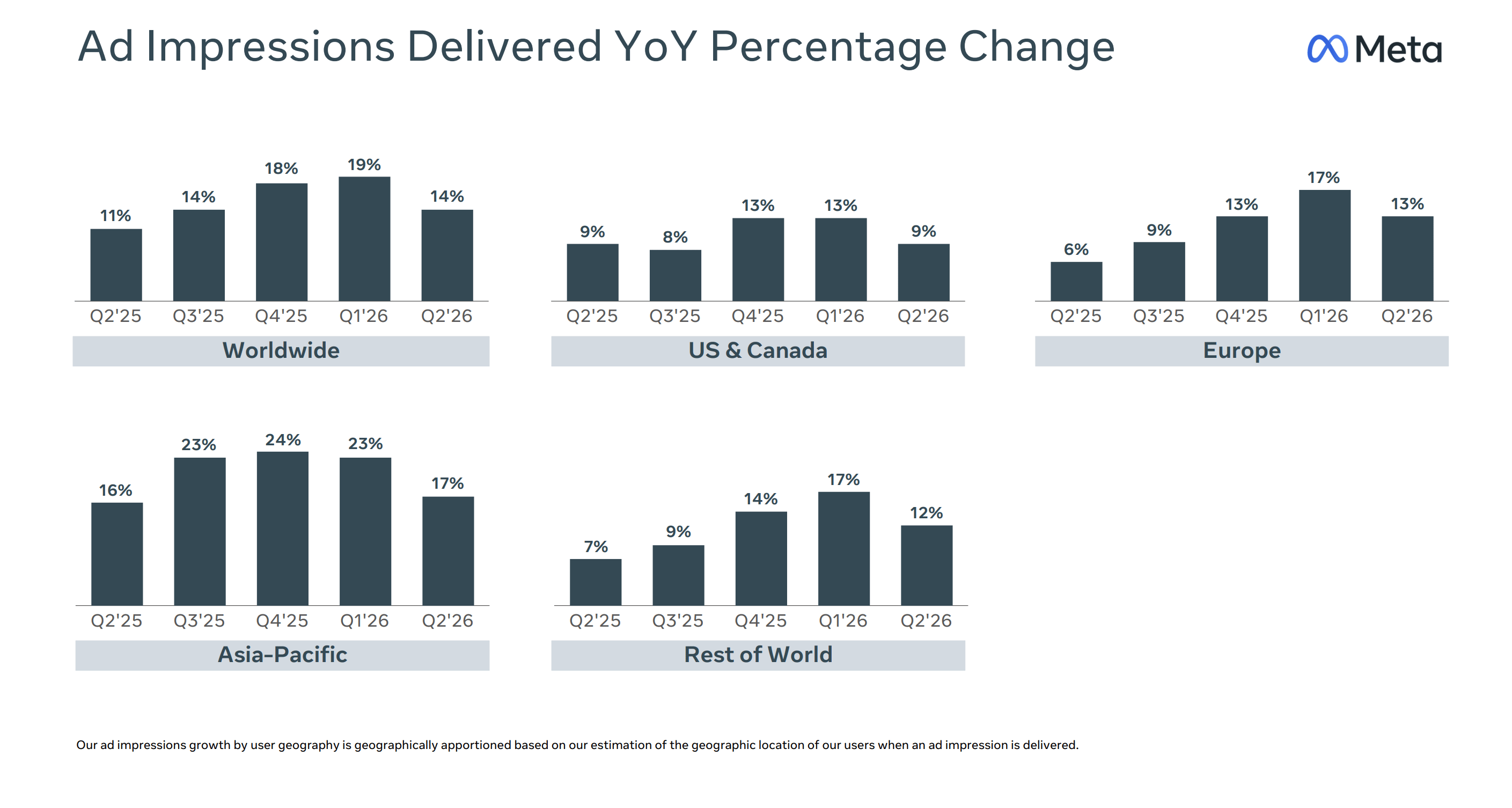
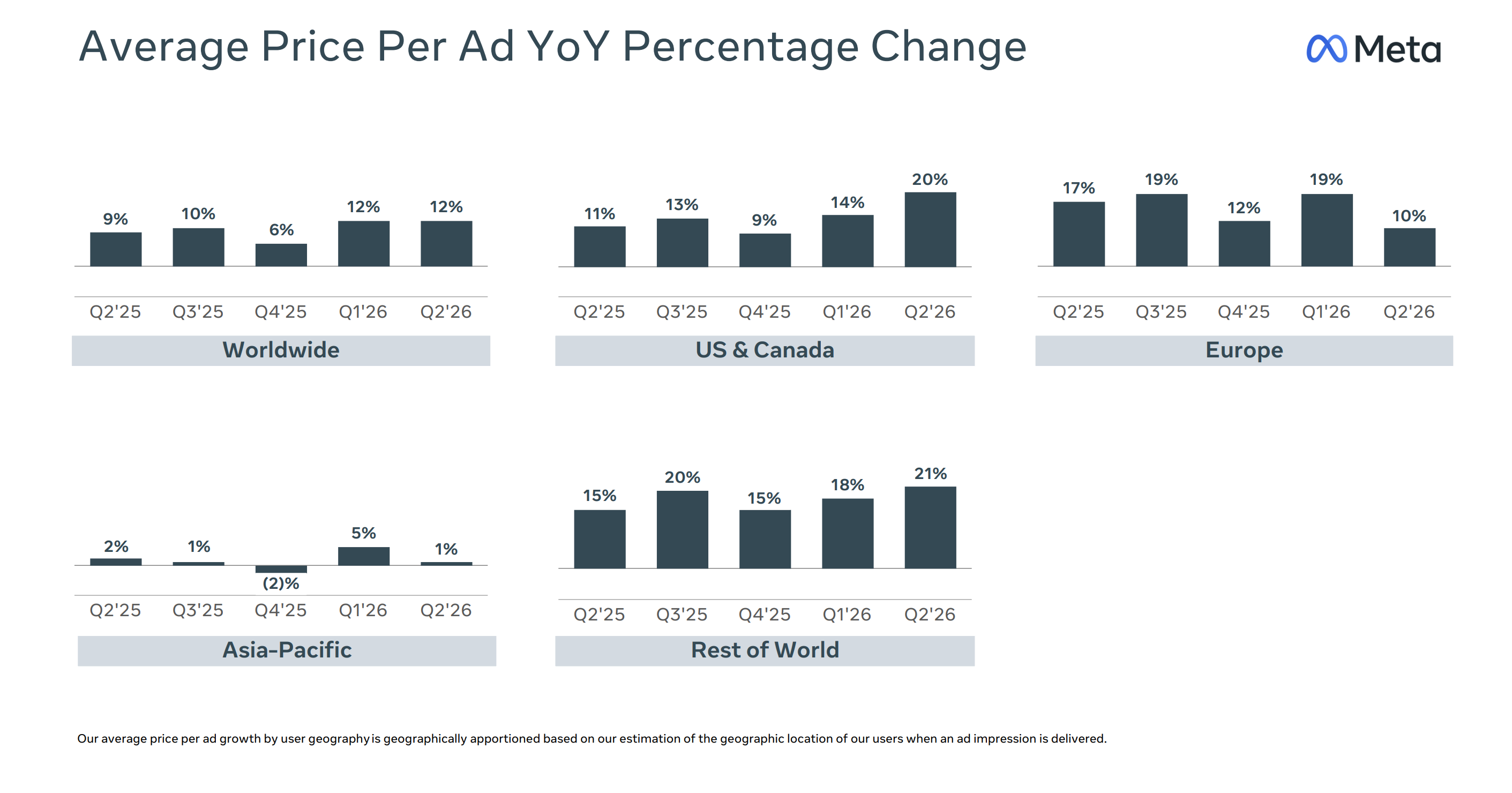
You can see it for yourself in the numbers: Family Average Revenue per Person (ARPP) hit an all-time high. Both ad volume and pricing power expanded across the board, with ad impressions up 14% and the average price per ad climbing 12% YoY. While growth rates varied across geographies—with the U.S. and Canada remaining the majority of revenue—the underlying ad engine is very healthy.
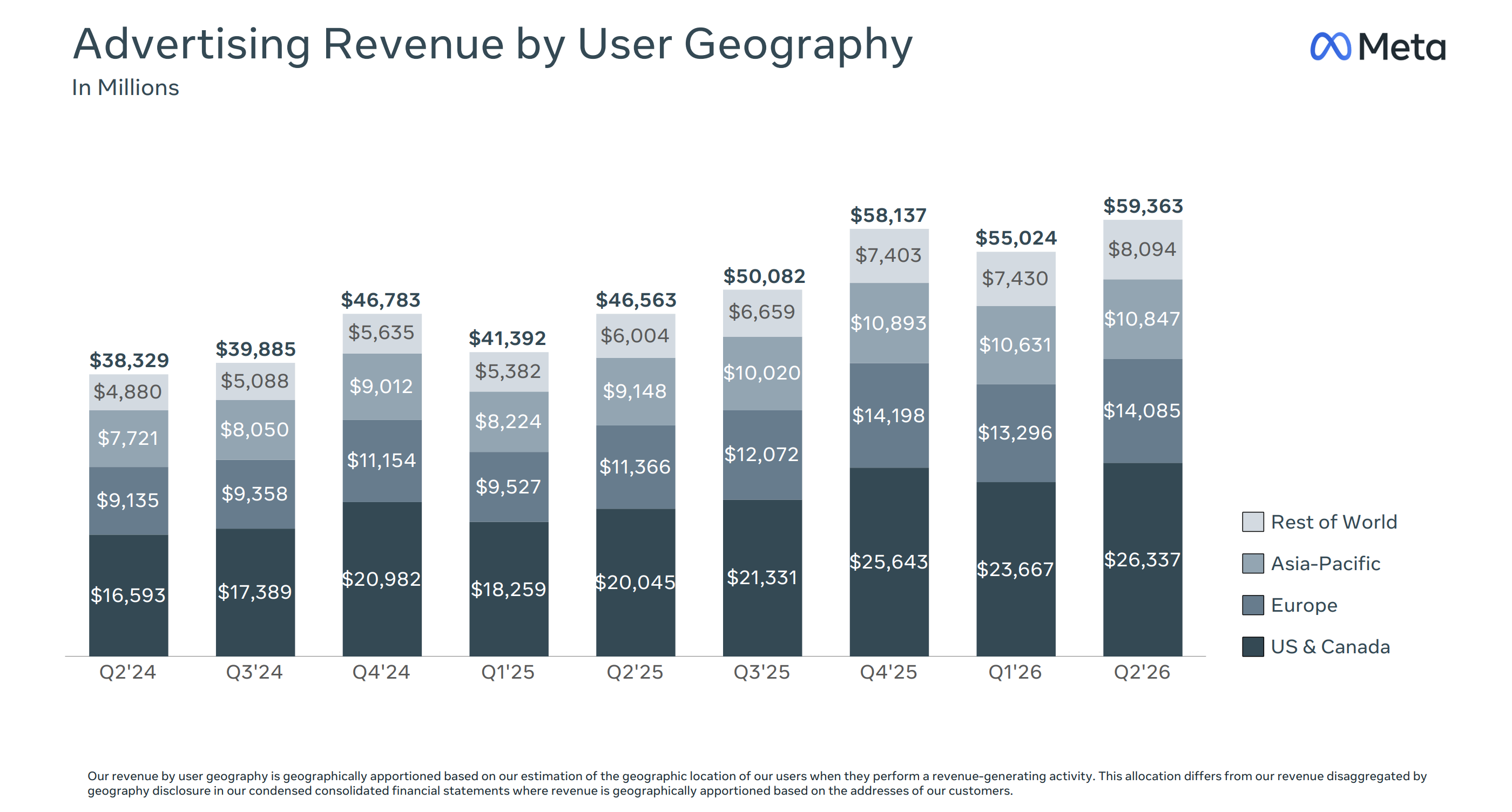
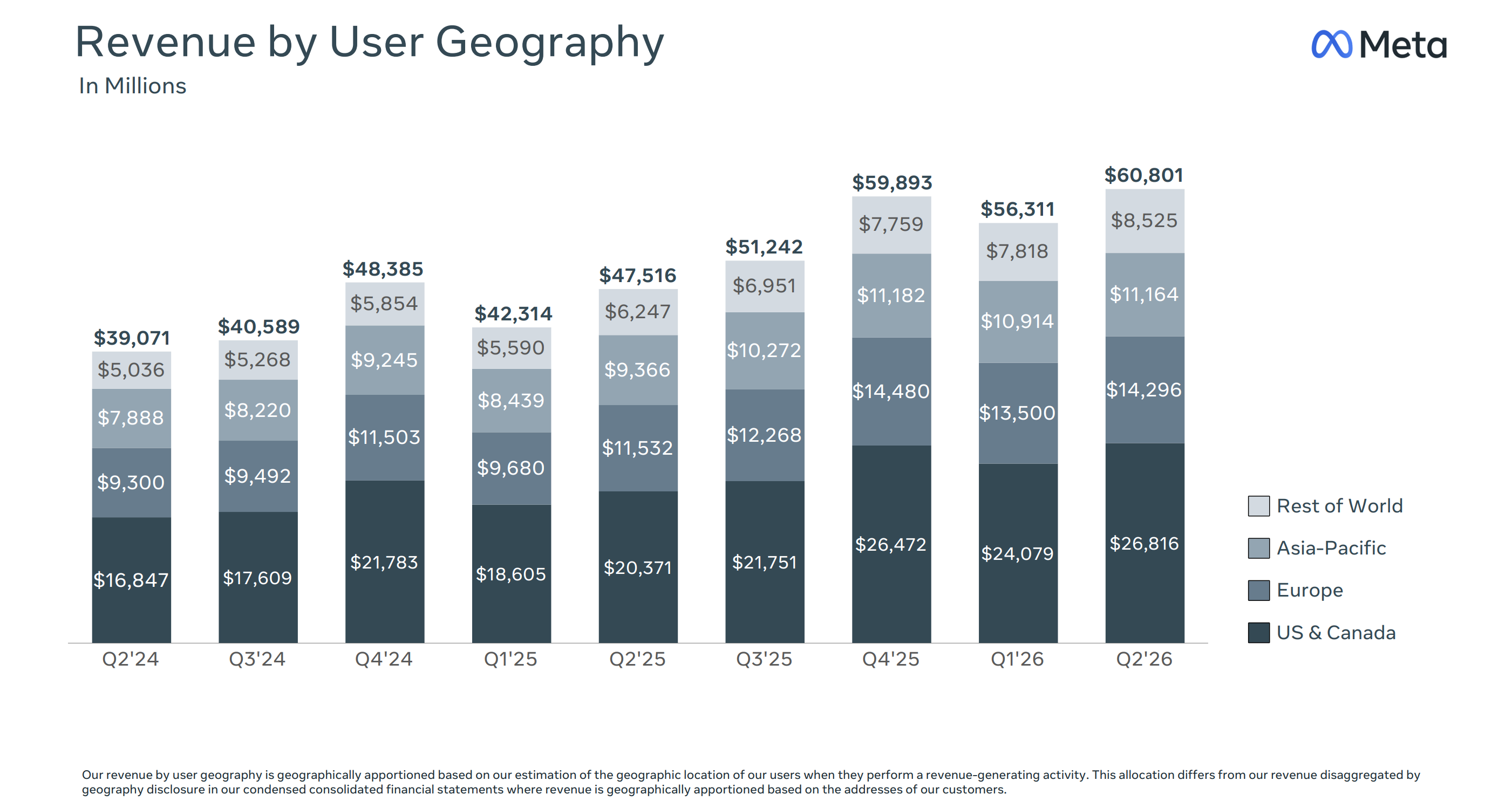
Overall, this does not look like a dying business to me, but rather a business that continues to compound and solidifying it’s moat.
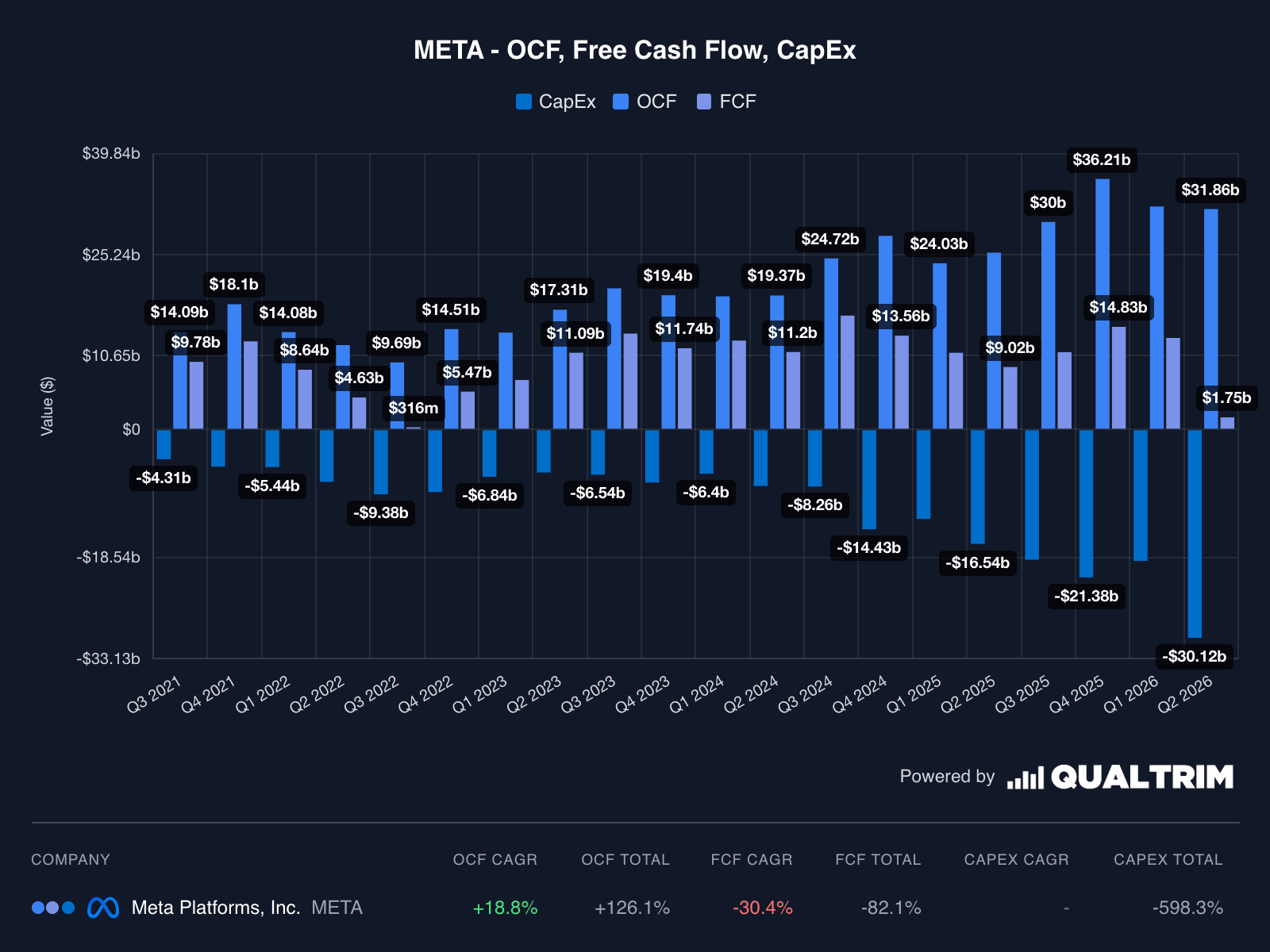
We can obviously that free cash flow is dipping given the reasons we discussed earlier about heavy expenses, Meta is closing to negative free cash flow probably in the next quarter. But, given their operating cash flows continuing to grow and having a strong balance sheet, Meat can withstand these investments in the years to come.
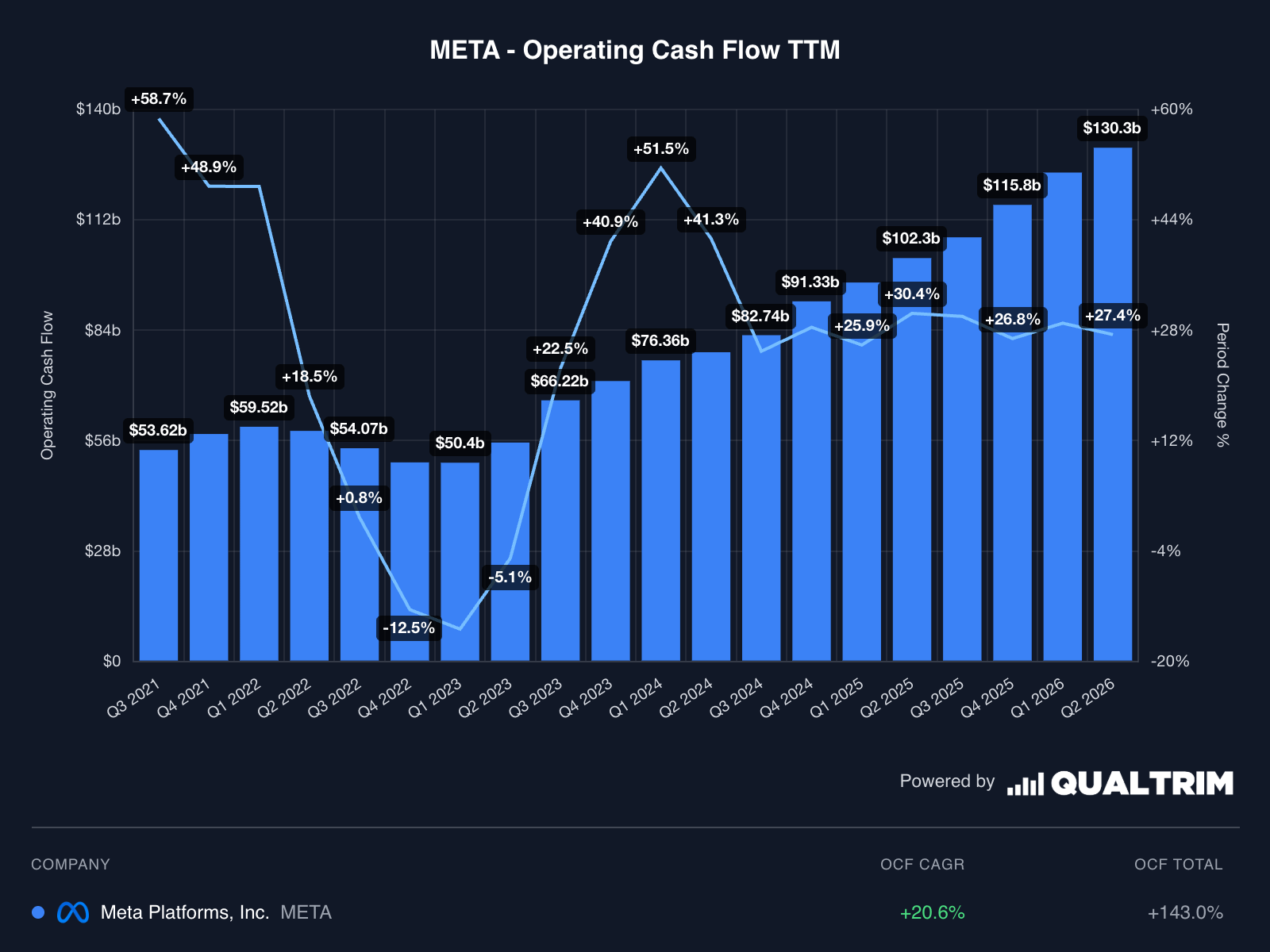
As you can see, operating cash flow in the trailing twelve months grew to $130.30 billion which is more than enough to cover for the $130-$145 billion in CapEx.
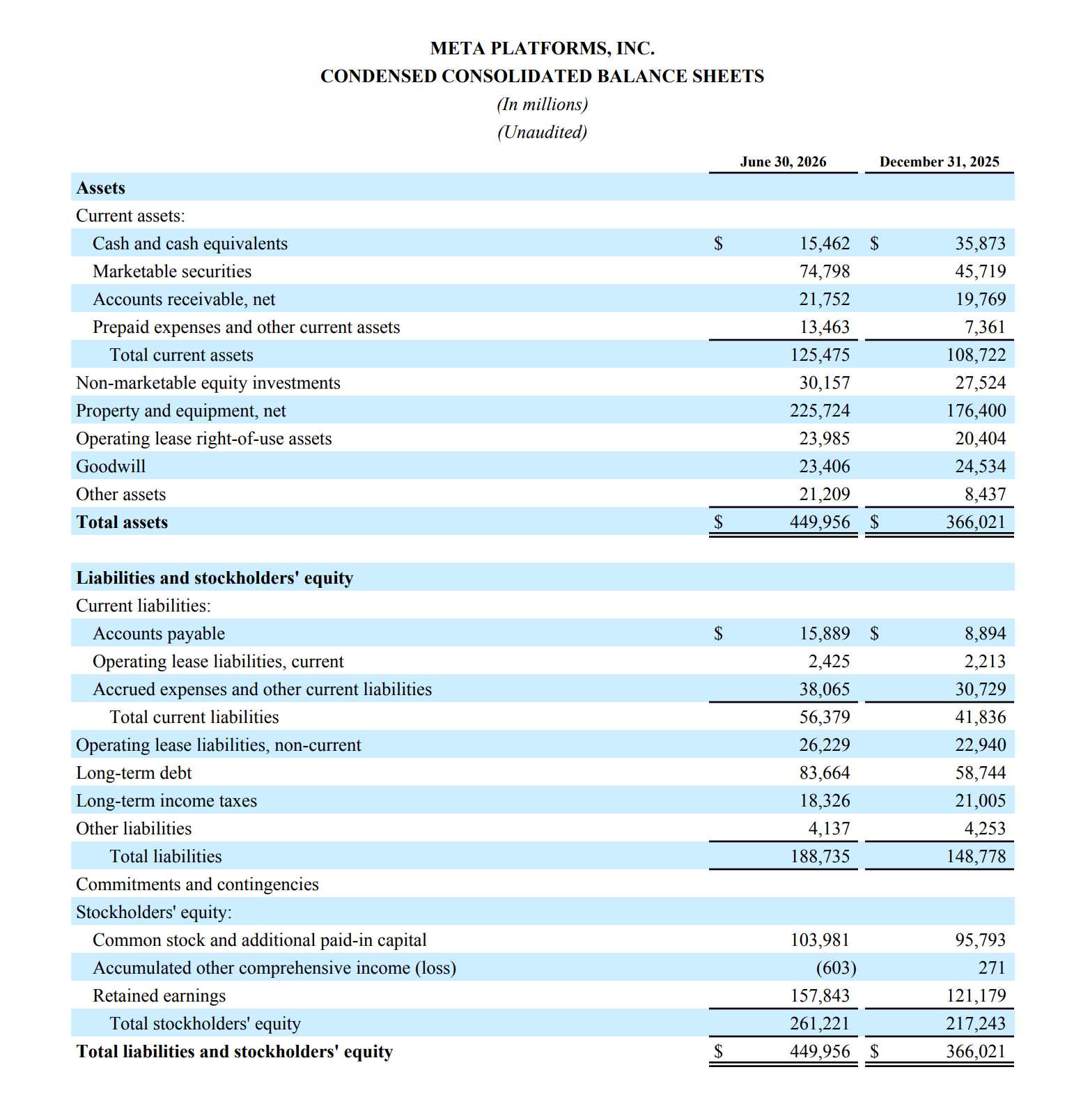
Liquid War Chest: $90.26 billion in cash, cash equivalents, and short-term marketable securities. This means that $74.80B sit in short-term treasuries earning 4-5% annual interest with zero risk.
Long-Term Debt: $83.66 billion.
Net Cash Buffer: +$6.60 billion (meaning their liquid cash still exceeds their total debt).
New Debt Raised: ~$24.9 billion added in H1 2026 to pre-fund their massive AI data center buildout.
Meta is deliberately using its fortress credit profile to raise cheap fixed-rate debt and front-load AI infrastructure while keeping a $90B liquid reserve generating yield. So the balance sheet is very strong. Onwards to guidance.
Key Guidance Numbers
Q3 2026 Revenue: Guided to $61.0 billion – $64.0 billion (representing ~25% YoY growth at the $62.5B midpoint, incorporating an estimated ~1% foreign exchange headwind).
Full-Year 2026 Total Expenses: Raised at the lower end to $165.0 billion – $169.0 billion (up from $162B–$169B) to absorb the $2.4 billion legal charge recorded in Q2.
Full-Year 2026 CapEx: Narrowed upward at the lower end to $130.0 billion – $145.0 billion (up from $125B–$145B), including principal payments on finance leases.
Tax Rate: Expected to be between 15% and 17% for the remaining quarters of 2026 (adjusted up from 13%–16%).
Qualitative Outlook Highlights
Full-Year Profitability: Management reiterated that they expect full-year 2026 operating income to be higher than full-year 2025.
2027 CapEx Trajectory: While Meta did not provide a specific dollar target for 2027, CFO Susan Li made it clear that infrastructure plans are geared toward aggressively maximizing compute capacity through 2026 and 2027.
Sure, the cash drain from this massive CapEx cycle is frustrating to watch in the short term. But Meta is currently trading at roughly 17x forward earnings—an remarkably cheap valuation for a company of this quality that is actively compounding earnings despite heavy infrastructure spend. As Bill Ackman often points out, when a business can grow earnings while simultaneously re-investing to widen its competitive moat, investors shouldn't panic—they should applaud.
I want to share some keynotes from the earnings call from Mark Zuckerberg which I think is important for investors to know:
1. On Monetizing AI & Selling Intelligence vs. Compute
“Selling intelligence yields far higher margins than selling compute directly. We get a lot of offers for our compute at a meaningful premium over what we paid for it... but it would be foolish to just sell all the compute and take a short-term profit when you can build intelligence on top of it, which compounds that value exponentially.”
2. On Why AI CapEx Is Already Paying Off in the Core Ad Engine
“On a dollar basis, our ads business is reporting faster year-over-year revenue growth than any other company’s reported ad business—so these AI investments are paying off.”
“LLMs add a first principles understanding of what the content is about and why it is compelling... Now there is going to be a whole new and nearly infinite universe of personalized content. This is going to make our services a lot more useful and engaging for people.”
3. On Personal Agents & The 5-Year Vision
“It’s extremely unlikely if you look out five years from now that you don’t have billions of people with a personal agent that understands your goals and that is just working on your behalf 24/7 to achieve your goals in whatever domain you care about—whether it’s health, finances, productivity, or relationships.”
“To build great personal agents, this needs to be a great consumer product that just works out of the box and is easy enough for billions of people to adopt and use.”
4. On Business Agents & Monetizing via Compute Auctions
“Over time, I expect that we’re going to evolve more of these products to be like our ad systems, where businesses only pay us when we achieve results for them. Over time, that will let us run an efficient auction over our compute, similar to how we do that for advertisers today.”
5. On the Long-Term Conviction behind Meta’s AI Bet
“I get that this is a big investment and it’s a big bet. We see the technology working, we’re happy with the trajectory of the lab, and we believe this is going to be a big thing. My personal bet is that the people who invest in this are going to be rewarded and feel very good over time.”
6. On Strategic Sovereign Control of Full-Stack Tech
“Having sovereignty over building your own models is going to be an important part of the stack going forward... Building the full-stack model is going to be a lot of the advantage over time in how we build personal superintelligence agents, business agents, and all these different use cases.”
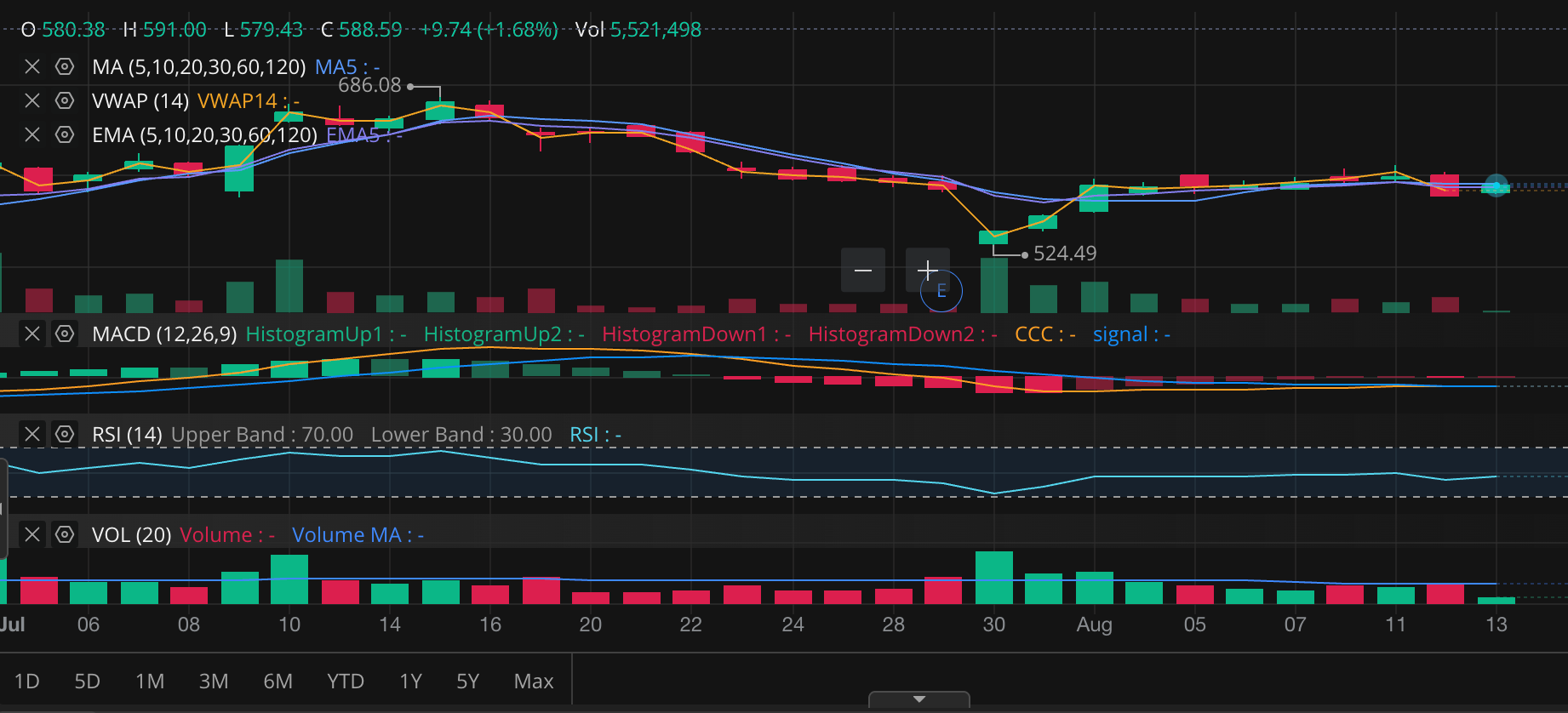
So if we look at Meta stock after their earnings it dropped roughly to $525 and in just 3 days it filled the gap to pre-earnings where the stock is at about $590 a share. So that was a great buying opportunity to snag some shares which I myself did:)
Final Thoughts
I think these companies are heading in the right direction and investing in AI infrastructure today will solidify their positions as the leaders in both AI infrastructure and distribution in the decades to come. Investors must be very patient with these companies as the CapEx cycle will eventually end, and these companies will yield very attractive returns for shareholders in the years to come.
If you enjoyed this deep dive, please consider liking this post and leaving a comment with your thoughts. If there’s any wrong information in the article please let me know so that I can apply the fixes needed.
Disclaimer: This is not financial advice, nor am I telling you to buy the stocks I mentioned here. You must do your own due diligence and determine for yourself if you are comfortable investing in these companies which are undergoing massive CapEx investments and if you’re patient enough to own for years.