

Amazon is widely regarded as one of the most dominant businesses on the planet, with its annual revenue run rate on track to approach 1 trillion dollars by the end of 2028.
The company’s diversification is vast. Beyond its core first-party retail and logistics empire, Amazon commands high-margin segments like AWS, digital advertising, third-party seller services, and subscriptions, while aggressively expanding into new verticals. It is building a broad satellite internet network to challenge Starlink, scaling advanced robotics across its fulfillment network, and staking a claim in autonomous vehicles through Zoox. But perhaps the most exciting growth engine right now is its custom silicon business: AWS Graviton and Trainium chips are on absolute fire, growing at 100% year-over-year and hitting a 20 billion dollar annual run rate.
Amazon's competitive moat is widening by the day, making it virtually certain that the company will be significantly larger five years and a decade from now.
Yet, investing requires more than identifying a great business; we must anchor our expectations in forward-looking returns driven by improving fundamentals. That brings us to the disconnect: despite its operational dominance, Amazon's stock has lagged over the past year and the last five years, and it continues to trail both the S&P 500 and the QQQ year-to-date.
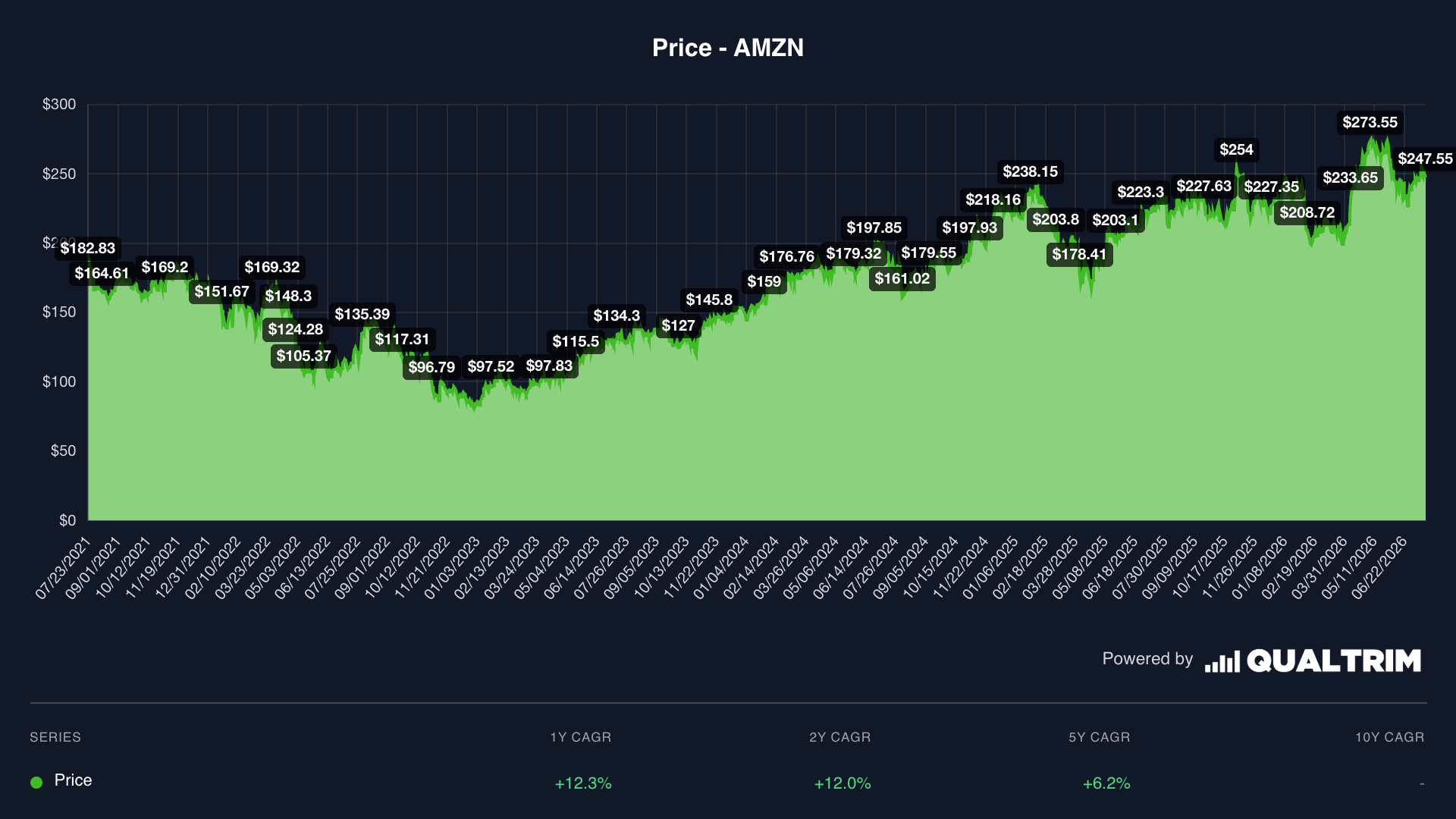
If you had bought 5 years ago Amazon stock, you would be up only 35% which is a massive underperformance relative to the S&P500. But in this article I’m here to tell you why I believe right now Amazon stock is a strong buy and why past performance does not guarantee future performance.
Economic Moat
Jeff Bezos firmly believed that every dollar of future cash flow should be aggressively reinvested back into the business to widen the moat. Wall Street definitely punished the stock in the short term as margins compressed, free cash flow dipped into the red, and GAAP earnings looked ugly. But while everyone was staring at the quarterly income statement, a massive transformation was happening in the background.
Bezos famously stated that Amazon would base its investment decisions on long-term market leadership rather than short-term profits. He viewed shareholders not as day-traders looking for a quick flip, but as partners in a multi-year journey. That exact mindset is why Amazon absorbed years of heavy spending to build out AWS, its logistics network, and Prime—investments that looked completely irrational at the time, but ultimately built unassailable moats decades later.
Does the heavy capital expenditure on data centers to meet the massive, supply-constrained demand for AI compute ring a bell? It is the exact same moat-widening playbook we saw in the past. And today in the AI era is no different. Amazon’s moat just continues to widen and AI will only strengthen the company further.
Let's walk through all of Amazon’s underlying business segments so you can see why this is a sleep-without-worry type of investment:
AWS (Amazon Web Services)

AWS has been Amazon’s crown jewel, laying the groundwork for its current dominance and the massive AI tailwinds it is riding today. Led by Andy Jassy—who started as Jeff Bezos’s technical advisor before building AWS from the ground up and eventually succeeding Bezos as CEO—the cloud titan was born out of an internal struggle to help Amazon's own engineers deploy software faster.
Jassy and his team recognized that virtually every company faced the same heavy infrastructure bottlenecks. That vision materialized in March 2006 with the launch of Amazon S3 (Simple Storage Service), a revolutionary utility that allowed developers to store and retrieve any amount of data securely over the web on a pay-as-you-go basis, completely eliminating the need to buy and maintain physical servers.
What started as a simple, highly scalable place to park files and logs fundamentally changed how the tech world operated. Today, those exact S3 data lakes and foundational cloud primitives are what store the massive, petabyte-scale datasets required to train modern artificial intelligence models.
Cloud computing is much more than just renting servers; it is about absolute enterprise stickiness. Once a corporation builds its core data pipelines, database architectures, and AI workflows on AWS, migrating away is expensive, risky, and operationally disruptive. AWS turns IT infrastructure into a mission-critical utility, providing the high-margin cash flow that funds Amazon's broader ecosystem bets while locking businesses into a deeply integrated developer platform.
AWS recently accelerated to a 28% year-over-year growth rate on a massive $150 billion annualized run rate, continuing to scale as demand outpaces supply. Every data center being brought online is immediately monetized to handle surging AI workloads. Backed by these structural tailwinds, AWS alone is well on its way toward a $600 billion annual revenue run rate over the next decade.
Advertising
Amazon has quietly evolved into a digital advertising powerhouse, standing shoulder-to-shoulder with tech heavyweights like Google and Meta.
The core of this moat comes down to user intent. When people open Google, they are looking for information. When they open Meta, they are looking for social connection and entertainment. But when people go to Amazon, they are holding a credit card with direct, unmitigated intent to buy.
Because those ads sit right at the exact point of sale, Amazon commands extraordinary pricing power. Brands can’t afford to ignore the platform because that is where the highest-converting buyers live. What started as simple sponsored product listings has expanded into a full-funnel advertising ecosystem—spanning sponsored brands, display ads, Prime Video inventory, and the Amazon Marketing Cloud.
This segment operates at exceptionally high margins, effectively monetizing the millions of shopping sessions passing through the ecosystem every single day and turning retail traffic into a high-margin cash flow machine.
Subscriptions

The Prime ecosystem is one of the most powerful consumer moats ever built. By bundling ultra-fast shipping, video streaming, music, and exclusive member perks into a single recurring fee, Amazon has trained hundreds of millions of consumers to default to its platform for everyday commerce.
This creates immense customer loyalty and an ironclad psychological barrier—once a household relies on Prime for its daily logistics and entertainment, shopping anywhere else feels like a downgrade. It generates predictable, high-margin recurring cash flow that insulates Amazon from consumer discretionary dips, keeps customer acquisition costs at zero, and ensures that the retail flywheel spins continuously without friction.
Chips Business

Amazon’s custom silicon division has evolved from a quiet internal project into an absolute powerhouse. Encompassing Graviton processors for general workloads, Nitro chips for networking, and Trainium accelerators for artificial intelligence, the chips business has already surged past a $20 billion annual revenue run rate, growing at triple-digit rates year-over-year.
In fact, Andy Jassy has pointed out that if Amazon spun this operation out as a standalone semiconductor vendor selling chips directly to third parties, that annual run rate would approach $50 billion. Right now, that hardware is kept entirely inside AWS to power cloud instances, and demand is staggering. Enterprises face intense compute scarcity as they race to build AI models, leaving Amazon’s custom silicon virtually sold out. With multi-year commitments locking in massive workloads, Amazon has built a premier semiconductor business that further deepens the software and hardware lock-in across AWS.
First Party And Third Party Sellers
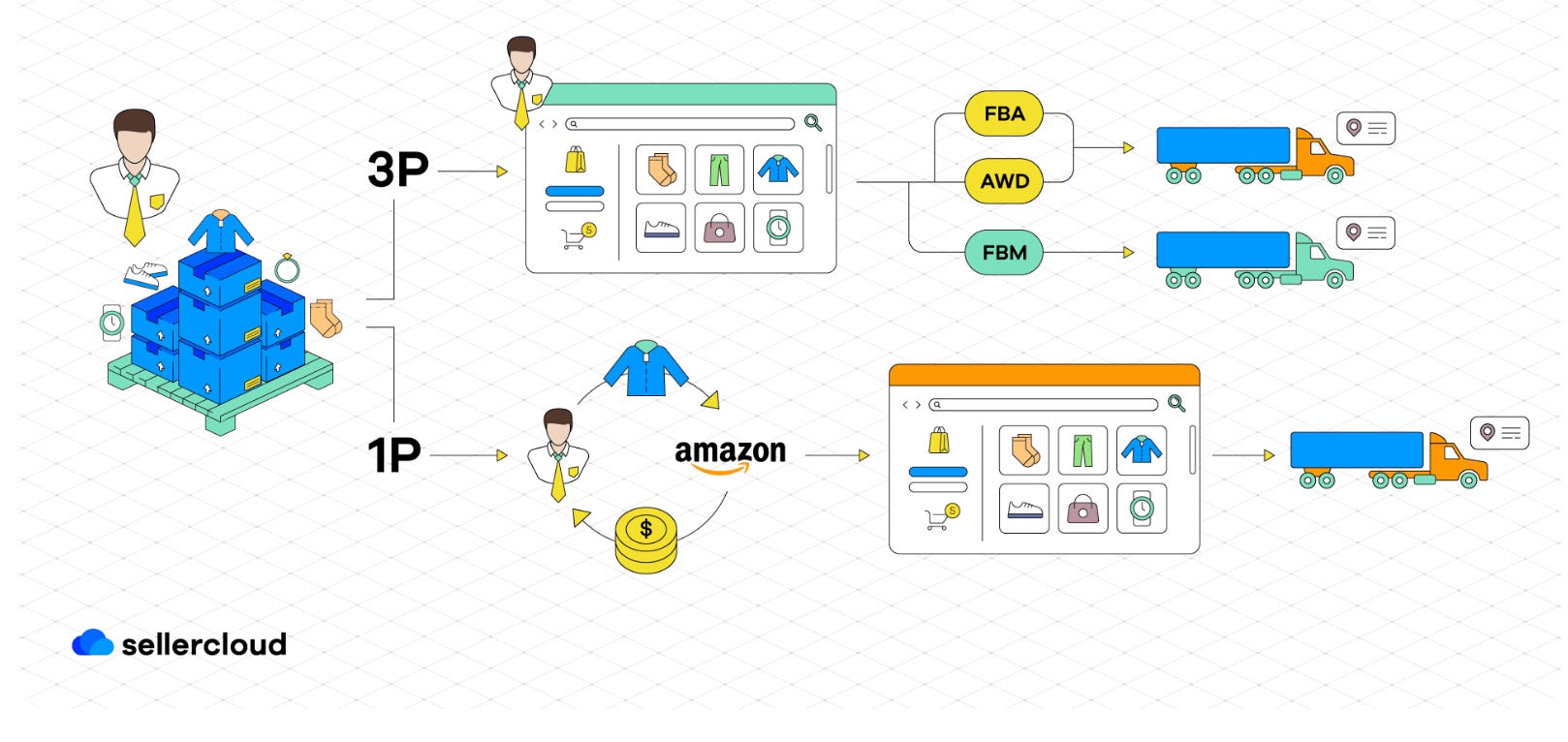
Amazon provides the optionality for vendors to sell their products either through their First Party or Third Party agreements depending on what the vendor chooses that is appropriate for them.
First Party Sellers - Amazon’s first-party (1P) retail operation serves as the foundational anchor of its massive consumer scale. While often viewed as a lower-margin retail business on paper, the 1P model is what fuels the entire ecosystem flywheel.
By buying inventory directly from manufacturers at wholesale and selling it under the trusted “Ships from and Sold by Amazon” banner, the company secures massive volume. That raw volume is what initially justified—and continues to sustain—the billions of dollars poured into warehouses, local fulfillment centers, and global logistics networks. It guarantees that consumers can always find what they need with absolute reliability, anchoring customer trust and driving the daily traffic that makes the rest of Amazon’s high-margin segments possible. For the vendor, partnering as a 1P supplier means selling wholesale directly to Amazon, which then takes complete ownership of the inventory, pricing, marketing, customer service, and returns. While the brand hands over control of the retail experience, it trades that operational friction for immediate access to massive consumer demand and guaranteed volume without managing the end-to-end retail execution.
Third Party Sellers - The third-party marketplace is where Amazon’s network effects truly explode. Today, independent merchants account for the majority of all physical units sold on the platform, turning Amazon from a traditional retailer into a massive digital platform.
The moat here is a self-reinforcing flywheel: millions of active buyers attract thousands of merchants, and that massive selection attracts even more consumers. But what makes this segment an incredible compounding machine is that Amazon doesn’t just host these sellers; it monetizes their operations. Through Fulfillment by Amazon (FBA), storage, and targeted seller advertising, Amazon provides the infrastructure that allows small and medium-sized businesses to scale globally. It generates high-margin service revenue while letting third-party merchants shoulder all the inventory risk, creating an economic engine that competitors simply cannot replicate. For the vendor, this model means retaining full control over pricing, marketing, and inventory management, allowing them to directly govern their own margins. At the same time, merchants can tap into Amazon’s advanced supply chain infrastructure—such as Amazon Warehousing and Distribution (AWD)—to seamlessly streamline their logistics without giving up ownership of their business.
Amazon Leo (Satellite Network)
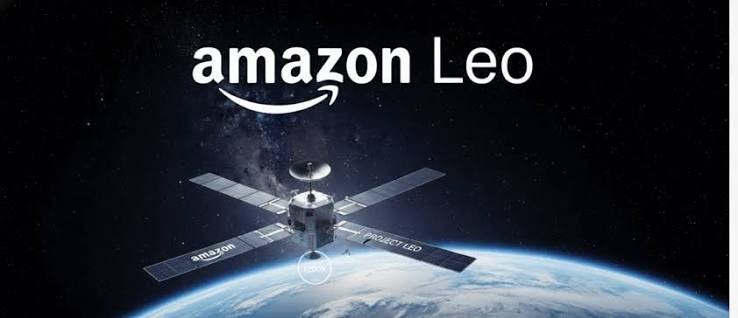
Amazon Leo has successfully deployed 396 production satellites into low Earth orbit. While that trails far behind SpaceX’s Starlink fleet, it marks the critical threshold needed to begin rolling out initial commercial broadband services.
Regarding margins, satellite internet economics mirror those of cloud computing and telecommunications: extremely high incremental margins once scale is reached.
Building and launching the constellation requires massive upfront capital expenditures—buying rockets, manufacturing thousands of custom satellites, and building ground stations. However, once the constellation is operational, the cost to add an incremental subscriber is remarkably low. Just like Starlink, which has matured into a highly profitable, high-margin cash generator for SpaceX, Amazon Leo’s revenues from remote households, enterprise backhauls, aviation Wi-Fi, and defense clients will drop straight down into exceptional long-term operating margins, further compounding Amazon’s structural profitability.
While Amazon hasn’t locked down official long-term revenue guidance for the segment yet, Wall Street analysts (such as those at Bank of America) project that Project Kuiper could pull in upwards of $7 billion in annual consumer revenue by 2032, tapping into a global satellite internet market expected to soar past $40 billion.
When you layer in high-value enterprise backhauls, aviation Wi-Fi, defense contracts, and deep AWS cloud data integration, the total addressable revenue pool expands significantly, positioning it as another multi-billion-dollar compounding engine once fully scaled.
Anthropic Investment
Amazon’s multi-billion-dollar strategic partnership with Anthropic is one of the most brilliant moves in modern corporate history. What started as a minority equity check has expanded into a massive, multi-layered alliance that positions Amazon at the absolute forefront of the artificial intelligence boom.
The financial and operational structure of the partnership creates a powerful, self-reinforcing loop:
The Equity Windfall: Amazon’s total committed capital has scaled up to $33 billion, securing a massive mid-teens equity stake in one of the world’s most valuable AI labs. As Anthropic’s valuation has skyrocketed, this equity position has turned into a staggering paper asset worth well over $100 billion, resulting in billions of dollars in pre-tax accounting gains that flow directly into Amazon’s financial statements.
The $100B+ Infrastructure Lock-In: As part of the agreement, Anthropic committed to spending more than $100 billion on AWS infrastructure over the next decade. This means every dollar of capital or funding Anthropic raises flows right back into Amazon’s ecosystem to rent compute.
Project Rainier & Custom Silicon Validation: Anthropic isn’t just renting generic cloud space; they are anchoring Project Rainier—one of the largest AI superclusters on earth—powered by hundreds of thousands of Amazon’s custom Trainium chips. Anthropic works hand-in-hand with Amazon’s Annapurna Labs to stress-test, optimize, and provide direct feedback on next-generation silicon.
Bedrock Monetization: Through Amazon Bedrock, enterprise customers worldwide get seamless access to Anthropic’s frontier Claude models. This drives massive enterprise consumption data traffic onto AWS, making Amazon the premier distribution hub for corporate AI deployment.
It is a closed-loop economic engine: Amazon helps fund and scale a premier AI pioneer, that pioneer spends its capital exclusively on AWS cloud primitives and custom silicon, and the entire ecosystem flywheel accelerates with every new model generation.
Other Revenue Segments
While the official “Other” category on the income statement is largely dominated by advertising services, it also hints at the early-stage monetization of emerging bets. But the real structural value lies in what is being built behind the scenes:
Zoox (Autonomous Mobility): Zoox is taking a completely unique approach to autonomous vehicles by building a custom, bidirectional robotaxi from the ground up—featuring no steering wheel, a carriage-style interior designed for passengers, and advanced safety envelopes. As commercial testing and rollouts scale in dense urban environments, Zoox positions Amazon to capture a massive slice of future autonomous fleet logistics and passenger mobility.

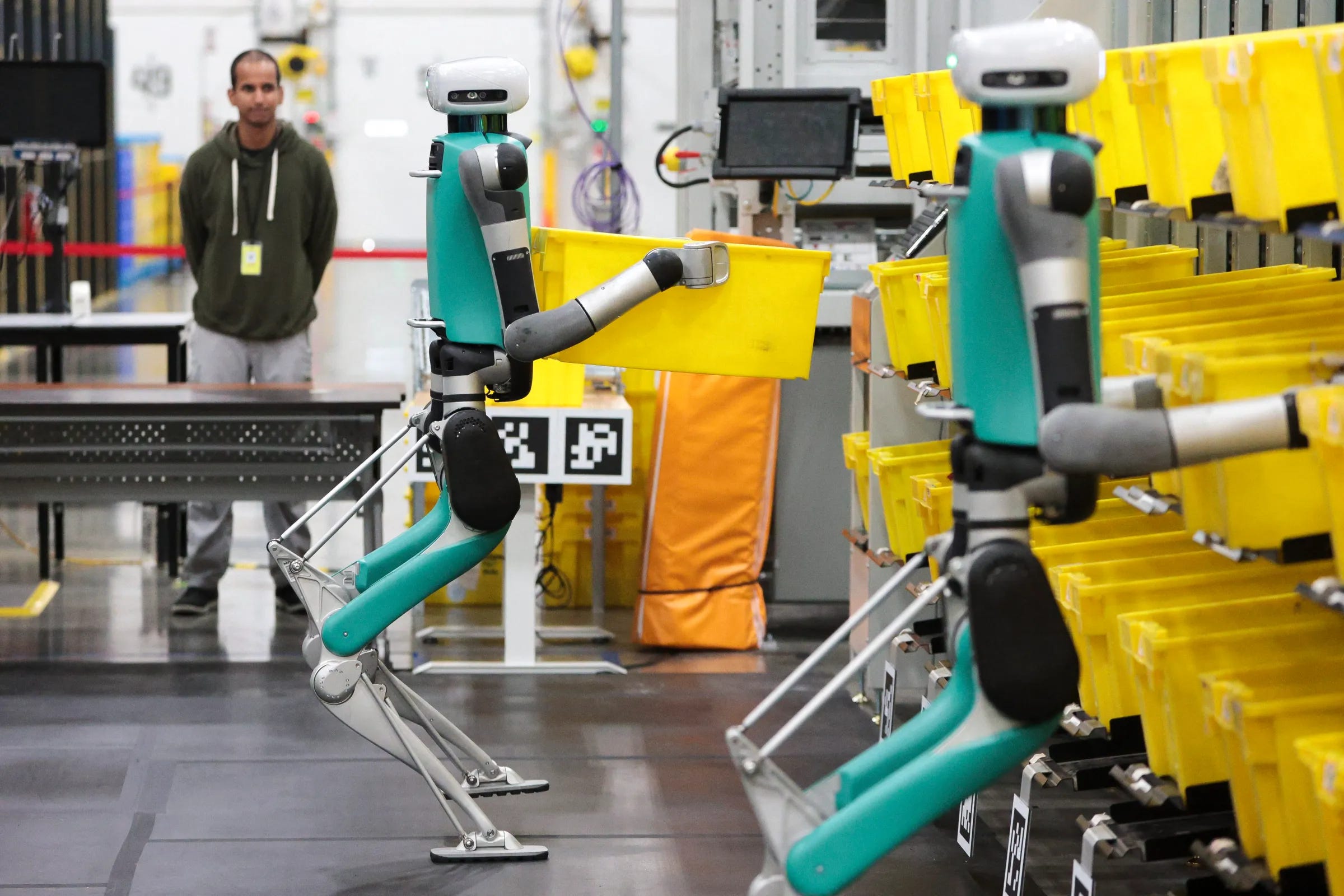
Taken from https://www.aboutamazon.com/news/innovation/zoox-headquarters-car-ride Robotics & Fulfillment Automation: Inside its warehouses, Amazon’s robotics division—bolstered by acquisitions like Kiva Systems and internal innovations like Sparrow and Proteus—is redefining industrial automation. By deploying hundreds of thousands of mobile robots and AI-driven sorting arms across its fulfillment network, Amazon continuously drives down cost-per-unit fulfillment, expands operational margins, and widens its cost advantage over every legacy retailer.

Amazon is still the dominant force in retail and logistics, the leader in cloud infrastructure with AWS, and an advertising giant sitting right alongside Google and Meta.
At the same time, the company’s margin profile is shifting. High-margin segments like AWS, digital advertising, and subscriptions are taking up meaningful portion of the overall revenue. Add the robotics segment and broad high speed satellite internet and you got yourself an explosive operating leverage of the business. The moat has never been more stronger with Amazon.
My Valuation Estimates
I always say valuation is the last thing investors should look at, and Amazon is no different. Now that we’ve established the economic moat of the business, we can turn our attention to valuation and determine what price we should actually pay for the stock.
Before touching any math, you need to verify whether a company possesses a durable economic moat and a business model capable of generating genuine, long-term returns.
I’ll share different valuation frameworks, focusing primarily on earnings-per-share (EPS), price-to-operating-cash-flow (P/OCF), EV/EBIT (enterprise to operaing income), and EV/EBITDA. I chose these metrics because Amazon is heading into a period of negative free cash flow due to massive capital expenditure investments. As a result, we need to look under the hood at the core operations of the business to properly assess its true value.
We’ll run through these valuation models to stress-test our numbers and build a probability-weighted outlook for the stock moving forward. But, first let’s take a look at the fundamentals to see if they are headed in the right direction up into the right.
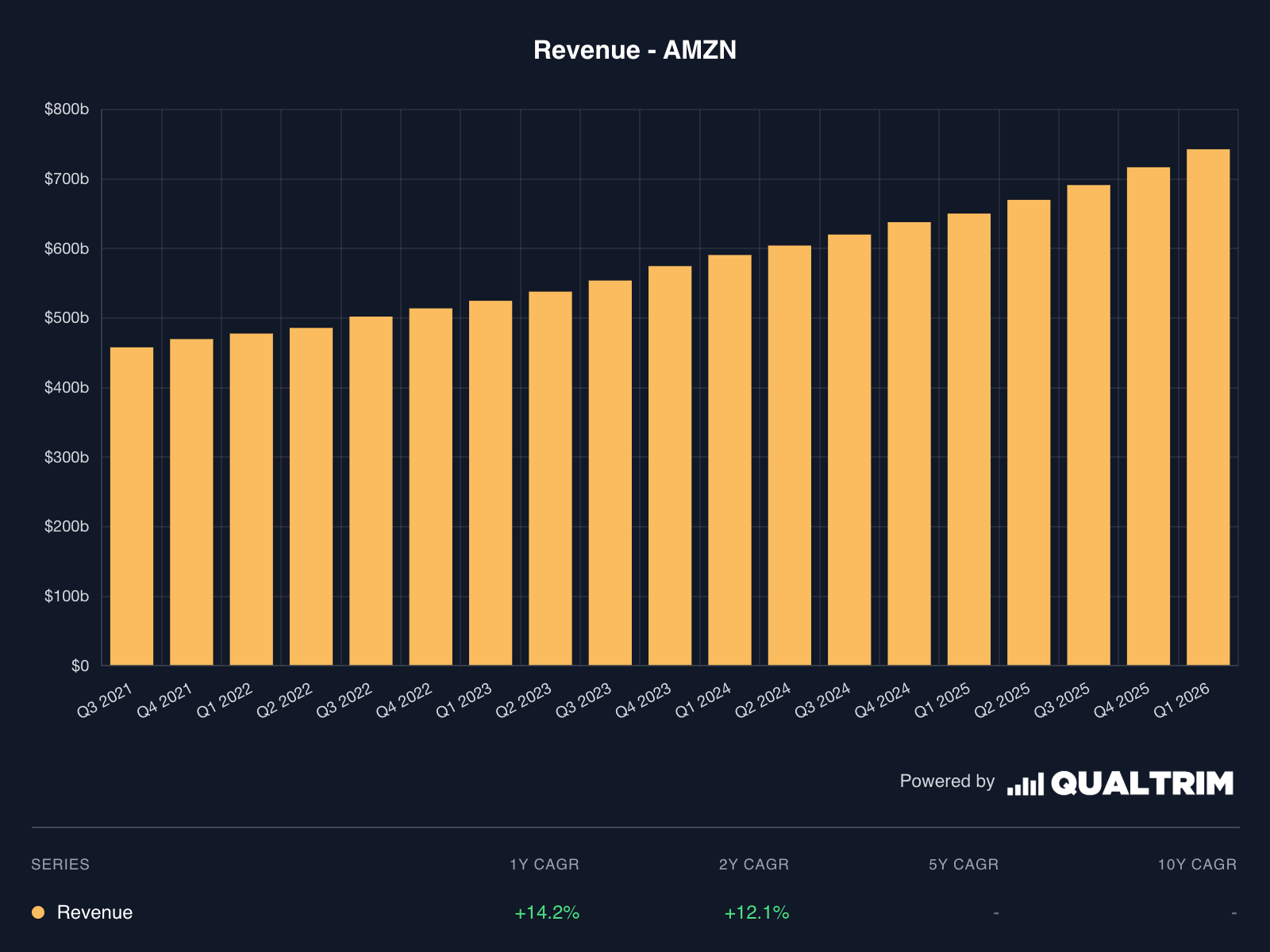
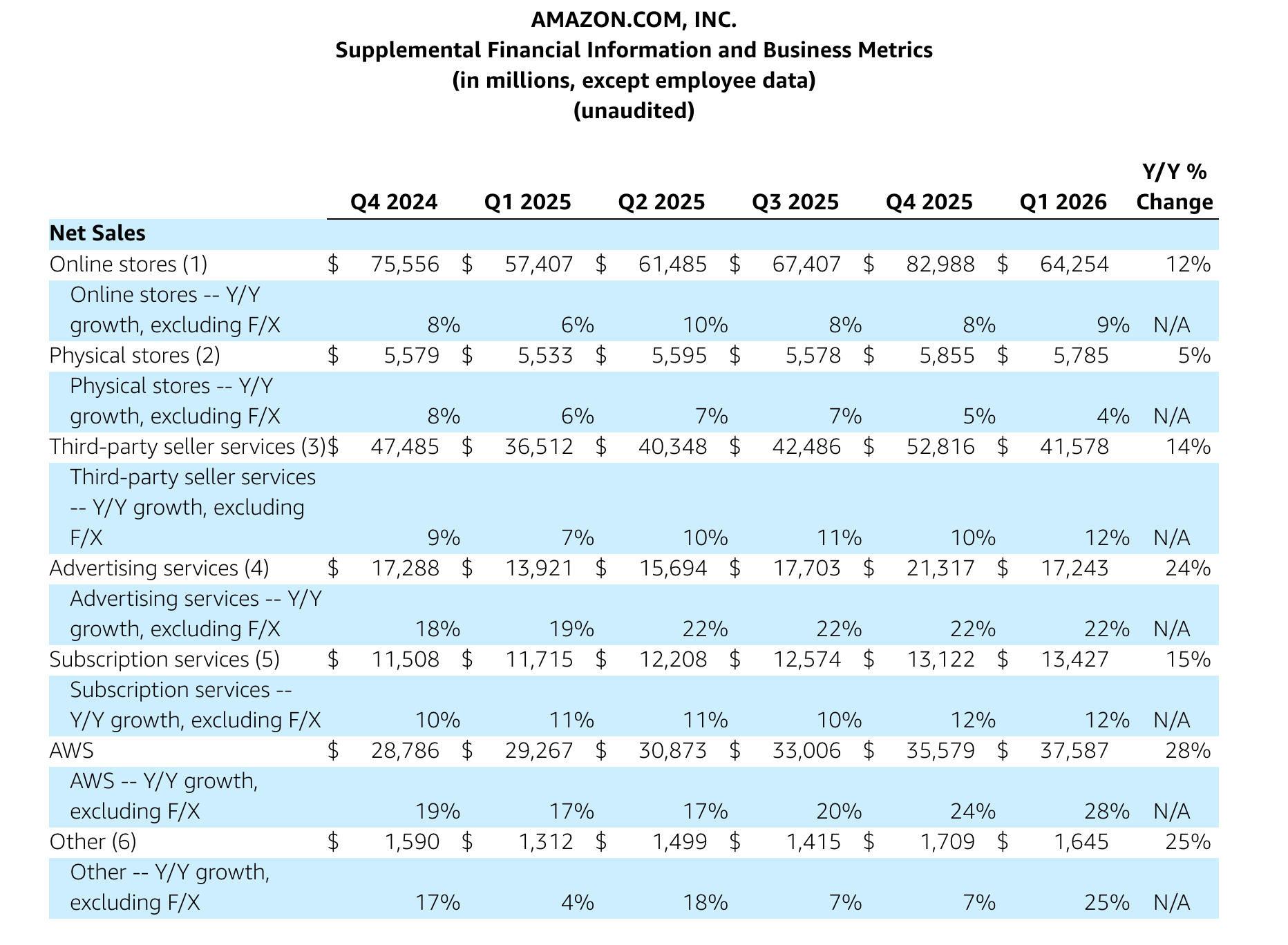
Given the size of Amazon, they still operate at a startup pace, aggressively reinvesting cash flow back into the business. Looking across their segments—with the exception of physical stores, which represent a very small portion of total revenue—every part of the business is compounding at double-digit growth rates, led by high-double-digit surges in their most lucrative engines, AWS and advertising. Overall, the revenue growth profile remains exceptionally strong.
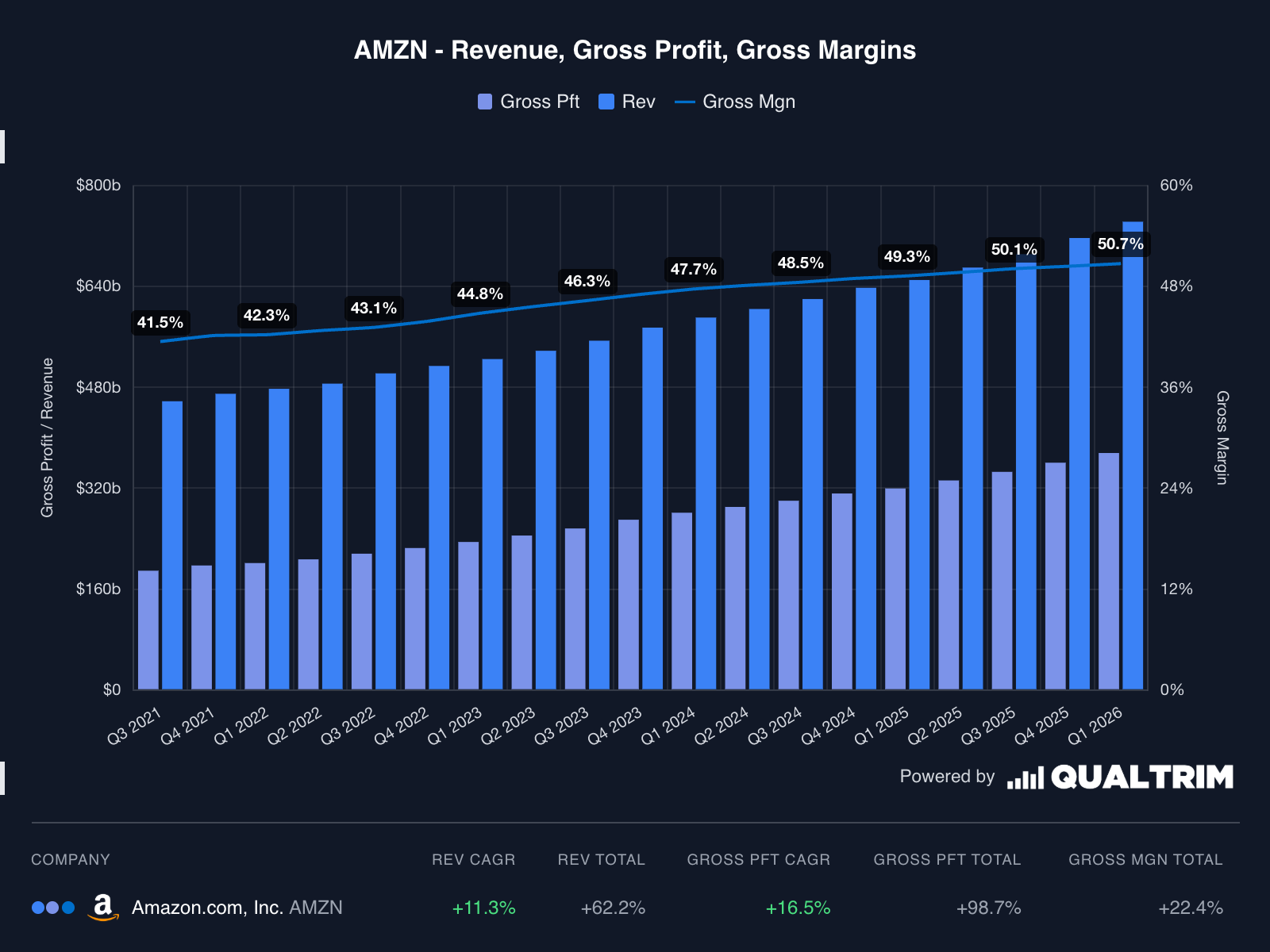
Amazon’s margins are expanding as the business becomes structurally more profitable. For every dollar of sales, Amazon generates roughly 50 cents in gross profit, showcasing powerful operating leverage across the entire ecosystem.
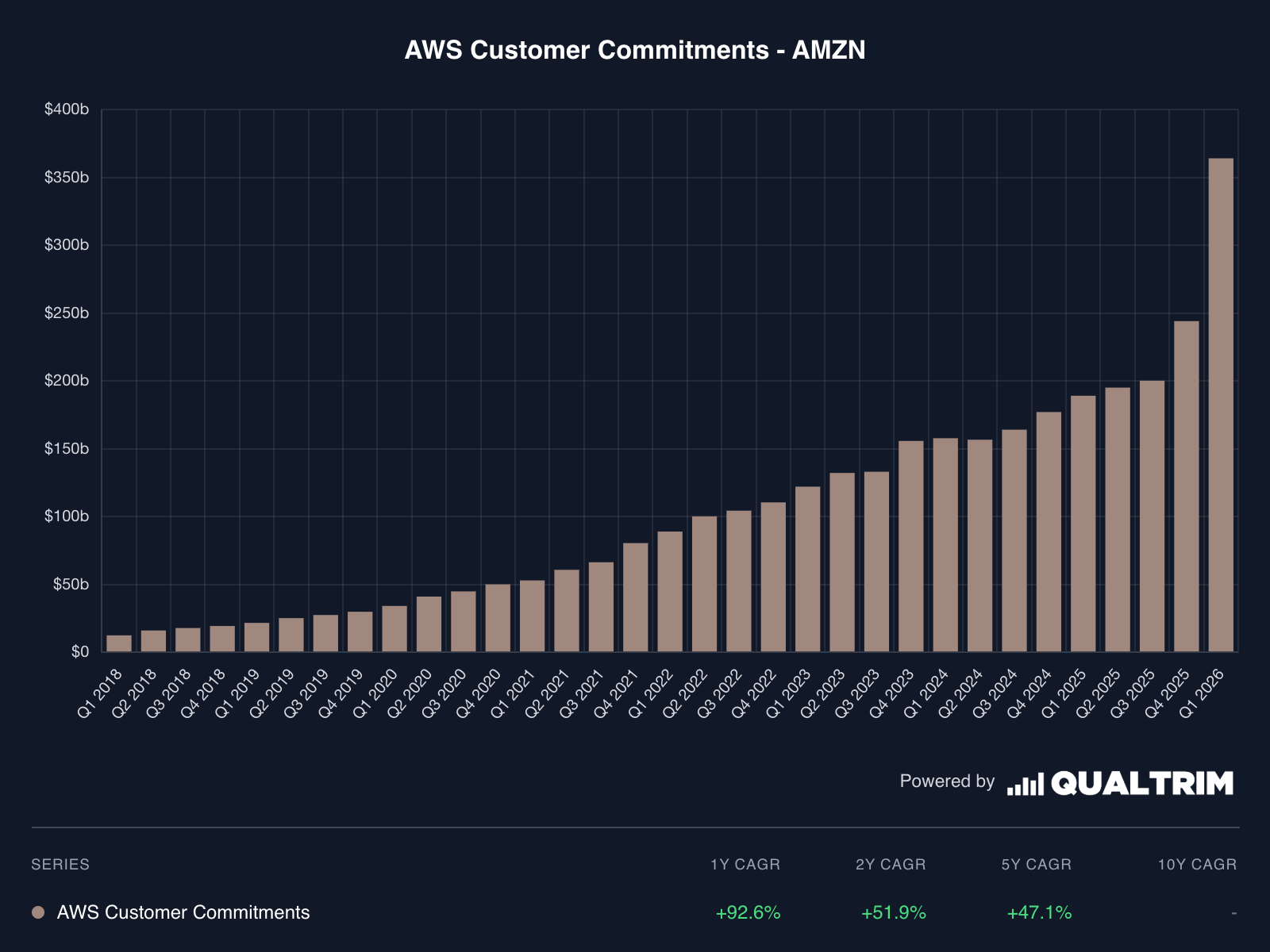
AWS backlog commitments continue to see massive demand up to 364 billion dollars which are to be recognized in the span of 12-24 months. Also, this record figure does not include separate massive agreements, such as a multi-billion dollar deal with Anthropic exceeding $100 billion.
I also expect that backlog to increase massively in their Q2 2026 earnings given that the demand is not slowing down. We also saw a preview of Google’s cloud backlog reaching above 500 billion dollars in their latest Q2 2026 earnings. I expect Amazon to match or even top that in their next earnings.
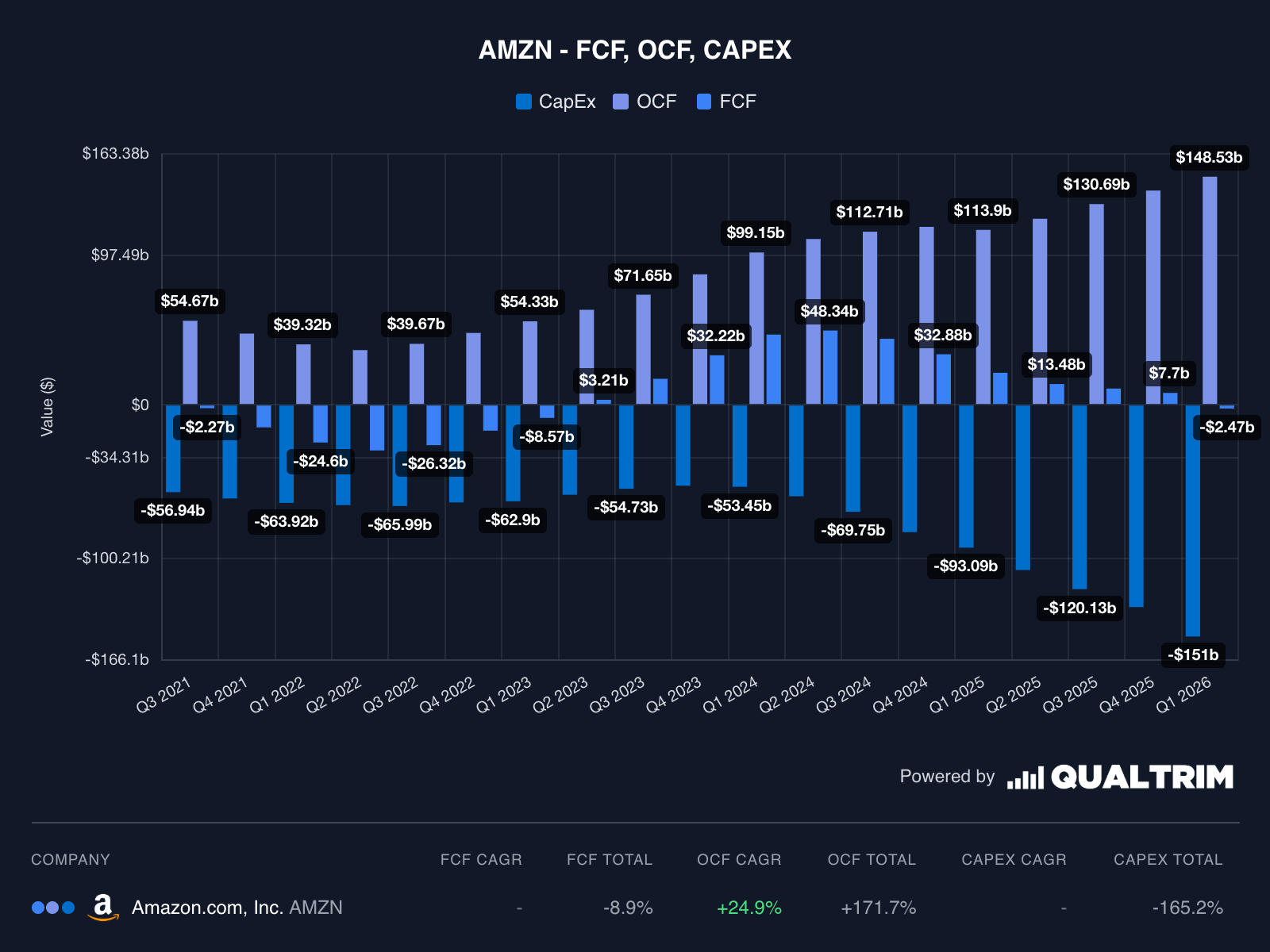
As you can see from this figure, free cash flow has turned negative due to Amazon's massive capital expenditure cycle. Every dollar of operating cash flow is being aggressively reinvested back into building data centers and securing the power capacity required to meet soaring AI inference demand. This is why our valuation model relies on the price-to-operating-cash-flow (P/OCF) metric rather than traditional FCF multiples to accurately value the business during this heavy investment phase.
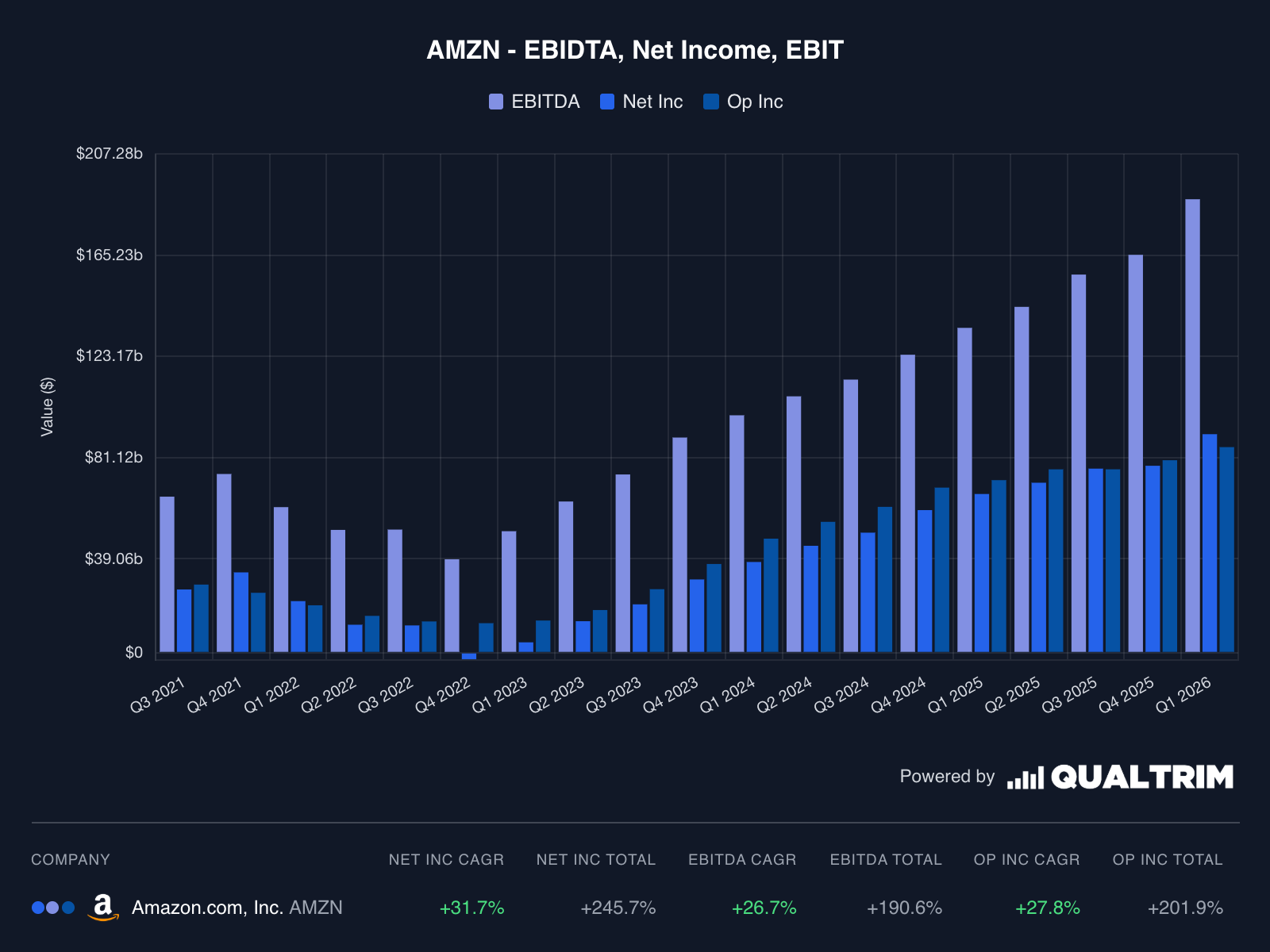
Amazon’s EBIT and profit margins continue to expand as high-margin segments like AWS, subscriptions, and advertising grow at a rapid pace and account for a larger share of overall revenue.
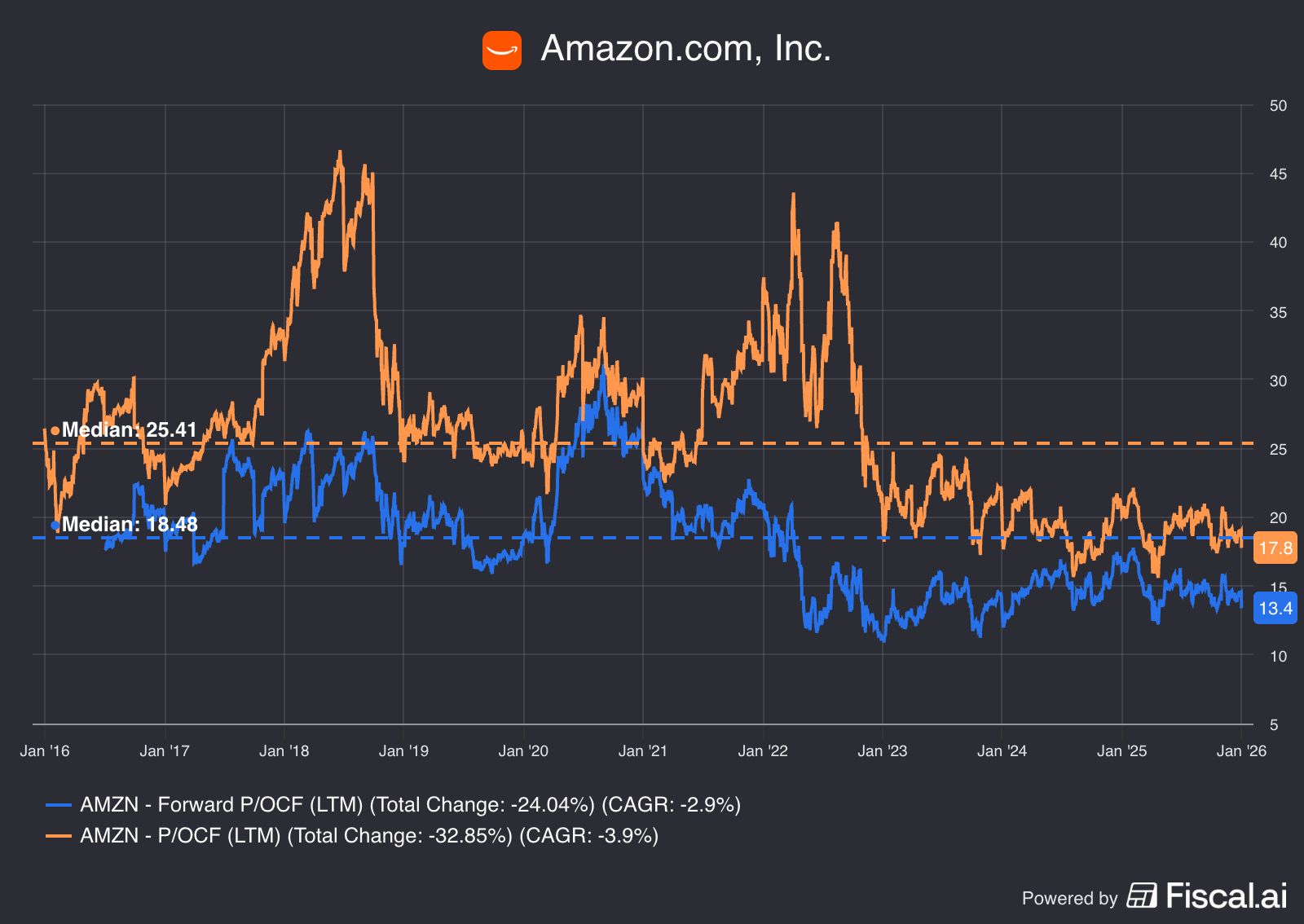
Amazon is currently trading at some of its lowest trailing and forward price-to-operating-cash-flow multiples in years. Rarely does a company of this caliber trade this cheaply relative to its fundamental growth rate, with analysts projecting operating cash flows to compound at a 26% CAGR over the next three years.
I want to share a video of Daniel Pronk here where he explains his reasoning about why Amazon provides such great longterm value for investors who buy the stock today with relatively low risk and can expect a 20% CAGR for the next 5-10 years:
His video also increased my conviction of increasing my position in Amazon despite my cost basis being much lower and the stock is more closer to all time highs. The fundamentals of the business are growing much faster than the stock price which provides a very clean asymmetric opportunity for longterm investors.
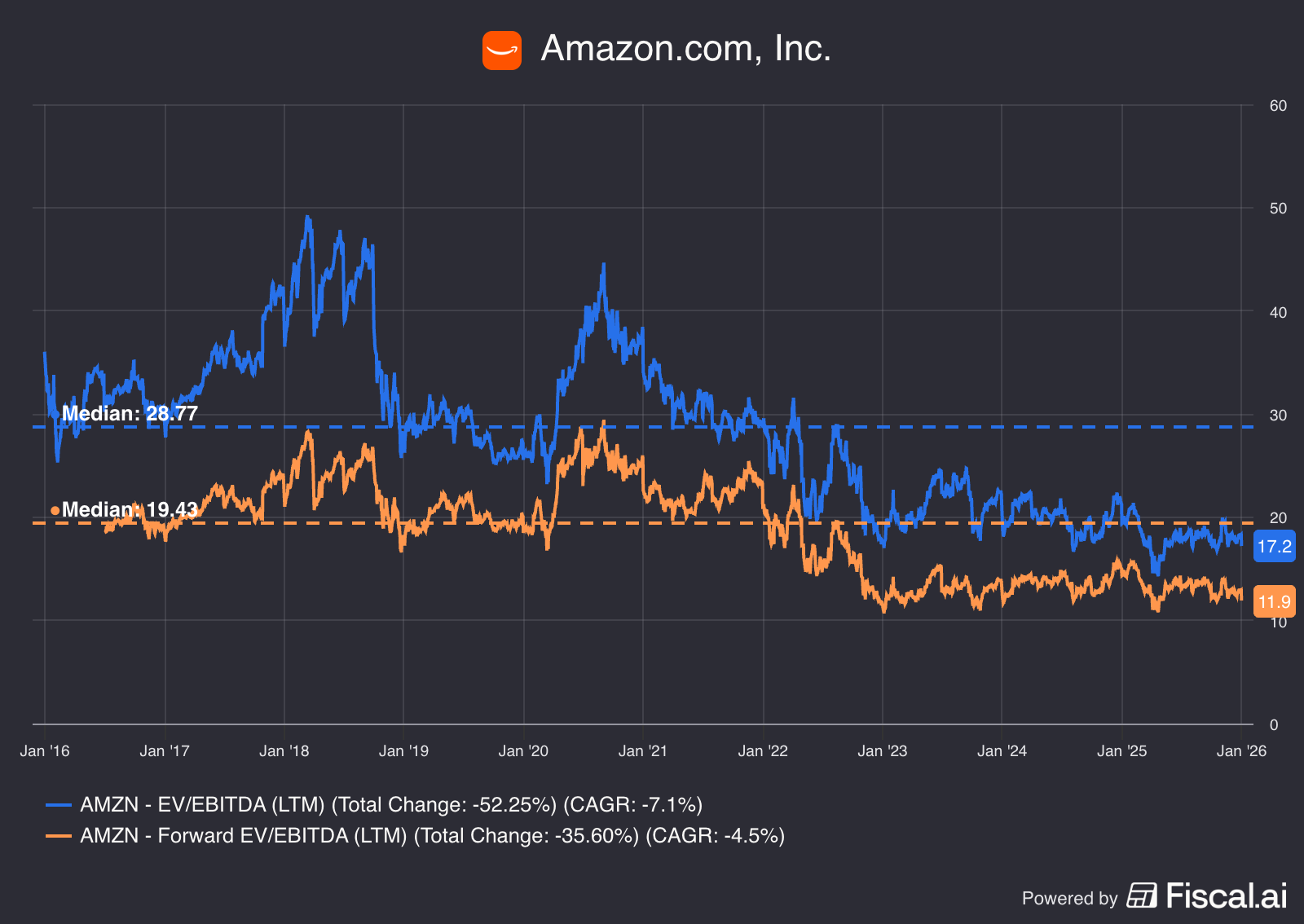
We can also examine the EV/EBITDA multiple, where Amazon is currently trading below its historical median valuation. Buying at these depressed relative multiples significantly lowers the risk of multiple compression moving forward.
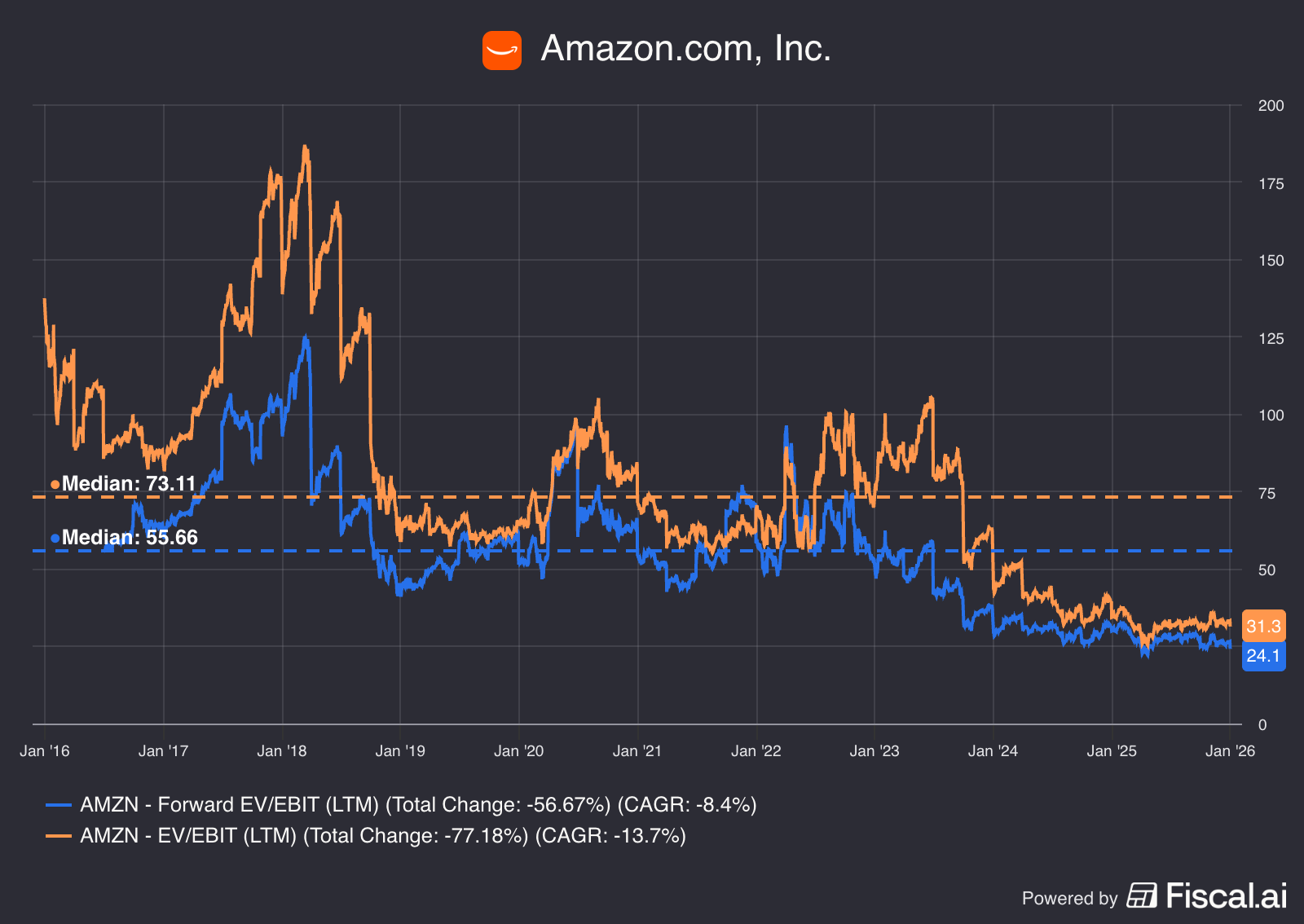
And the EV/EBIT multiple sits well below Amazon’s historical median, which once again underscores just how attractive the current valuation is. Combined with massive future optionality and structural margin expansion, these forward multiples will compress rapidly as Amazon continues to flex its operating leverage.
Now that we’ve covered the core fundamental drivers behind the business, let’s build out a Discounted Cash Flow (DCF) model to project our expected returns if we buy at today’s price.
Let’s start with a simple EPS estimates:
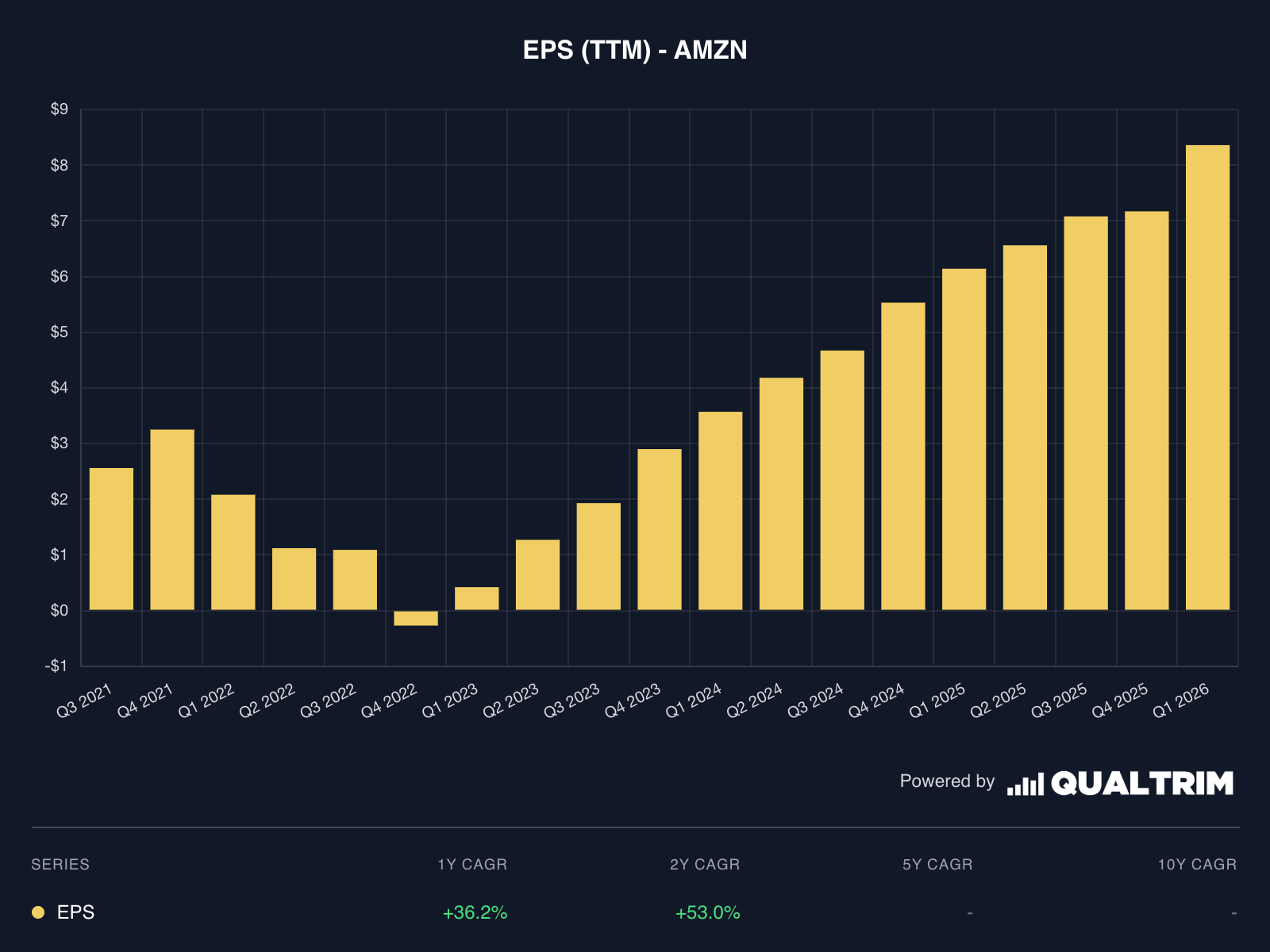
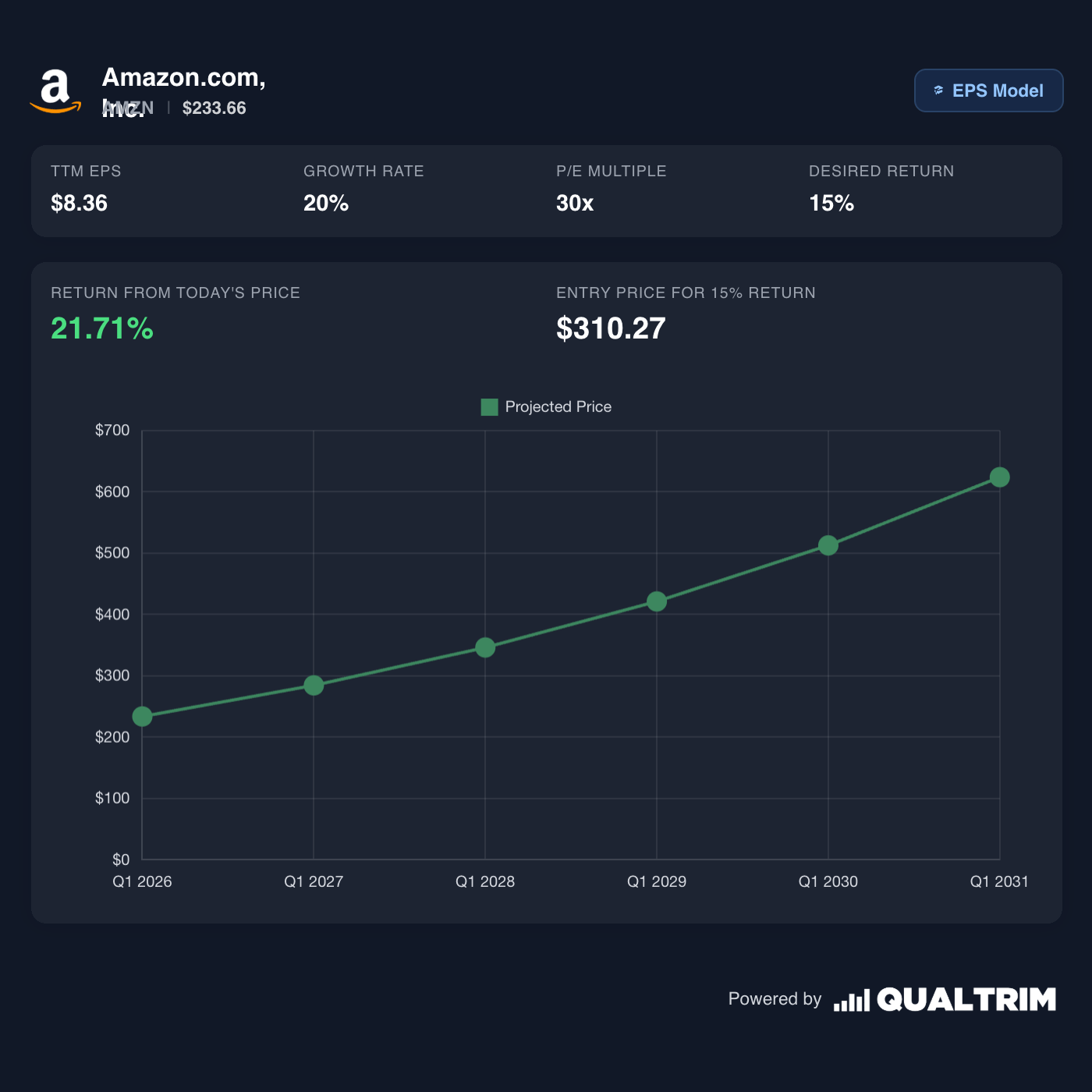
Amazon’s Earnings Per Share are growing at a rapid pace. Every business segment is firing on all cylinders. AWS is accelerating at 28% YOY growth, advertising is growing above 20% YOY, chips business is booming, and even their first and third party sellers revenue is accelerating thanks to AI.
What I projected here is roughly a 20% EPS growth rate—which is entirely doable given that Amazon is experiencing margin expansion. Starting from a massive baseline revenue of over $700 billion, even incremental margin improvements translate into significant bottom-line growth.
Assuming Amazon trades at a forward P/E multiple of 30x, which is a fair and reasonable valuation for a company of this quality, buying at today’s share price of $233.36 yields an expected annualized return (CAGR) of 21.72%.
Now, to build a more comprehensive valuation model, I prefer to value Amazon using operating cash flow rather than EPS. For hyperscalers heavily engaged in infrastructure spending, operating cash flow is often a superior metric because it reveals the underlying cash generated by the business.
While EPS reflects profitability on paper—heavily influenced by non-cash accounting charges like depreciation and amortization—operating cash flow cuts straight to the actual cash coming through the door.
To cross-verify, we’ll also look at EV/EBITDA and EV/EBIT. Testing multiple valuation angles ensures we get a well-rounded picture of where the stock stands relative to today’s share price and whether it represents a compelling buy.
To properly run an EV/EBIT or EV/EBITDA model, we must account for D&A (Depreciation & Amortization). This is particularly vital for Amazon given the company’s unprecedented capital deployment toward custom infrastructure, high-density data centers, and advanced GPU clusters.
Essentially, D&A is the accounting practice of spreading the historical cost of a long-lived asset across its estimated useful life, rather than expensing the entire cash outlay the moment it is purchased.
Depreciation applies strictly to tangible, physical assets—such as Amazon’s massive fleets of AI servers, custom silicon, cooling systems, and data center facilities.
Amortization applies to intangible, non-physical assets—such as acquired patents, intellectual property, and proprietary software architectures.
Let’s review the bear, base and bull cases.
My Bear Case: The Depreciation Wave Outruns the Payoff
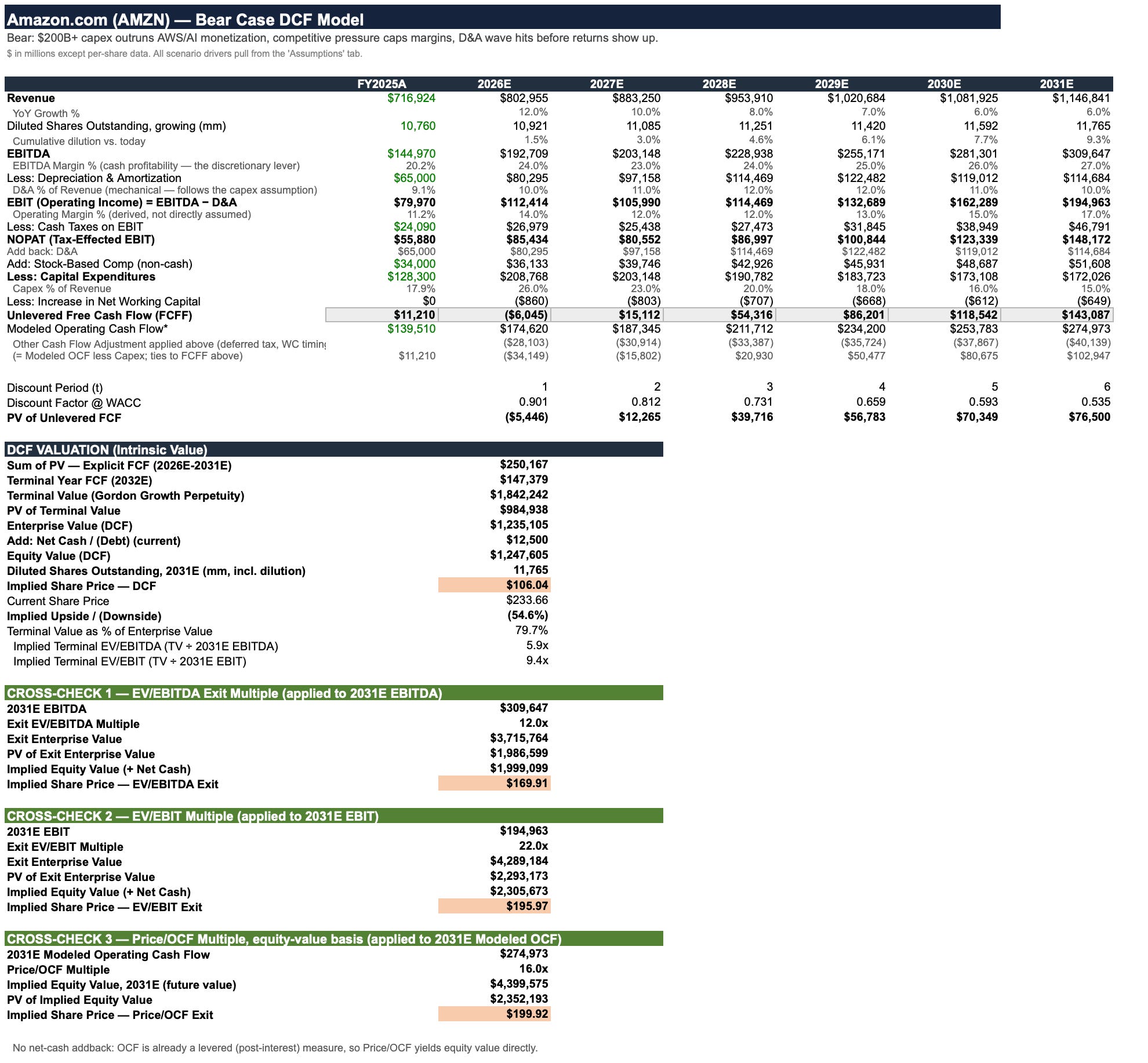
The primary bear case centers on the risk that Amazon’s massive capital expenditure cycle becomes a prolonged drag with little to show for the investment. In this scenario, heavy depreciation and amortization weigh down earnings, revenue growth stalls, and margins fail to expand.
While this outcome seems unlikely given that virtually every segment of Amazon is accelerating right now, it is always prudent to model conservative assumptions. To stress-test this, I assigned compressed, low-end multiples across P/OCF, EV/EBIT, and EV/EBITDA. Even under this combination of stagnant growth, compressed multiples, and heavy spending, the model yields an intrinsic bear-case value of close to $200 per share. I’ve assigned a 20% probability to this scenario.
My Base Case: Amazon Delivers Roughly What It’s Promising
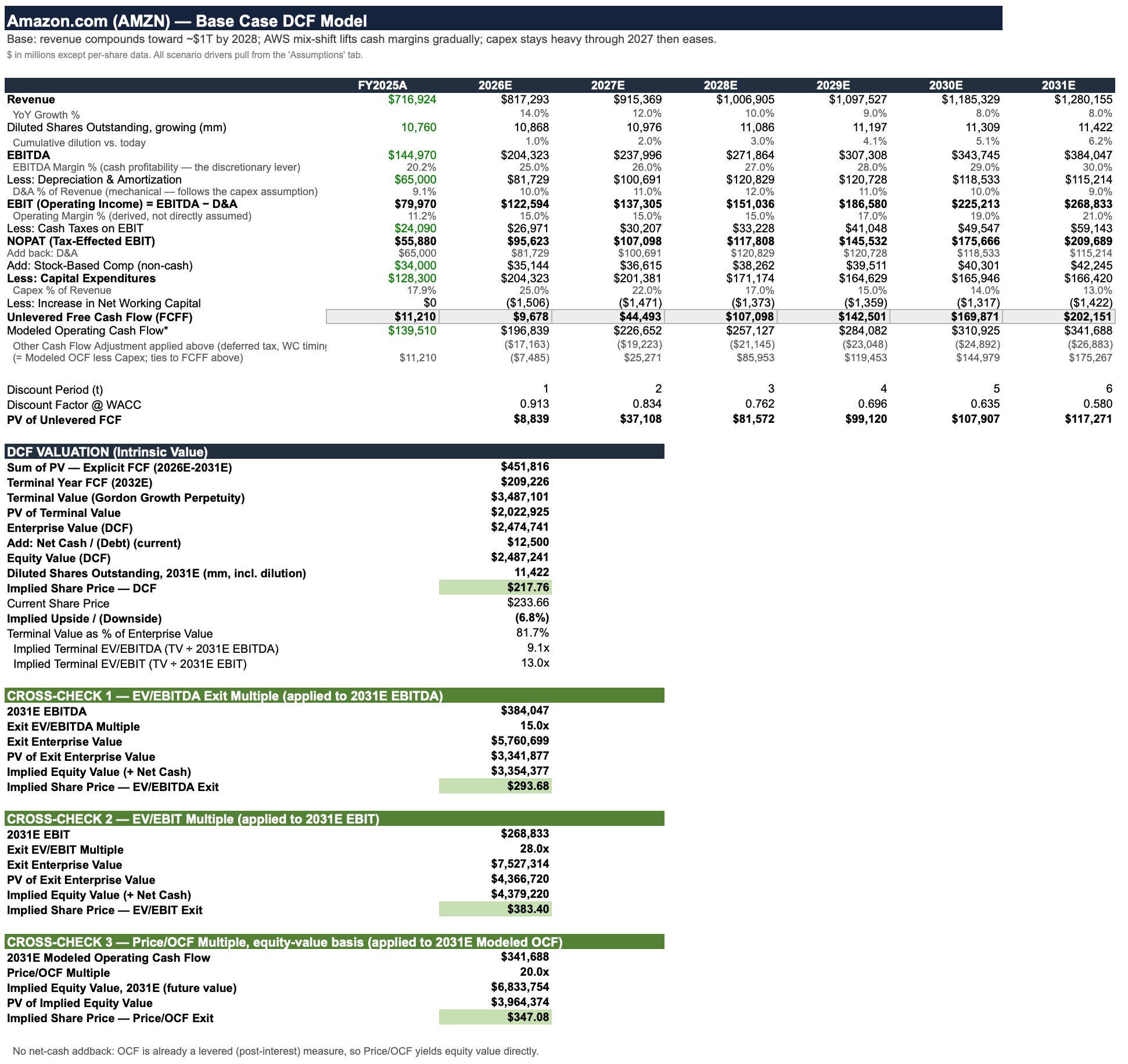
This represents the base case, aligning closely with analyst projections that Amazon is on track to become the first company in the world to reach $1 trillion in revenue by the end of 2028.
Amazon continues to demonstrate immense operating leverage, with the bottom line compounding much faster than the top line as the massive revenue base generates outsized profit conversion. As noted earlier, the price-to-operating-cash-flow (P/OCF) ratio is the most reliable metric to value Amazon during this phase because it captures the true underlying cash generation of the business. Once capital expenditures normalize and moderate in the future, this massive cash flow generation will provide immense optionality for shareholder returns.
Under this base case—applying a conservative 20x P/OCF multiple—Amazon’s intrinsic value sits above $300, pointing to a fair value of $347 per share today. I’ve assigned a 60% probability to this scenario.
My Bull Case: The Investment Pays Off Faster Than Promised
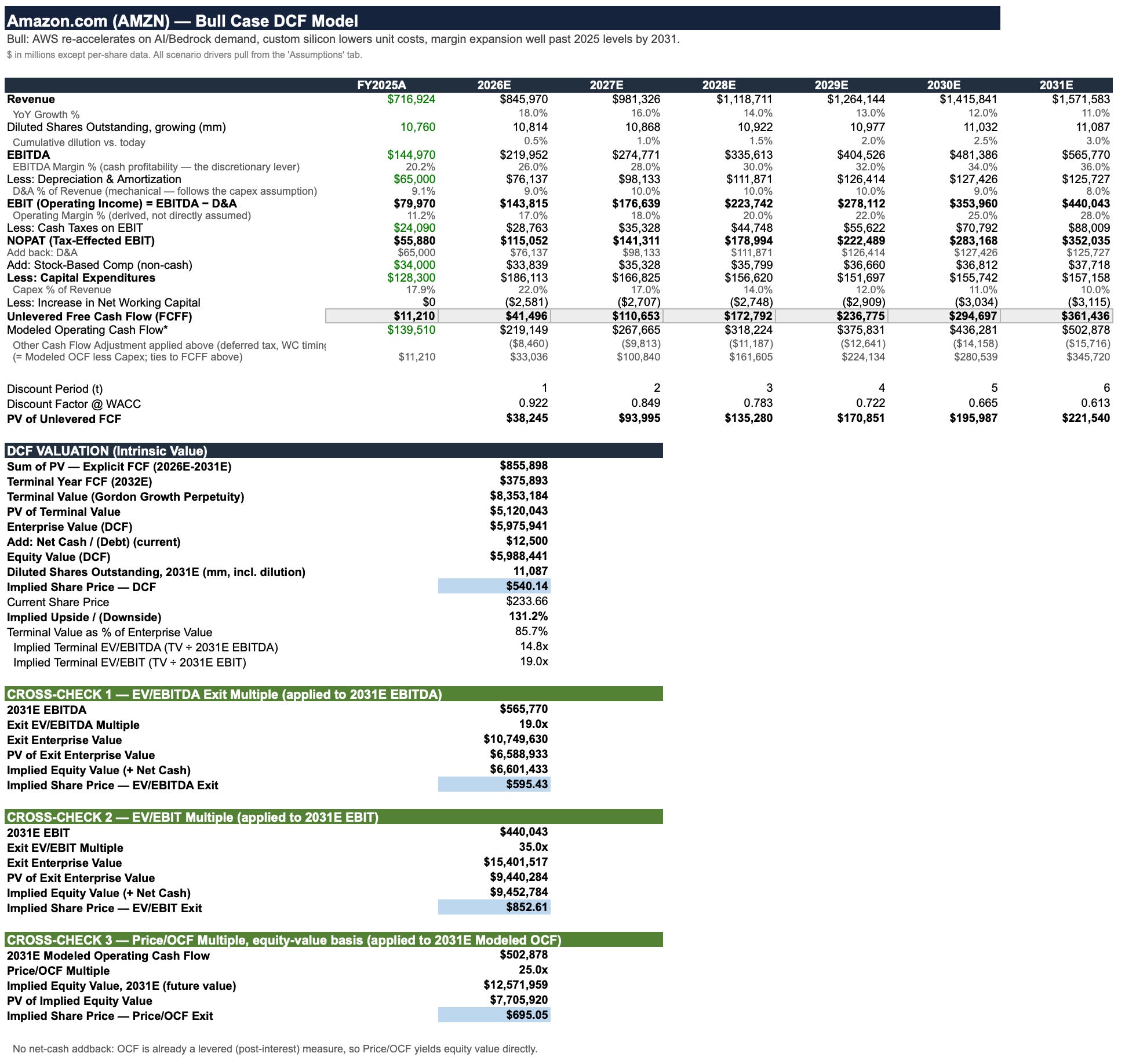
This scenario incorporates transformative growth drivers, factoring in Amazon’s custom silicon chip business and Project Kuiper (Leo) becoming fully integrated profit centers that boost future earnings. On top of that, all core business segments accelerate, leading analysts to project that Amazon could exit 2031 generating an incredible $476 billion in operating cash flow.
Leaning into an optimistic stance, this model assumes Amazon hits $502 billion in operating cash flow by year-end 2031. This optimism is supported by Andy Jassy and management’s proven capital allocation track record—highlighted by their strategic Anthropic investment, where Amazon’s equity stake alone has is worth roughtly $200 billion.
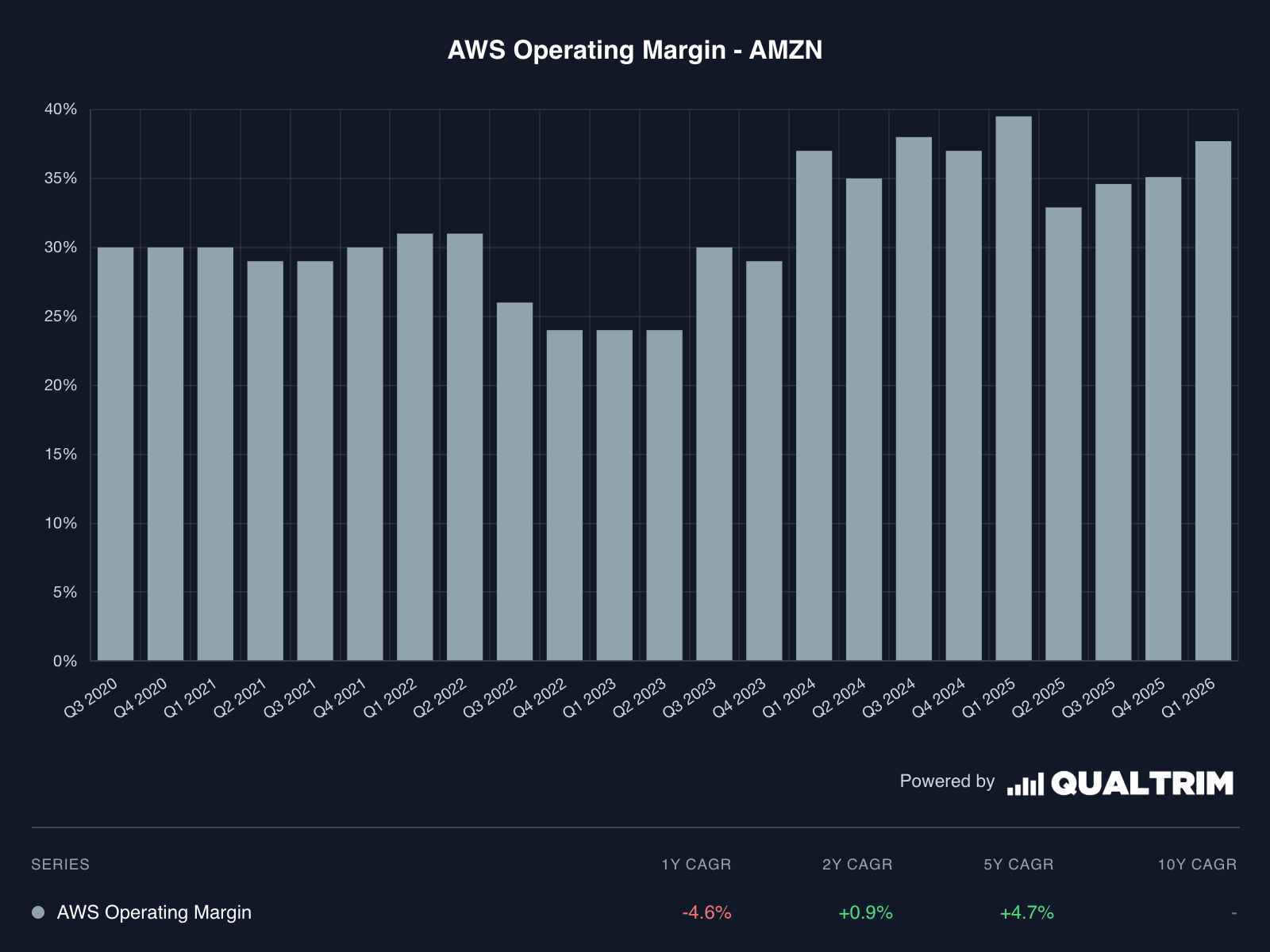
Furthermore, Andy Jassy has projected that AWS alone could reach $600 billion in annual revenue by 2036. Given that AWS historically operates with margins between 35% and 40%, the profit potential scales exponentially if those margins expand even further.
Amazon possesses immense long-term optionality. Even so, to remain disciplined, a conservative 20% probability is assigned to this bull case.
Verdict
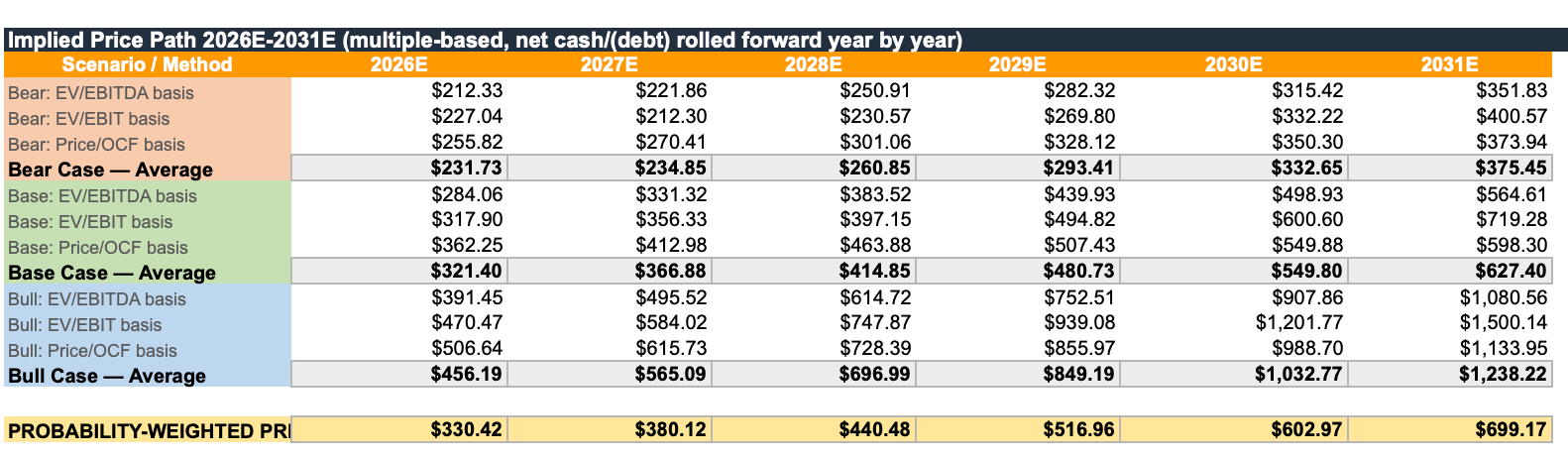
Combining the probabilities of our bear, base, and bull scenarios—alongside valuation metrics like P/OCF, EV/EBIT, and EV/EBITDA—yields a probability-weighted fair value of $330 per share, which aligns closely with consensus analyst projections.
Buying the stock at today’s price of $233.66 sets us up for an expected compound annual growth rate (CAGR) of roughly 24.51% purely from closing the gap to fair value over the next five years (leading to 2031), before factoring in underlying business growth and cash flow expansion.
About Jeff Bezos and Andy Jassy
I always find it vital before investing in any company to examine the leaders at the helm. I want to understand how they think about growth strategy, how they approach capital allocation—trusting them to deploy retained earnings wisely to drive a high return on invested capital (ROIC)—and, most importantly, whether they possess strong shareholder alignment.
Ultimately, I want long-term thinkers who genuinely care about compounding shareholder equity over decades. That is the exact leadership profile I look for, and both Jeff Bezos and current CEO Andy Jassy embody those exact traits.
I want to share a section of Andy Jassy’s 2025 letter to shareholders so that you can get an idea of what type of a company Amazon is before you think in investing in it:
When you identify disproportionate inflections, bet big. Choosing which inflections are truly seminal versus “just interesting” requires judgment. Reasonable people can disagree. But, if you believe you’ve found one of these disproportionate shifts, you want to invest as aggressively as you responsibly can. This will create investment spikes that will invite scrutiny, but the game-changers don’t typically accommodate smoother investment horizons.
One of these seminal shifts is AI. Every customer experience will be reinvented by AI, and there will be a slew of new experiences only possible because of AI. I’ve followed the public debate on whether this technology is over-hyped, whether we’re in “a bubble,” and if the margins and ROIC will be appealing. My strong conviction, at least for Amazon, is that the answers are no, no, and yes. Here are some truths that are hard to debate.
1/ We have never seen a technology more quickly adopted than AI. When ChatGPT launched in November 2022, it reached 100 million users in two months—four times faster than TikTok and 15 times faster than Instagram (ChatGPT already has over 900 million weekly active users). Both OpenAI and Anthropic have revenue run rates reportedly approaching $30 billion. These are breathtaking numbers for companies this soon after their commercial launches. When Edison opened his first commercial power station in 1882, most people understood it as a better way to light a room. What they couldn’t see was that electricity would eventually reorganize every factory, home, and industry on Earth. AI may have comparable impact. The difference is that electricity took 40 years to get where it was going. AI appears to be moving ten times faster.
2/ Amazon is smack in the middle of this land rush, and companies are choosing AWS for AI. Three years after AWS launched commercially, it had a $58 million revenue run rate. Three years into this AI wave, AWS’s AI revenue run rate is over $15 billion in Q1 2026 (nearly 260 times larger than AWS at that same point)—and ascending rapidly.
Customers are choosing AWS for AI for a few reasons. First, we have broader capabilities than others, with compelling offerings for model-building (SageMaker), high-performance inference with leading selection of frontier models (Bedrock), lower-cost inference (on our custom silicon, Trainium), agent-building (Strands), scalable and secure agent environments (AgentCore), and turnkey agents for coding, software migrations, and most tasks knowledge workers use in their daily routines (Kiro, Transform, and Quick). Second, as customers expand their use of AI, they want their inference to reside near their other applications and data (for latency reasons), and much more of it resides in AWS than anywhere else. Third, as customers expand their AI usage, they consume a lot of additional non-AI services, where AWS also has the broadest and most capable offerings. And fourth, AWS has the strongest security and operational performance of any AI and infrastructure provider. We spend a lot of time listening to customers, and they continue to remark about AWS’s advantaged performance as they increasingly move their AI to AWS.
3/ AWS could be growing even faster. AWS added 3.9 gigawatts (“GW”) of new power capacity in 2025, expects to double total power capacity by the end of 2027, and is monetizing that capacity as fast as it’s installed. In Q4 2025, AWS reported 24% YoY growth with a $142 billion dollar revenue run rate. That’s a lot of absolute growth. And yet, we still have capacity constraints that yield unserved demand. [As an aside, two large AWS customers have already asked if they could buy *all* of our Graviton instance capacity in 2026 (Graviton is our widely-adopted custom CPU chip)—we can’t agree to these requests given other customers’ needs, but it gives you an idea of the demand.]
4/ Our chips business is on fire, changes the economics for AWS, and will be much larger than most think. Virtually all AI thus far has been done on NVIDIA chips, but a new shift has started. We have a strong partnership with NVIDIA, will always have customers who choose to run NVIDIA, and we will continue to make AWS the best place to run NVIDIA. However, customers want better price-performance. We’ve seen this movie before. In the CPU space, virtually all of the workloads ran on Intel chips until we invented Graviton in 2018. Graviton, which has up to 40% better price-performance than other x86 processors, is now used expansively by 98% of the top 1,000 EC2 customers. The same story arc is unfolding in AI. Our second version of our custom AI silicon (Trainium2) had about 30% better price-performance than comparable GPUs, and has largely sold out. Trainium3, which just started shipping at the start of 2026 and is 30-40% more price-performant than Trainium2, is nearly fully-subscribed. A significant chunk of Trainium4, which is still about 18 months from broad availability, has already been reserved. And, Amazon Bedrock, AWS’s primary (and very fast-growing) inference service, runs most of its inference on Trainium. Demand for Trainium is booming.
Having our own hotly demanded AI chip opens up many possibilities, but perhaps none larger than the ability to lower costs for customers and secure better economics for AWS. At scale, we expect Trainium will save us tens of billions of capex dollars per year, and provide several hundred basis points of operating margin advantage versus relying on others’ chips for inference.
Our annual revenue run rate for our chips business (inclusive of Graviton, Trainium, and Nitro—our EC2 NIC) is now over $20 billion, and growing triple digit percentages YoY. To dimensionalize this versus other chips companies, that run rate is somewhat understated by our currently only monetizing our chips through EC2. If our chips business was a stand-alone business, and sold chips produced this year to AWS and other third parties (as other leading chips companies do), our annual run rate would be ~$50 billion. There’s so much demand for our chips that it’s quite possible we’ll sell racks of them to third parties in the future.
5/ The way AWS’s cash cycle works is that the faster AWS grows, the more short-term capex we’ll spend. AWS has to lay out cash for land, power, buildings, chips, servers, and networking gear in advance of when we can monetize it (typically 6-24 months before we start billing customers, depending on the component). However, these capex investments fund assets with many-year useful lives (30+ years for datacenters; 5-6 years for chips, servers, and networking gear). The FCF and ROIC for these investments are cumulatively quite attractive a couple years after being in service; however, in times of very high growth (like now), where the capex growth meaningfully outpaces the revenue growth, the early-years FCF is challenged until these initial tranches of capacity are being monetized and revenue growth out-paces capex growth. We’ve been through this cycle with the first big AWS growth wave, and liked the results. We expect to feel similarly about this next wave, with much larger potential downstream revenue and FCF.
6/ We have customer commitments that make our capex investments predictable. We’re not investing approximately $200 billion in capex in 2026 on a hunch. The recent OpenAI commitment (over $100 billion) is an example of this, but there are several other customer agreements completed (and unannounced), or deep in process. Of the AWS capex we expect to spend in 2026, much of which will be monetized in 2027-2028, we already have customer commitments for a substantial portion of it.
We are willing to make large capex investments and endure short-term FCF headwinds for the substantial medium to long-term FCF surplus. AI is a once-in-a-lifetime opportunity where the current growth is unprecedented and the future growth even bigger. AWS has a significant leadership position with the broadest functionality, strongest security and operational performance, largest share of customers and revenue, strong desire from customers to run their AI in AWS, and an opportunity to build what could be a new pillar for Amazon in chips. We’re not going to be conservative in how we play this—we’re investing to be the meaningful leader, and our future business, operating income, and FCF will be much larger because of it.
I’m not going to share everything here from the shareholder letter, but if you want to read the whole letter you can find it here: link
Final Thoughts
Amazon remains one of the most fascinating companies in the market—permanently fixed at the center of retail investor debates and a constant lightning rod for negative headlines. Yet, as the data shows, the financial reality inside the fortress tells a completely different story.
If you enjoyed this deep dive, please consider hitting the Like button and leaving a comment with your personal thesis on Amazon. I work very hard in making those articles and the DCF models so I would appreciate your support.
I value accurate, rigorous analysis above all else—if you spot any data points that need tweaking or have a different take on the numbers, let me know in the comments below so I can keep this piece as accurate as possible for the community!
Disclaimer: I own shares of Amazon. This is not financial advice, nor am I telling you to buy the stock. You must do your own due diligence and determine for yourself if you are comfortable investing in a company that is aggressively funding the next decade of growth while temporarily burning free cash flow in the short term.
Great article Arthur! This is exactly why I'm bullish on Amazon too. People only look at the stock price vs S&P and think it's dead money, but the business underneath is getting way stronger. AWS growing 28% again on a $150B run rate, advertising taking off because everyone on Amazon is ready to buy, and now the chips business doing $20B, all high margin stuff.
I love the point about capex. They spent like crazy to build warehouses and AWS years ago and everyone complained, now those are the moats. Same thing now with AI data centers and Trainium. Short term free cash flow looks bad but it's the right long term move. great job amigo!